Go search for any nonfiction topic on Amazon right now. Any topic. What you will probably find is a wall of books with near identical covers, suspiciously round page counts, and author names that do not turn up anywhere else on the internet. Click one and the description reads fine on the surface but somehow tells you nothing. The reviews are either a row of glowing five stars posted within two days of publication or angry one stars from readers who feel ripped off. You close the tab. You try a different search. Same thing again.
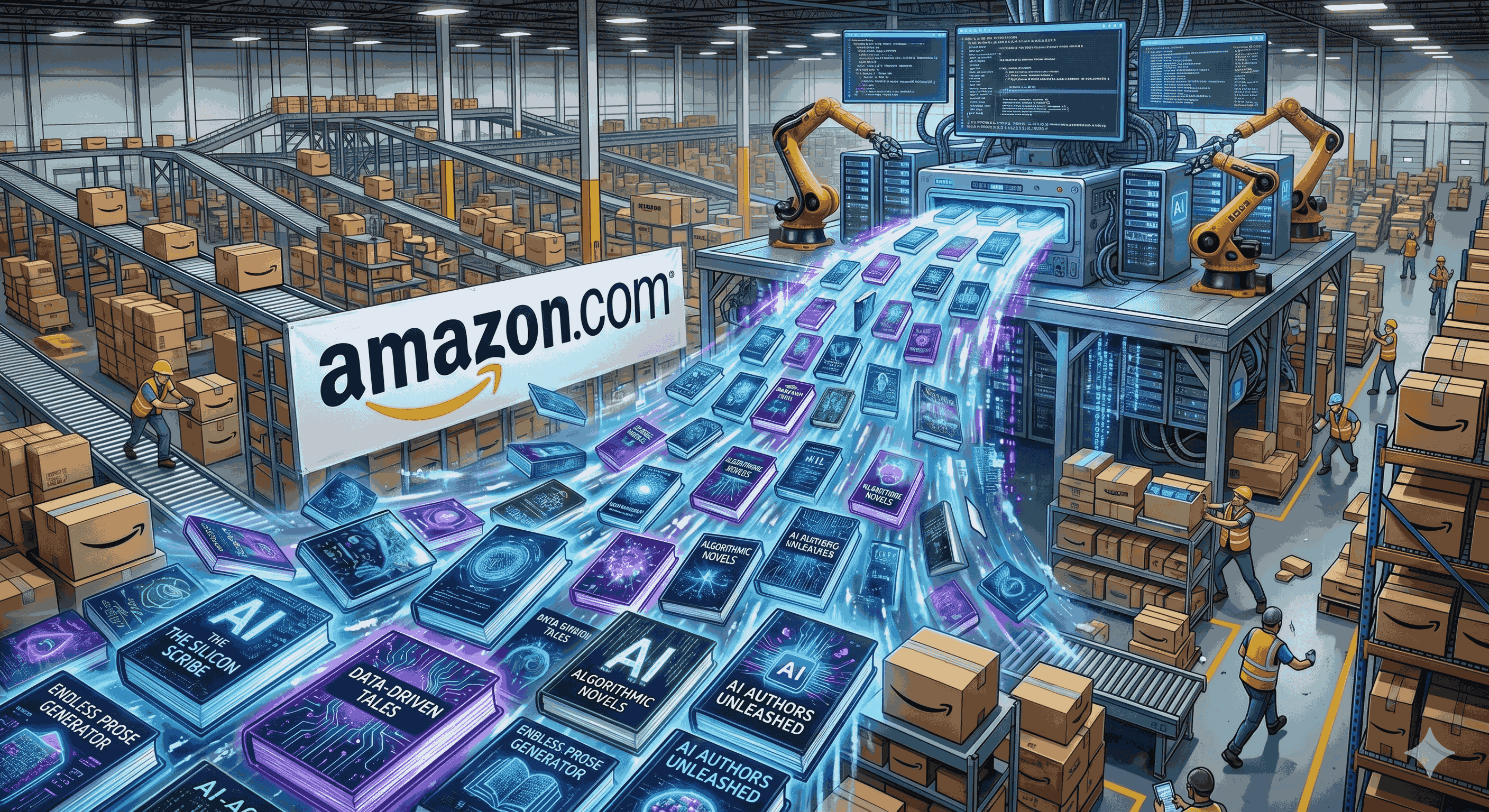
This is what buying books looks like in 2026. Amazon's catalogue has been hit with a wave of AI generated titles moving faster than any human moderation team could keep up with. The Authors Guild put the number of AI generated books being uploaded to Kindle Direct Publishing at over 700 per day by late 2025. That number has almost certainly gone up since. For real authors trying to get their work in front of readers the effect is not subtle anymore. It is the main problem in self publishing right now and it is starting to affect traditionally published books too.
How Bad Is It Actually
Bad enough that writers who have been on Amazon for years are seeing the worst numbers of their careers. One romance author i spoke to, who did not want to be named, told me her monthly page reads through Kindle Unlimited dropped by about 40 percent between mid 2024 and early 2025. Nothing in her publishing schedule or marketing had changed. She put it down to the algorithm burying her books under a tide of AI generated romance titles being uploaded sometimes 50 at a time from the same accounts.
The reason this happens is not complicated. Amazon's recommendation system rewards books that get bought or borrowed quickly after they go live. Content farms figured that out. They put a book up, push fake reviews through to create early sales signals, and the algorithm starts recommending it. That recommendation spot is now taken. The real author's book, the one that took eight months to write and went through multiple rounds of editing, is competing for the same spot and losing to something that was generated in an afternoon.
Some categories are worse than others. True crime, self help, financial advice, children's books, and anything tied to a recent news story are absolutely saturated. Search for a book about a trending true crime case and you will find AI generated titles from accounts that did not exist three weeks ago sitting above books from writers who spent years researching the subject. That is where we are.
What the Platforms Say vs What They Actually Do
Amazon updated its KDP guidelines back in 2023 and said authors had to declare if their content was AI generated. The policy exists on paper. In practice it is a checkbox. Nobody at Amazon reads a manuscript before it goes live. The whole thing runs on honesty and the people flooding the platform with AI content are not particularly interested in being honest.
Apple Books and Kobo have had similar problems, just at lower volume. Barnes and Noble Press brought in tighter account verification for new publishers in 2024 which helped a bit. But most of the problem sits on Amazon because that is where the money is. Kindle Unlimited alone pays out more than half a billion dollars a year in royalties, which makes it an obvious target for anyone trying to game the system at scale.
In March 2025 Amazon said it was going to start using AI detection tools to catch potentially AI generated content before publication. Authors who tested it found it all over the place. Some clearly AI generated books went straight through. Some books written by actual humans got flagged. Amazon has not said anything publicly about how the system works or what its accuracy looks like. The Authors Guild called it a step in the right direction and not nearly enough, which felt about right.
Epiloguelys, which Amazon owns, has its own version of the problem. Fake books on Amazon automatically get Epiloguelys pages. Readers who do not know a book is AI generated leave reviews there. Some of those reviews end up on the pages of legitimate books with similar titles. The cleanup is manual and slow and nobody seems to be in a hurry about it.
The Real Cost Nobody Talks About
The money lost by individual authors is real even if it is hard to put an exact number on. But there is another cost that gets talked about less. When readers get burned a few times by AI generated books they start trusting the platform less. A reader who pays five dollars for something that turns out to be a reformatted Wikipedia article does not just get a refund and move on. They become more careful. They rely more on personal recommendations from people they know and less on what the platform suggests to them. That is bad for every author on the platform, including the ones writing genuinely good books that just cannot be found anymore.
Librarians have been picking up on this from a different direction. Several public library systems that offer digital lending through Hoopla or OverDrive have noticed patrons returning books unfinished at higher rates than a few years ago. Not all of that comes down to AI content but librarians in communities where people have talked about it say readers are increasingly frustrated. They borrowed the book because the cover looked professional and the description sounded interesting. They opened it and found something that felt assembled rather than written. That feeling stays with you.
What Some Authors Are Doing About It
Some writers have been pushing back in practical ways. A group of self published romance authors put together a shared spreadsheet in 2024 to track known content farm accounts on Amazon. They report the accounts as a group, which gets a faster response than individual complaints do. A number of accounts with hundreds of AI generated titles have been taken down that way, though new ones keep appearing to replace them.
Other authors are putting more energy into personal branding as a way to survive the flood. If readers follow you specifically rather than just searching by genre then the algorithm matters less to you. Newsletter lists, author websites and direct reader communities on Substack or Patreon have become more important to midlist authors than they were even three years ago. It is extra work on top of the writing, which is already a full time job, but authors who have built those direct relationships say those readers are not going anywhere regardless of what the algorithm does.
There is also a growing conversation among authors about pushing for platform level changes through collective pressure. The Authors Guild has been the loudest voice in that space but independent communities of self published writers are organising in ways that did not really exist before this problem got impossible to ignore. Whether any of it moves the needle depends a lot on whether it starts to cost Amazon something they actually care about.
🛡️ How Readers Can Actually Help Right Now
- Report AI generated books directly on the listing page. Amazon has a report button on every product page. Use it. A lot of reports from real readers gets human review faster than author complaints alone tend to.
- Leave honest reviews that name the problem. A review that says the book appears to be AI generated and gives specific examples like repeated phrases or obvious factual errors helps other readers and creates a record that is harder for platforms to ignore.
- Follow authors directly rather than just genres. Sign up for newsletters from writers you enjoy. Follow them somewhere other than Amazon. When you find a book you love, tell someone, because the algorithm probably will not.
- Do a quick check before you buy. Search the author name outside of Amazon. Do they have a website? Other books with real publication histories? Have they been interviewed or reviewed anywhere other than their own Amazon page? Two minutes of checking saves money and frustration.
- Buy direct from authors when you can. Some authors sell through their own sites using tools like Payhip or Gumroad. The author keeps more of the money and the whole transaction happens outside the platform that is causing the problem in the first place.
The honest answer is that the platforms are not going to fix this fast because fixing it costs money and slows things down. Amazon takes a cut of every book sold regardless of whether a human being wrote it. Until that changes, through regulation or real financial pressure or collective action that actually hurts platform revenue, the motivation to clean things up stays pretty weak.
That leaves readers and authors in a strange position together. Readers want good books. Authors want to be found. The platform sitting between them is more interested right now in the number of connections it makes than the quality of what gets connected. That is not a new problem for internet businesses. But it is hitting publishing harder than most other creative industries at this moment and the people who love books most are the ones paying the price for it.