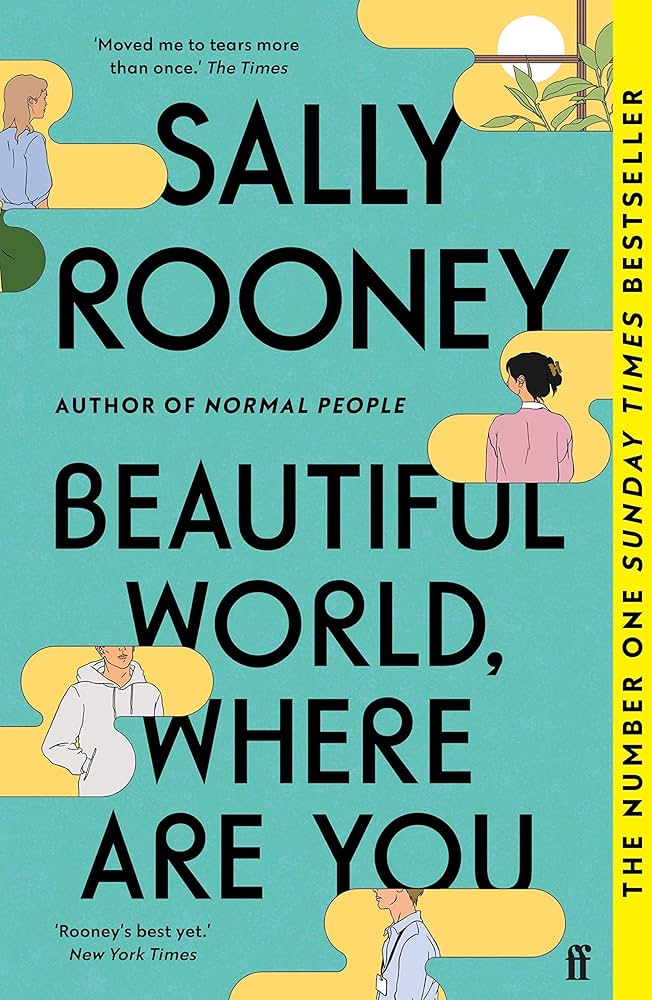
Beautiful World, Where Are You
| Published | 2021-09-07 |
| Series | Standalone |
| Genre | Literary Fiction |
| Language | English |
| Publisher | Farrar, Straus and Giroux (US), Faber and Faber (UK) |
| ISBN-10 | 0374602603 |
| ISBN-13 | 978-0374602604 |
📝Honest Review
Summary:
Alice is a successful novelist who has just moved to a small town in Ireland after a breakdown, trying to figure out who she is now that her books made her famous before she was ready for it.
Her best friend Eileen is in Dublin working an underpaid job at a literary magazine and slipping back into something complicated with Simon, a man she has known since childhood.
The two women write each other long emails about politics and meaning and the state of the world while their actual lives quietly fall apart and slowly come back together. It was Rooney's third novel and became a Sunday Times and global number one bestseller.
✅ What I Liked
The emails between Alice and Eileen are the best thing in this book and i think a lot of the criticism Rooney got for them missed what she was actually doing.
These two characters write each other long discursive emails about civilization and beauty and politics and the emails are doing real intellectual work, not just filler between plot scenes. Reading two smart people genuinely trying to think through what a meaningful life looks like in a collapsing world is something i do not get from most contemporary fiction and i found it genuinely engaging rather than indulgent.
Eileen is also one of Rooney's best characters. Her relationship with Simon, built on years of history and unresolved feeling, has the specific ache of a connection that should have worked out a long time ago and somehow never quite did.
The prose is exactly what you expect from Rooney, clean and precise and devastating in small moments rather than big ones, and there are scenes here, particularly between Eileen and Simon, that are as good as anything she has written.
❌ What Could Be Better
Alice is harder to connect with than Eileen and i think this is intentional but it does cost the book some warmth.
She has just come out of a breakdown after sudden literary fame and her numbness and self protection make sense given what she has been through, but it means a lot of her sections feel distant in a way that kept me at arm's length for much of the book. Felix, the man she becomes involved with, is interesting but underexplained, and i wanted more access to what was actually happening inside him beyond what Alice projects onto him.
The emails, while intellectually engaging, occasionally feel like they are doing too much of the philosophical heavy lifting for the novel, almost like two separate texts running in parallel rather than fully integrated into the story. And the ending resolves a little too neatly for a book that spent so long being skeptical about whether anything resolves neatly at all.
The structure alternates between close third person chapters following Alice and Eileen and long email exchanges between the two of them, and the emails are where the book's real ambition lives.
Alice is a novelist who became famous very quickly and very young and the fame broke something in her. She has moved to a small coastal town in Ireland to recover and she meets Felix, who works in a warehouse and has no real interest in or knowledge of her literary success, which is part of why she is drawn to him. Their relationship is prickly and uncertain for most of the book, built on a kind of mutual testing that never quite settles into comfort.
Eileen is in Dublin, underpaid at a literary magazine, still working through feelings for Simon that go back to childhood. Simon is older than her, religious in a way that is unfashionable among the people they both know, and steady in a way that contrasts sharply with the chaos in Eileen's emotional life. Their sections together are the warmest and most carefully built relationship writing in the whole novel.
What makes this book different from Conversations with Friends and Normal People is the emails. Alice and Eileen write each other long messages about the climate crisis and the decline of the novel as an art form and what beauty even means anymore in a civilization that feels like it is ending. I know some readers found these sections pretentious or felt like Rooney was using her characters as mouthpieces for her own essay writing.
I did not feel that way reading them. I found the emails genuinely moving as a portrait of friendship conducted at a distance, two people trying to stay close and stay thinking together even while their daily lives pull them toward different men and different versions of themselves.
Alice is the character i had the most trouble connecting with emotionally. Her numbness after the breakdown is realistic and Rooney writes it carefully, but it does create a kind of coolness around her sections that kept me from caring about her quite as much as i cared about Eileen. Felix is interesting as a presence but i wanted to understand him better than the book allowed me to, since most of what we know about him comes filtered through Alice's uncertain reading of him.
Eileen and Simon are where the book's heart really is for me. Their history together, the years of near misses and unspoken feeling, gives their scenes a weight that the Alice and Felix sections never quite reach. When the two of them finally move toward something honest with each other, it lands with real force because Rooney has made you wait for it the right amount of time.
The ending gathers everyone together and resolves things more warmly than the rest of the book had led me to expect, and i had mixed feelings about that. Part of me appreciated the warmth after everything these characters had been carrying. Another part of me wondered if a book this skeptical about whether anything in the world can be fixed should have allowed itself quite that much comfort at the end.
Four stars. It is not my favourite Rooney, that is still Normal People, but the emails alone make this worth reading, and Eileen and Simon's story is some of the best relationship writing she has done.
📊Community Rating
🎭Vibe Check
Read spoilers, debates, and detailed user reviews in our discussion room.
Discover Your Next Great Read
Handpicked recommendations from our collection of literary treasures