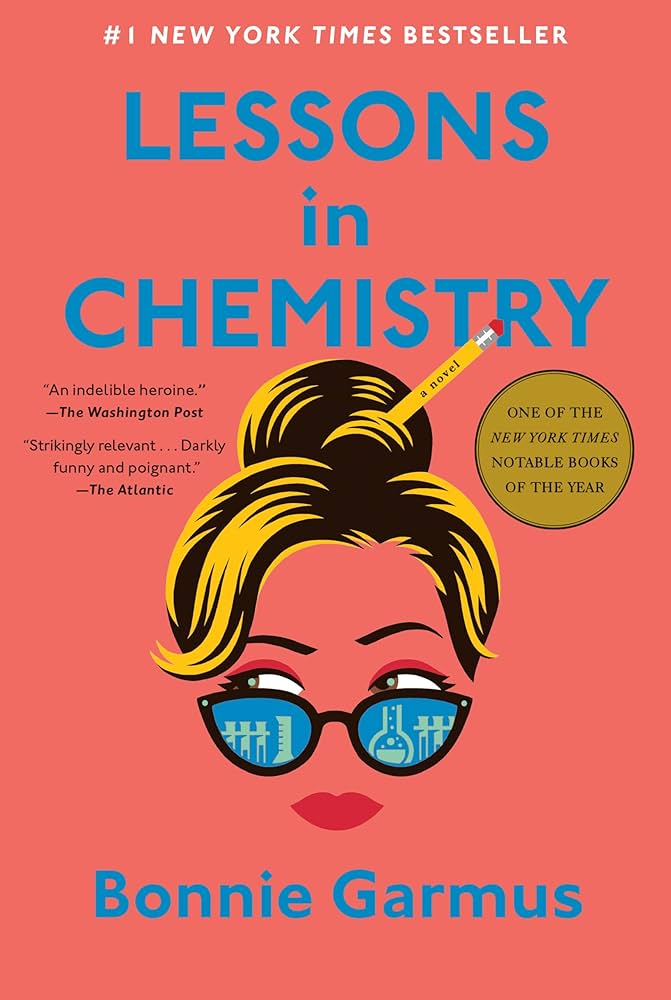
Lessons in Chemistry
| Published | 2022-04-05 |
| Series | Standalone |
| Genre | Historical Fiction |
| Language | English |
| Publisher | Doubleday |
| ISBN-10 | 038554734X |
| ISBN-13 | 978-0385547345 |
📝Honest Review
Summary:
Elizabeth Zott is a brilliant research chemist in 1960s California who keeps getting pushed out of the rooms where serious science happens because she is a woman in a world that has decided she does not belong there.
After a series of losses that would break most people she ends up hosting an afternoon cooking show and turns it into something nobody asked for and nobody quite expected, a stage for teaching women actual chemistry while she pretends to teach them dinner. It is funny and it is angry and it made eight million people around the world fall in love with Elizabeth Zott and her dog Six Thirty.
✅ What I Liked
Elizabeth Zott is one of the most purely satisfying protagonists i have read in a long time. She is brilliant and she knows she is brilliant and she refuses to perform smallness or gratitude to make the men around her comfortable and watching her hold that line through repeated unfairness is genuinely cathartic. Garmus writes the sexism of the era with real specificity rather than as a vague backdrop, the actual mechanics of how a smart woman gets pushed out of serious science one small humiliation at a time, and that specificity is what makes the anger in this book land rather than feeling generic.
Six Thirty the dog is also a wonderful addition and Garmus gives him interiority without ever tipping into cute or twee. The sections from his perspective are some of the most quietly moving in the book. And the cooking show sections, once Elizabeth finally gets there, are genuinely fun to read even while doing serious work underneath the comedy.
❌ What Could Be Better
The plot leans on a string of coincidences and tragedies that occasionally felt like Garmus was reaching for maximum emotional impact rather than letting the story breathe naturally. There are a few twists in the back half, particularly around Elizabeth's family history, that felt more like soap opera than the sharper character driven writing of the first half. Some of the male characters meant to represent the casual misogyny of the era are drawn fairly thinly and exist mostly to be obstacles rather than full people, which works for the satire but occasionally flattens the world around Elizabeth. And the very ending wraps things up a little too neatly for a book that spent so much of its length being honest about how unfairly the world treats women like Elizabeth.
Elizabeth Zott is a chemist working at a research institute in California in the early 1960s and she is better at her job than almost everyone around her and almost nobody will admit that out loud. She gets passed over and talked down to and harassed and eventually pushed out, not because her work is lacking but because the people around her have decided in advance what a woman in a lab is allowed to be. Garmus writes these dynamics with real precision. It is never one big dramatic act of sexism. It is a hundred small ones stacked on top of each other until the weight of them becomes impossible to keep carrying.
The relationship at the center of the book, between Elizabeth and a fellow scientist named Calvin Evans, is one of the more unusual romances i have read because it is built almost entirely on mutual respect for each other's minds rather than on the conventional beats romance novels usually rely on. Calvin sees Elizabeth clearly in a way nobody else in her life does and that clarity is more romantic than almost anything more conventionally swoony could have been. What happens to their relationship sets the rest of the plot in motion and i will not say more than that because the way Garmus reveals it matters.
Elizabeth ends up, through a chain of circumstances that involve a television producer and a desperate studio and her own refusal to dumb herself down even slightly, hosting an afternoon cooking show. What she actually does on that show is teach chemistry disguised as cooking, explaining the actual molecular reasons behind why a sauce thickens or why bread rises, while housewives across America tune in expecting something much simpler and end up getting an education they did not know they wanted. This is the part of the book that made me grin the most while reading. Garmus clearly enjoyed writing these scenes and that enjoyment is contagious.
Six Thirty, Elizabeth's dog, deserves real mention. Garmus gives him sections from his own perspective and somehow makes this work without it ever feeling gimmicky. He understands more words than a dog reasonably should and his loyalty to Elizabeth and to her daughter is one of the warmest threads in the whole book. I am not someone who is usually won over by animal narrators in fiction and Six Thirty won me over completely.
Where the book occasionally stumbles is in its plotting. There are a number of revelations and coincidences in the second half, particularly concerning Elizabeth's family background, that felt engineered for maximum emotional effect rather than emerging naturally from the story Garmus had been telling.
I do not think these moments ruin the book but i noticed the seams a little more than i wanted to. Some of the men in the story, especially the ones at the research institute, are drawn with broad strokes that serve the satire well but do not always feel like full people, which is a minor cost of how effectively Garmus is making her point about the era.
The ending resolves things a bit more neatly and warmly than the rest of the book had prepared me for, given how unflinching Garmus had been about the unfairness Elizabeth faces throughout. I understand the impulse to give readers some comfort after putting Elizabeth through so much and i did not resent it exactly, but it felt slightly softer than the sharper, angrier book that came before it.
Four and a half stars. This is a genuinely entertaining novel with real teeth underneath the charm and Elizabeth Zott is the kind of character you carry with you after you close the book. If you have not seen the television adaptation yet, read the novel first. The book is sharper and funnier and Six Thirty alone is worth the time.
📊Community Rating
🎭Vibe Check
Read spoilers, debates, and detailed user reviews in our discussion room.
Discover Your Next Great Read
Handpicked recommendations from our collection of literary treasures