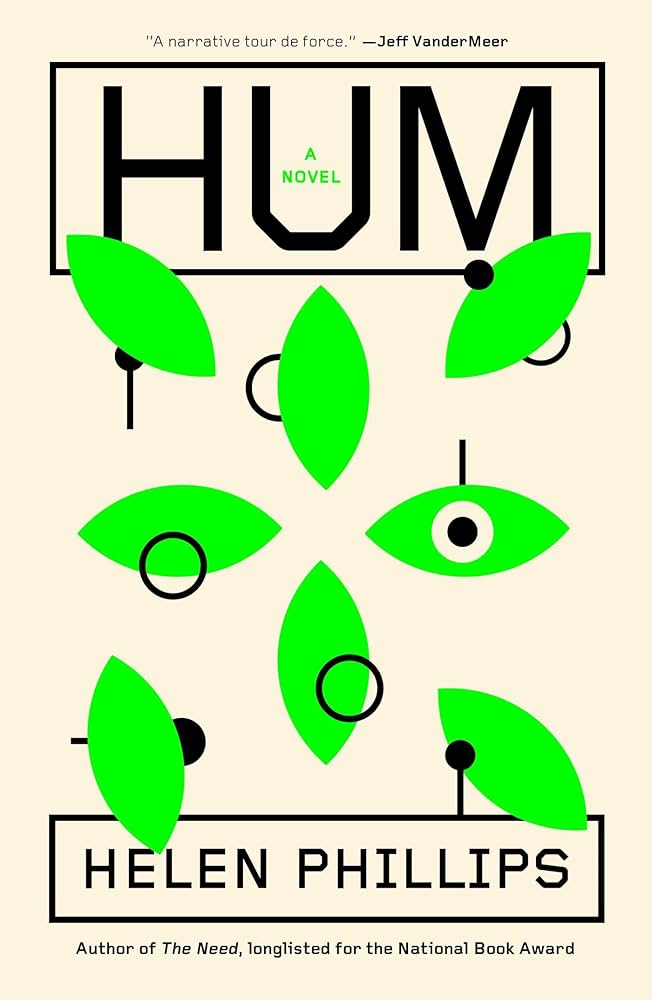
Hum
| Published | 2024-08-06 |
| Series | standalone |
| Genre | Fiction |
| Language | English |
| Publisher | S&S / Marysue Rucci Books |
| ISBN-10 | 1668008831 |
| ISBN-13 | 978-1668008836 |
📝Honest Review
May is a mother of two in a city that is hot all the time and crowded and full of debt and screens. her family has Hums, which are humanoid AI robots that have been everywhere long enough that her kids have grown up around them and find them completely normal. the Hums are good at everything. they do surgery and childcare and customer service and they do it all better than the humans who used to do those jobs. May and her husband Jem have lost income because of this in ways the book does not spell out directly but you feel in every money conversation they have.
what May does is spend money she does not really have on a weekend at the Botanical Garden which is a preserved natural space in the middle of the city and the only place you can go to be around actual trees and animals and soil. it costs a lot because of course it does. everything real costs a lot. the opening third of the book is mostly about the family arriving and settling in and Phillips uses it to establish the world through what May notices and what she worries about. i found this section completely absorbing even though almost nothing happens in it. Phillips writes the texture of anxiety and parenthood with the kind of precision that makes you feel seen rather than observed.
the second section is where things start to go wrong at the Garden and i want to stay vague about exactly what because the specifics are part of what makes it work. what i will say is that a Hum becomes important to the story in ways May did not expect and the relationship between her and this particular Hum is the most interesting thing in the book because it asks a question Phillips is clearly thinking about very seriously. if something can feel and respond to pain and express something that looks like longing does it matter whether that thing was born or built. May does not know how to answer that. neither do i. the book does not pretend to know either and i think that is the right position to take in 2024.
the climate stuff is woven in rather than announced. the heat is constant and the air is bad and the Garden exists because someone decided a long time ago to preserve it and now it is the only version of nature most city children have ever touched. Phillips does not write a speech about this. she just makes it the background against which everything else happens and the effect is that you feel the loss without being told to feel it.
the chapters are very short. two pages, sometimes three, sometimes less. this is a structural choice and it works better than i expected. each chapter ends on a small beat that pulls you forward and the rhythm of it gives the whole book the pacing of something much more plotted than it actually is. i read faster through this than through books twice its length and when i finished i was slightly surprised by how quickly it had gone.
the Botanical Garden section resolves in a way that left me wanting more of everything. more time with the Hum, more complication, more consequence. the book builds a world and a set of questions that feel enormous and then finds an ending that is quiet in a way that felt slightly too quiet for me personally. i do not think it is a flaw exactly. i think Phillips was being honest about the fact that the questions she is raising do not have clean endings in real life and she was not going to invent one. but i sat with a feeling of something unfinished when i put it down and i am still not entirely sure whether that was the intention or whether she ran out of road.
four stars. it is one of the better pieces of speculative fiction i have read in the last few years and if you have ever stood in a park in a city and felt quietly grateful that it was there you will understand immediately what this book is doing.
Summary:
May lives in a hot overcrowded city full of humanoid robots called Hums that do everything from surgery to customer service. she is struggling with debt and two young kids and a marriage that is quietly under strain. she splurges on a weekend trip to the Botanical Garden, one of the last real patches of green left in the city, hoping it will be a break. it is not quite the break she was hoping for. the book is about motherhood and AI and climate and what we actually owe the people we love when everything around us is pulling in different directions.
✅ What I Liked
the short chapters are the thing i want to talk about first because they are doing real structural work in this book. each one is maybe two or three pages and they end on a beat that keeps you reading and the cumulative effect is that the book builds tension the way a good thriller does even though the subject matter is much quieter than a thriller. Phillips writes about the texture of daily life in this near future city with a specificity that is genuinely unsettling because almost none of it feels far away. ads that know what you are feeling before you say it out loud. AI assistants that are better at reading your children than you are. a nature reserve you have to pay to enter because actual nature costs money now. none of this is presented as shocking. it is just the background of May's life and that normalisation is scarier than any dramatic reveal could be. May herself is also really well drawn. she loves her children with the specific exhausted ferocity of a parent who is doing too much and she carries the weight of this book in a way that feels completely real.
❌ What Could Be Better
the plot that develops in the Botanical Garden section, which i do not want to describe in detail, felt slightly thin to me compared to the richness of the world Phillips had built in the first half of the book. the threat that emerges there is real enough but it resolved a little too quickly and a little too neatly and i was left wanting it to have been pushed further. the Hum character who becomes important in that section is interesting but also somewhat underdeveloped given how much the ending depends on how you feel about them. and i think some readers will find the ending more ambiguous than satisfying. i did not mind the ambiguity but i can see why someone who had spent six hours inside this world would want it to land with a bit more weight. the book sets up enormous questions about AI and consciousness and what we owe to things that feel but are not human and then does not quite fully answer them. whether that is a flaw or just honesty about the fact that nobody has those answers yet is a question i am still turning over.
📊Community Rating
🎭Vibe Check
Read spoilers, debates, and detailed user reviews in our discussion room.
Discover Your Next Great Read
Handpicked recommendations from our collection of literary treasures