Can AI-Written Stories Ever Feel Truly Human?
A machine can copy the shape of grief, desire and memory. The harder question is whether a story needs a living mind behind it before we can call the feeling real.
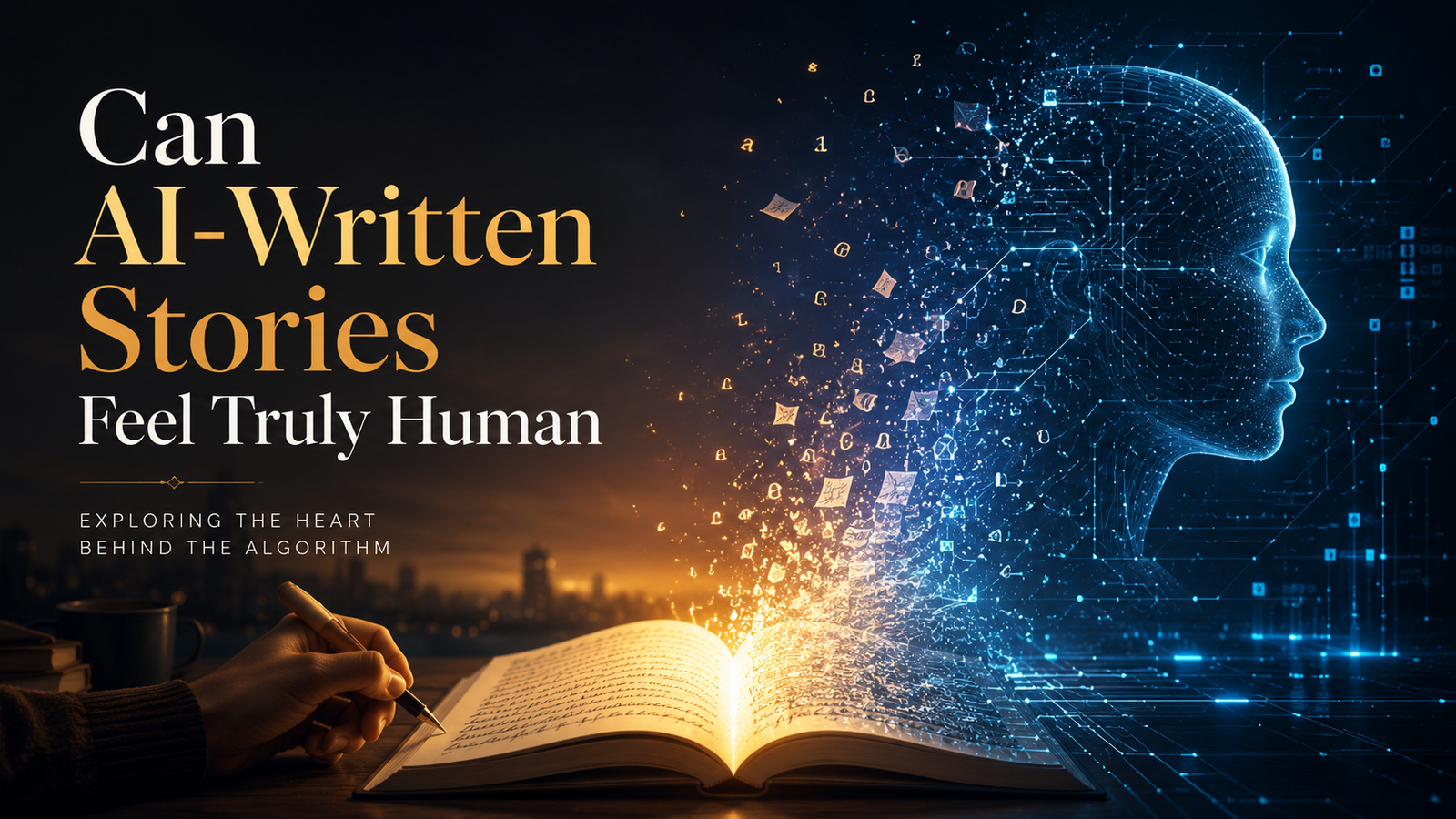
An AI-written story can make a reader laugh, pause or even cry. That is no longer a wild claim. Language models can produce clean scenes, convincing dialogue and emotional turns that look familiar because they have learned from huge amounts of human language. In a blind reading, many people may not know who wrote the page.
My answer is still cautious. AI can create writing that feels human in a passage or a short story. It can imitate the signals we connect with emotion. Yet a story feels truly human to me when the language carries more than skill. It carries a point of view shaped by a life, a body, a history, private fears, bad choices and something the writer risks by saying it.
They can feel human on the page, especially when a person guides, selects and rewrites the material. A fully machine-generated story may still move us, but the feeling comes from patterns borrowed from human expression and from the reader’s own emotional response. The machine does not bring lived stakes to the sentence.
Readers are not always able to tell
We often imagine that AI writing has an obvious smell. The sentences are too smooth. The metaphors are safe. The ending explains itself. Sometimes that is true. It is not a reliable test.
A 2024 study in Scientific Reports asked non-expert readers to identify poems written by famous poets and poems generated by AI in those poets’ styles. The readers performed slightly below chance. They were more likely to call the AI poems human than the real poems. The researchers found that participants often preferred the clearer rhythm and easier meaning of the AI work.
Another 2024 study in Science Advances gave some writers access to AI-generated story ideas. Their short stories were judged as more creative, better written and more enjoyable, with the biggest gain among writers who scored lower on a creativity test. There was a cost. The AI-assisted stories became more similar to one another.
Detection accuracy
Non-expert readers identified AI and human poems at a rate below chance in the 2024 poetry study.
Story writers
The creative-writing experiment placed participants in human-only and AI-idea conditions.
Better pages, narrower range
AI ideas helped individual stories while reducing variety across the full group of stories.
This matters because “I can tell” is not a strong literary argument. A weak human story can sound mechanical. A polished AI story can sound warm. The real debate begins after detection fails. What are we valuing when both pages seem readable?
Feeling human is not the same as being human
A story can perform emotion
A model can place a trembling hand beside an unopened letter. It can make a character avoid eye contact, repeat a private phrase or leave a sentence unfinished. These are readable signals of fear, grief and longing.
A person can mean the emotion
A human writer may choose that same image because it carries a private association, a cultural memory or a shame they have spent years trying to name. The sentence is connected to consequence outside the page.
Readers never receive a writer’s life directly. We receive words. In that narrow sense, literature has always depended on an act of faith. We do not need to know whether a novelist has lived through every event in a book. Imagination is part of the art.
The difference is not that human writers only describe what happened to them. It is that they imagine from inside a human condition. They know hunger through a body, time through ageing, embarrassment through social memory and loss through the knowledge that people do not return. Even fantasy grows from those limits.
AI can arrange the language of heartbreak. A human writer knows that the sentence may expose something they would rather hide.
The gap between performance and personal riskDoes that private risk automatically make the writing better? No. Pain is not talent. Lived experience can produce flat prose, and a skilled writer can invent lives far from their own. Still, the presence of a person changes the meaning of the act. Someone chose to speak. Someone can be questioned, praised, misunderstood or held responsible.
Where AI stories often lose me
The emotion arrives too neatly
AI often understands the expected shape of a feeling. A lonely character notices rain. A grieving parent touches an old photograph. A frightened child hears the clock. The image works, but it can feel selected because it is widely legible rather than privately exact.
Human emotion is often awkward. We remember the wrong object. We laugh in a hospital. We become angry at a person who did nothing. Strong fiction keeps that mess instead of cleaning it into a lesson.
The story wants to satisfy too quickly
A language model is built to continue. It tends to reward the prompt by giving a recognisable answer. Literary fiction often gains power by resisting that comfort. It may leave a motive partly hidden, let a conversation end badly or refuse to tell us which character is right.
Ambiguity is not the same as confusion. It is the feeling that a life is larger than the explanation offered for it. AI can imitate ambiguity when asked, but it may still produce an organised uncertainty, a mystery with polished edges.
The voice can feel like a centre made from averages
Models are powerful because they learn relationships across immense amounts of language. That same strength can pull writing toward familiar choices. The safest metaphor, the likely rhythm and the expected emotional turn are always nearby.
The Science Advances study found this tension in a measurable form. AI assistance improved some individual stories, yet the collection became less diverse. For me, that may be the larger danger. We could receive more competent stories while hearing fewer strange voices.
There is no life continuing after the final line
When a human author writes a novel, the book becomes part of a longer argument with their own work and with the culture around them. Readers can ask what changed between books. We can see obsessions deepen, political ideas shift and old mistakes return in a new form.
A model can maintain a style, but it does not wake years later ashamed of an earlier sentence. It has no artistic career in the human sense unless people build and direct one around it.
Human and AI collaboration changes the question
The phrase AI-written story hides many different processes. One person may type a prompt and publish the first output. Another may use AI to test a plot problem, reject most of the suggestions, rewrite every line and build the final story through months of choices. Calling both works the same thing is not useful.
Prompting
A person sets a direction, character or situation.
Selecting
The writer chooses what to keep and what to reject.
Rewriting
Language, structure and meaning are changed through human judgment.
Taking responsibility
A named person owns the final choices and discloses major AI use.
This is where I can imagine AI becoming a real part of literary work without replacing the writer. It may act like a rough improvisation partner. It can offer bad possibilities quickly, which gives the writer something to resist. It can help a nervous beginner reach a first draft. It can reveal that the obvious version of a scene is not the version worth keeping.
The human part is not the number of keystrokes. It is the chain of meaningful choices. What is the story trying to say? Which suggestion feels false? What must be removed even if it sounds pretty? What moral cost is hidden inside the plot? A person has to decide what the work is for.
Readers care about trust as much as quality
A reader may enjoy a story before learning it was generated by AI and feel differently afterward. That reaction is sometimes dismissed as prejudice. I think it reveals that books are more than containers of sentences.
We read novels partly to meet another mind. We wonder why the writer noticed this detail, why they returned to this fear and what it cost to write the scene. The author does not need to be a celebrity. Their existence matters because literature creates a relationship across distance.
Research on disclosure has found that labels can lower evaluations of creative work, especially when people believe the form depends on personal emotion. That does not prove every negative reaction is fair. It shows that origin forms part of the experience.
The publishing world is already responding to this concern. The Authors Guild opened its Human Authored certification to qualifying U.S. books in March 2026. Its updated May 2026 guidance also asks writers to disclose substantial AI-generated text and to protect reader trust. These moves do not settle the artistic debate, but they show that readers and writers want clearer boundaries.
For me, disclosure should be normal. A reader can still love a human-directed, AI-assisted novel. The problem begins when marketing asks us to believe we are hearing one person’s voice while hiding how the text was made.
The future may belong to clearer creative identities
I do not think AI fiction will disappear. It will become cheaper, faster and harder to identify. Some readers will choose it because they want a custom romance, an endless adventure or a bedtime story shaped around a child’s interests. There is nothing mysterious about that appeal.
Human-written literature may become more valued for a different reason. Readers may look for work connected to a known creative process, not because every human sentence is better, but because another person’s attention is part of what they are buying. A novel may matter as evidence that someone spent years thinking about one question when easier options existed.
The strongest AI-assisted books will probably be the ones where the writer does not use the tool to avoid imagination. They will use it to challenge imagination, then make choices the model could not justify on its own. The writer will remain visible in the pressure, refusal and responsibility behind the final form.
A machine may produce the sentence that moves us. The human question begins when we ask why this sentence needed to exist and who is willing to answer for it.
My final viewSo yes, AI-written stories can feel human. They may fool us. They may comfort us. A few may stay in memory. Yet truly human literature is not defined only by whether a page passes a blind test. It is a meeting between language, experience and responsibility.
AI can copy the footprints. A writer has to decide where the road leads, why it matters and what they are prepared to lose by taking us there.
Main research sources
Scientific Reports study on AI-generated poetry for reader detection, preference and the role of accessibility in judging AI and human poems.
Science Advances study on generative AI and short-story creativity for the finding that AI ideas can improve individual story ratings while reducing collective diversity.
Research on AI disclosure and creative-content evaluation for evidence that knowledge of AI authorship can change how emotionally personal work is received.
U.S. Copyright Office report announcement on AI and copyrightability for its position on human expressive control, prompting and AI-assisted works.
Authors Guild AI best practices updated in May 2026 for current guidance on disclosure, reader trust and responsible use by writers.
Authors Guild Human Authored certification for the publishing industry’s effort to identify books whose text was written by people.
Keep Asking What Makes a Story Matter
Explore more essays on books, authors, reading culture and the changing future of literature on Epiloguely.
Explore More Blog Posts