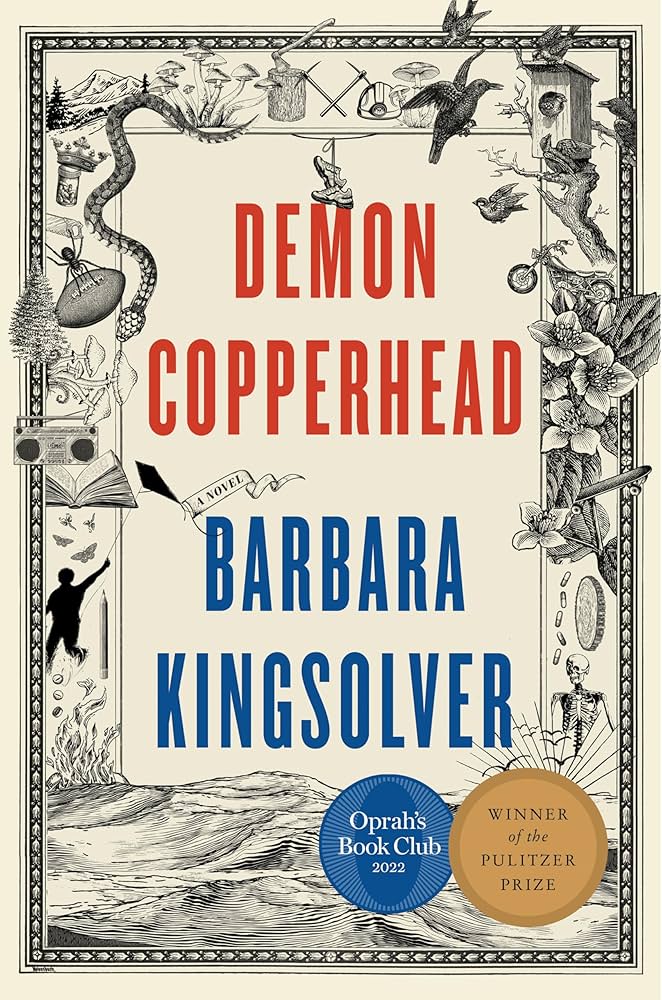
Demon Copperhead
| Published | 2022-10-18 |
| Series | Standalone |
| Genre | Literary Fiction |
| Language | English |
| Publisher | Harper |
| ISBN-10 | 0063251922 |
| ISBN-13 | 978-0063251922 |
📝Honest Review
Summary:
Demon is born to a teenage mother in a trailer in Appalachian Virginia, already marked by where he comes from before he understands what that even means. The novel follows him through foster homes and child labor and athletic promise and addiction in a part of America the rest of the country mostly forgets exists until an opioid crisis makes the news cycle pause on it for a week. It is loosely built on Charles Dickens' David Copperfield, transplanted from Victorian London into modern day Appalachia, and it won both the Pulitzer Prize and the Women's Prize for Fiction in 2023.
✅ What I Liked
Demon's voice is the whole reason this book works and it works completely. Kingsolver writes him with so much specificity and humor and pain that you forget within a few pages that you are reading a novel built on a Dickens structure. He sounds like a real kid from a real place, funny in the particular way that smart kids in hard circumstances are often funny, because humor is sometimes the only tool available to survive what is happening to you. The way Kingsolver handles the opioid crisis is also genuinely important. She does not write addiction as a moral failing or as a tragic plot device.
She writes it as something that grows directly out of poverty and pain and a medical system that handed out pills like candy to people in genuine physical agony, and that honesty gives the book real political weight without it ever feeling like a lecture. The supporting characters, especially June and Coach Winfield, are drawn with real tenderness.
❌ What Could Be Better
The book is 560 pages and it follows the long episodic Dickensian structure faithfully which means there are stretches, particularly in the foster care section in the middle, that move more slowly and pile on additional hardship in a way that started to feel slightly relentless to me.
I understand why Kingsolver structured it this way given the source material but there were chapters where i felt the accumulation of misery a bit more than i felt the forward momentum of the story. Some of the side characters who exist mainly to mirror specific figures from David Copperfield feel slightly more like literary devices than fully realized people, which is the cost of working so closely from a classic source text. And readers who do not know David Copperfield at all will still follow the story completely fine but might miss some of the structural pleasure of watching Kingsolver transpose it.
Demon is born in a trailer in Lee County, Virginia to a teenage mother who is still struggling with her own addiction and he tells you straight away, with the kind of dark humor that runs through the whole book, that he was already considered a lost cause before he had done anything to earn that label. What follows is his childhood and adolescence moving through the failures of the foster care system, through hard labor on tobacco farms, through a genuine talent for football that almost gives him a way out, and eventually into the opioid addiction that swallowed so much of his community whole.
Kingsolver is working directly from David Copperfield here and if you know that novel you will recognize the bones of it everywhere, the absent father, the difficult stepfather figure, the kind woman who takes him in, the friend who seems golden and turns out to be something else. What is remarkable is how completely she makes this structure her own. This never reads like an academic exercise in adaptation. It reads like Demon's actual life because Kingsolver has done the harder work of finding a contemporary equivalent for every Dickensian beat that feels earned rather than mechanical.
The voice is everything in this book. Demon narrates his own story and he does it with a mixture of bitter humor and genuine tenderness that makes him one of the most alive narrators i have read in years. He notices everything. He understands more about the adults around him than they realize a kid would. He makes jokes about things that are not funny because that is sometimes the only way to survive telling the story at all. Kingsolver never lets the voice slip into something more literary or distant. It stays specific and Appalachian and completely his the whole way through.
What the book is really angry about, underneath the story of one boy, is how an entire region of America got treated as disposable. Kingsolver writes about the opioid crisis not as a sudden epidemic that arrived from nowhere but as the direct result of decades of economic abandonment, a medical system that profited from prescribing addictive pain medication to people doing genuinely dangerous physical labor, and a culture that looked at the resulting addiction and called it a personal failing rather than what it actually was. This anger never overwhelms the storytelling. It runs underneath it the whole time, giving weight to every loss Demon experiences.
The foster care section in the middle of the book is the hardest stretch to get through, not because it is badly written but because Kingsolver does not soften what happens to kids who fall through the cracks of an overwhelmed system. There were chapters where i needed to put the book down for a day before continuing because the accumulation of hardship felt almost too much. I think this is intentional. I think Kingsolver wants you to feel the exhaustion of it the way Demon feels it. But i would be lying if i said it was always comfortable to read.
June, a nurse who becomes one of the steadiest presences in Demon's life, and Coach Winfield, who sees something in Demon that the rest of the world has stopped looking for, are two of the most genuinely good characters in contemporary fiction i have encountered recently. Kingsolver writes goodness without making it boring or simple, which is harder than writing villainy well.
The ending earns every bit of hope it allows itself, which is not very much, but what little it gives feels completely real rather than imposed. I will not say what happens. I will say that i finished the book and sat with it for a long time before i did anything else, which is the highest compliment i can give any novel.
Five stars without any hesitation. This is one of the most important American novels published in the last decade and it deserves every prize it won.
📊Community Rating
🎭Vibe Check
Read spoilers, debates, and detailed user reviews in our discussion room.
Discover Your Next Great Read
Handpicked recommendations from our collection of literary treasures