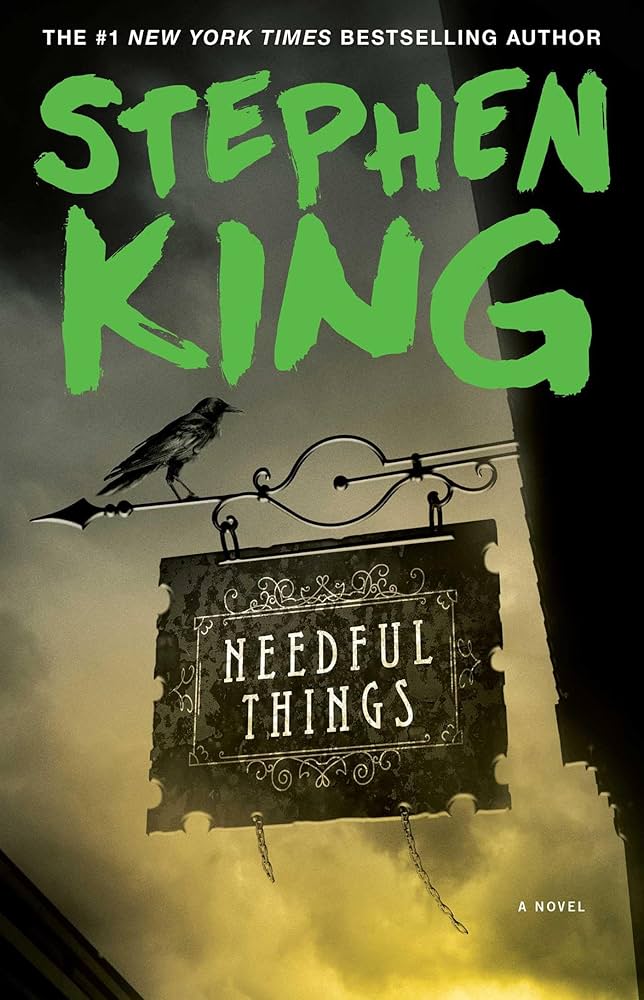
The first 250 pages are almost violence-free, just Castle Rock, the diner talk, the church rivalries, the old feuds everyone pretends are buried. He's so good at this slow layering that by the time you've met a dozen townspeople and their petty little wars, you realize every one of those wars is a fuse. And Gaunt is carrying matches.
The cast is huge. Too huge, honestly, and that's a real flaw, some people blur because there's no room for all of them to breathe. But the ones who get space are excellent. Sheriff Alan Pangborn is one of King's finest leads, a decent, grieving man completely out of his depth against something he can't even name, who keeps showing up anyway. Polly Chalmers gets a heartbreaking arc. And Gaunt himself, patient, smiling, old in a way that has nothing to do with years, is one of the best things King has ever put on a page.
Then the third act detonates. Castle Rock doesn't crumble, it goes off. Neighbors killing neighbors, buildings burning, decades of small-town hate boiling over at once. Loud, almost operatic, and some readers find it too much. I found it paid-for, King spent 600 pages making sure I understood exactly why these specific people would do these specific things.
Best King? No. The middle sags, the crowd's too big, some threads get shortchanged. But as a portrait of tribalism and the human talent for self-destruction wearing a horror costume, it's remarkable. And as a goodbye to Castle Rock, the town he'd been writing since 1979, it's a brutal, fitting one. He blows up his own recurring setting on purpose. There's something almost personal in that.
Book Summary
A mysterious stranger named Leland Gaunt rolls into the small town of Castle Rock, Maine, and opens a curiosity shop called Needful Things. His shelves seem to hold the one thing each person in town has always secretly wanted, a rare baseball card for an eleven-year-old boy, an amulet for a woman crippled by arthritis, a keepsake for a grieving widow. The price is always reasonable. Some cash, and one small harmless prank to be played on a neighbor. It seems like nothing. But Gaunt is not what he appears to be, and the pranks are not harmless at all. One by one, old grudges crack open, suspicion turns to rage, and the perfectly ordinary people of Castle Rock begin destroying each other, while Gaunt watches, collects, and smiles.
What I Liked
Gaunt is terrifying precisely because he barely lifts a finger, human greed does his work for him. The patient, violence-free first half is confident writing most horror authors wouldn't risk. Pangborn's plain decency makes him more compelling than any loud hero ever is. And the core idea, that we'll hand our freedom to anyone who promises us what we want, has only gotten more relevant since 1991.
What Could Be Better
The sheer size of the cast hurts the middle, too many people, too many subplots, not enough room. Several townsfolk are basically levers to escalate the chaos rather than people. And the ending, satisfying as it is on the Gaunt front, ties off a little neater than a book this messy has earned.
Context Behind the Book
King wrote this as a deliberate send-off to Castle Rock, the fictional Maine town he'd been using across a decade of books. He's said he wanted to free himself from it and move on, and you can feel that in how thoroughly the third act razes the place. Born in Portland, Maine, 1947; lives in Bangor with his wife, the novelist Tabitha King.