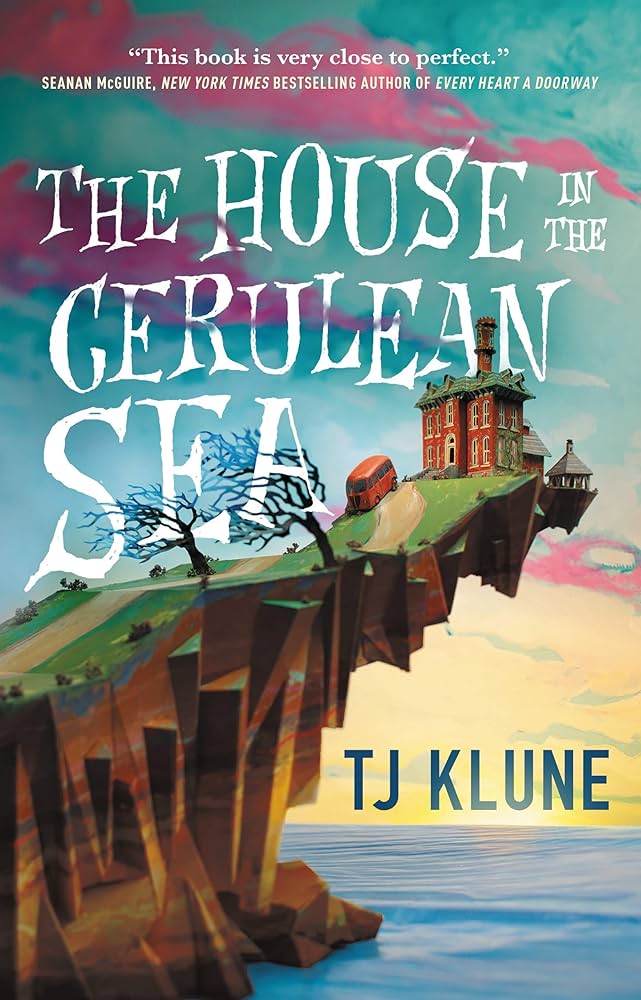
The House in the Cerulean Sea book cover by TJ Klune
⏱️
Estimated Read Time
9–11 hours

The House in the Cerulean Sea Review

✍️ Book by TJ Klune
Shadab's Rating
β˜…β˜…β˜…β˜…β˜† 4.4 (editorial rating)
Tap to Rate
Published2020-03-17
SeriesCerulean Chronicles
GenreFantasy, LGBTQ+ Fiction, Found Family
LanguageEnglish
PublisherTor Books
ISBN-101250217288
ISBN-139781250217288

πŸ“The House in the Cerulean Sea β€” My Honest Review

Written and reviewed by . The opinions and rating in this review are my own.

Summary:

A cautious caseworker inspects an orphanage for magical children and discovers the institution he serves may be more dangerous than those it fears. The story is shaped by Linus's gradual courage and Arthur's protective warmth make the found-family arc emotionally satisfying. Its strongest elements include the children, island home, bureaucratic comedy, low-stakes romance, and contrast between policy and genuine care, while its larger concerns are prejudice, bureaucracy, family, courage, belonging, protection, control, and institutional fear. The result is a fantasy novel that combines a clear narrative situation with questions that continue beyond the ending.

βœ… What I Liked

I especially liked the children, island home, bureaucratic comedy, low-stakes romance, and contrast between policy and genuine care. Those elements gave the book its most memorable emotional and visual identity. The story is strongest when it trusts scenes, objects, routines, and conversations to reveal its ideas without stopping to explain everything. The character work also stayed with me: Linus's gradual courage and Arthur's protective warmth make the found-family arc emotionally satisfying.

❌ What Could Be Better

My main issue was the moral lines are simple, bureaucracy is cartoonish, and the allegory has been criticized for flattening real histories. These choices did not ruin the reading experience, but they made some sections feel less convincing than the strongest parts. Readers expecting a very different rhythm or tone should know that before starting.

There are books I admire politely and books that pull me into an argument. This one did the second. The House in the Cerulean Sea is easy to summarize, but harder to reduce to one reaction.

The setup is clear: A cautious caseworker inspects an orphanage for magical children and discovers the institution he serves may be more dangerous than those it fears. The book lets this situation become normal before showing what that normality costs.

The lead is not always easy to like, and that helped the story. Linus's gradual courage and Arthur's protective warmth make the found-family arc emotionally satisfying. A more polished character would have made the eventual choices flatter and less believable.

The book is at its best with the children, island home, bureaucratic comedy, low-stakes romance, and contrast between policy and genuine care. I could see why readers remember those sections. They keep the novel from feeling like a collection of themes looking for a plot.

I read the novel mainly as an exploration of prejudice, bureaucracy, family, courage, belonging, protection, control, and institutional fear. The useful question is not only what the correct belief might be, but what happens when someone tries to live by it while other people have needs of their own.

Another thing I appreciated is that The House in the Cerulean Sea understands its own scale. A private decision rarely stays private; it changes a friendship, household, institution, or imagined future. That keeps the larger ideas attached to ordinary feeling.

I appreciated the attention given to consequence. The story does not treat a choice as finished once the dramatic scene ends. It follows what that choice does to trust, routine, memory, and the way people describe themselves afterward. In a book dealing with prejudice, bureaucracy, family, courage, belonging, protection, control, and institutional fear, that continued pressure is essential; without it, the central conflict would have felt like an idea rather than a lived experience.

There were also moments when I recognized why this book has found such a wide audience. The premise offers an easy entry point, but the staying power comes from the more personal material: the children, island home, bureaucratic comedy, low-stakes romance, and contrast between policy and genuine care. Those details give readers something concrete to carry away, even if they disagree about the characters, the message, or the effectiveness of the ending.

The book also gave me a useful amount of emotional resistance. I did not agree with every decision or accept every explanation, but I remained interested in why the story wanted me to look at the situation from that angle. A review becomes more interesting when the reaction is not simply approval. Here, the tension between admiration and frustration helped me see the novel's priorities more clearly.

The book asks for a particular kind of attention. Knowing that in advance matters because somebody expecting a different genre speed may judge it for being a book it never intended to become.

Where it lost me a little was the moral lines are simple, bureaucracy is cartoonish, and the allegory has been criticized for flattening real histories. The problem is not that every story needs realism or perfect balance. It is that the book occasionally asks for an emotional response before earning every step that would make that response unavoidable.

The conclusion works for me because a timid insider uses knowledge of the system to challenge the rules that kept others unsafe. It gives the story a final shape without pretending that shape removes the damage inside it.

For me, it lands at 4.4/5. I would suggest it to readers interested in fantasy, lgbtq+ fiction, found family. Even the parts I disliked helped clarify what the book was trying to do.

πŸ’‘ Context Behind The Book

TJ Klune is known for queer romance and fantasy centered on found family, kindness, safe communities, and characters learning to resist systems that taught them to hide.

πŸ“ŠShadab's Rating

4.4
β˜…β˜…β˜…β˜…β˜…
Editor Rating Β· No community ratings yet

No community ratings yet. The score shown above is the editor's rating. Be the first reader to rate this book.

Tap a star to rate this book

🎭Vibe Check

What's the vibe of this book?
πŸ’¬ Join the Readers' Discussion

Read spoilers, debates, and detailed user reviews in our discussion room.