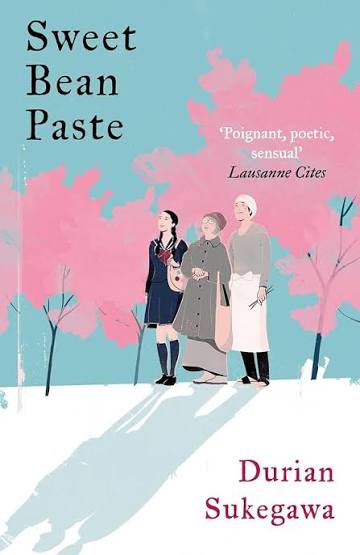
Sweet Bean Paste book cover by Durian Sukegawa
⏱️
Estimated Read Time
5-7 hours

Sweet Bean Paste Review

✍️ Book by Durian Sukegawa
Editorial Rating
★★★★★ 4.5
Epiloguely review by Shadab Alam
Reader Rating
☆☆☆☆☆ 0.0
No reader ratings yet
Rate This Book
A written review is optional
Published2017-10-05
SeriesStandalone
GenreContemporary Fiction, Japanese Fiction
LanguageEnglish
PublisherOneworld Publications
ISBN-101786071959
ISBN-139781786071958

📝Epiloguely Editorial Review

Written and reviewed by .

I did not expect the making of sweet bean paste to be the part of Sweet Bean Paste that stayed with me most.

Yet some of the book’s strongest moments are simply Tokue working with the beans, paying attention to their texture, the weather, and the amount of time they need. The process is slow and ordinary, but it tells us a great deal about her before the novel explains much about her past.

The story begins with a discouraged man running a small dorayaki shop. His work has become routine, and there is little sense that he takes much pleasure in it. Then Tokue, an older woman with unusually good sweet bean paste, asks him for a job.

At first, her importance seems practical. She can make something better than he can.

It becomes much more than that.

Tokue approaches cooking with a kind of attention that the people around her have lost. She listens, observes, and seems genuinely interested in the smallest parts of the process. That patience gives the novel much of its warmth.

It also makes what we later learn about her harder to accept.

Her history is shaped by illness and by the discrimination attached to leprosy. The book is not only interested in what happened to her medically. It is interested in everything that followed from other people deciding what someone with that illness should be allowed to do, where they should live, and how close they should be permitted to come to ordinary society.

That distinction mattered to me.

Tokue does not become interesting because she suffered.

She is already funny, curious, stubborn, and observant. Her past explains some of the sadness around her, but the book does not need to reduce her to it.

The friendship that develops through the shop was probably my favorite part of the novel.

There is a noticeable age difference between the characters, but the relationship never feels like a simple wise-old-person-teaches-younger-person lesson. Both are carrying things they would rather not discuss. Tokue may understand life differently, but she is not presented as someone who has solved it.

I liked that.

The food preparation gives their relationship somewhere to exist without constant explanation. They can work beside each other. They can talk about beans instead of themselves. A change in the paste or the way someone performs a familiar task can reveal more than a speech about grief or dignity would.

The seasonal details have a similar effect.

Nature keeps moving regardless of what the characters have lost. Flowers appear. Weather changes. Food has to be prepared again the next day. There is something gentle about that rhythm, but not necessarily comforting. Life continuing is not the same thing as life becoming fair.

The treatment of discrimination is where the novel becomes much harder.

Once Tokue’s history becomes known, the reaction around her shows how quickly kindness can disappear when fear and prejudice enter the room. What affected me most was how ordinary some of that cruelty feels. People do not always need to behave like obvious villains to exclude someone. Sometimes they simply decide that avoiding discomfort matters more than another person’s dignity.

The book is strongest when it allows those decisions to speak for themselves.

There were places, though, where I felt the message being stated more directly than it needed to be. The novel had already shown me enough through Tokue’s treatment, her work, and her relationships. A few later moments explain ideas that were already clear.

Some of the supporting characters also feel lightly drawn compared with Tokue. They serve a purpose in the story, but I did not always feel I knew them beyond that purpose.

I wanted a little more room around them.

That would have made the discrimination feel even more unsettling, because prejudice becomes harder to dismiss when the people participating in it are complicated rather than simply functional.

Still, those weaknesses did not change what worked for me.

Sweet Bean Paste is a small novel dealing with subjects that are anything but small: illness, loneliness, work, regret, exclusion, friendship, and the right to have an ordinary life.

That last part may be the one I kept thinking about.

Tokue is not asking for some grand reward. Much of what has been taken from her consists of things other people barely notice—the ability to work, to belong somewhere, to be around others without being treated as a danger first and a person second.

That is why the scenes of her making food carry so much weight.

They give her something prejudice tried to take away: participation in ordinary life.

I did not agree with every choice the novel makes, and I think a little more restraint would have strengthened some of its emotional moments. But I believed its concern for Tokue, and I believed the anger underneath its gentleness.

In the end, I remembered the beans, the seasons, and the care Tokue brings to something as simple as filling a dorayaki.

The book does not make that work symbolic by announcing it.

It becomes meaningful because she is finally allowed to do it.

Book Summary

A discouraged man running a dorayaki shop hires an older woman whose exceptional sweet bean paste slowly reveals a history of exclusion. The emotional pull comes from the fact that Tokue's attention to beans, seasons, and listening gives the novel its gentle moral center. The novel deals with illness, discrimination, work, friendship, nature, regret, dignity, and the right to ordinary life without offering a completely clean answer.

What I Liked

My favorite parts involved the food preparation, friendship across generations, seasonal detail, and quiet exposure of leprosy stigma. They worked especially well because Tokue's attention to beans, seasons, and listening gives the novel its gentle moral center. In Sweet Bean Paste, the result felt specific rather than manufactured.

What Could Be Better

My reservation is that supporting characters are lightly sketched, and the message can be stated too directly. Another reader may accept it, but I felt Sweet Bean Paste lose some control there.

Context Behind the Book

Durian Sukegawa is a Japanese writer, poet, performer, and musician; this novel became internationally known for humane attention to exclusion and food.

Reader Reviews

0 published written reviews · Reader star ratings remain separate from the editorial rating.

No reader reviews yet Be the first reader to share a thoughtful review of at least 100 words. A quick star rating can still be submitted separately above.

📊Reader Rating Breakdown

0.0
★★★★★
No reader ratings yet

No reader ratings yet. Be the first reader to rate this book using the separate quick-rating stars above.

🎭Vibe Check

What's the vibe of this book?
💬 Open Reader Comments & Discussion

Use the separate comment-style discussion room for spoilers, endings, characters, theories, questions, and replies. Formal reader reviews stay on this page.