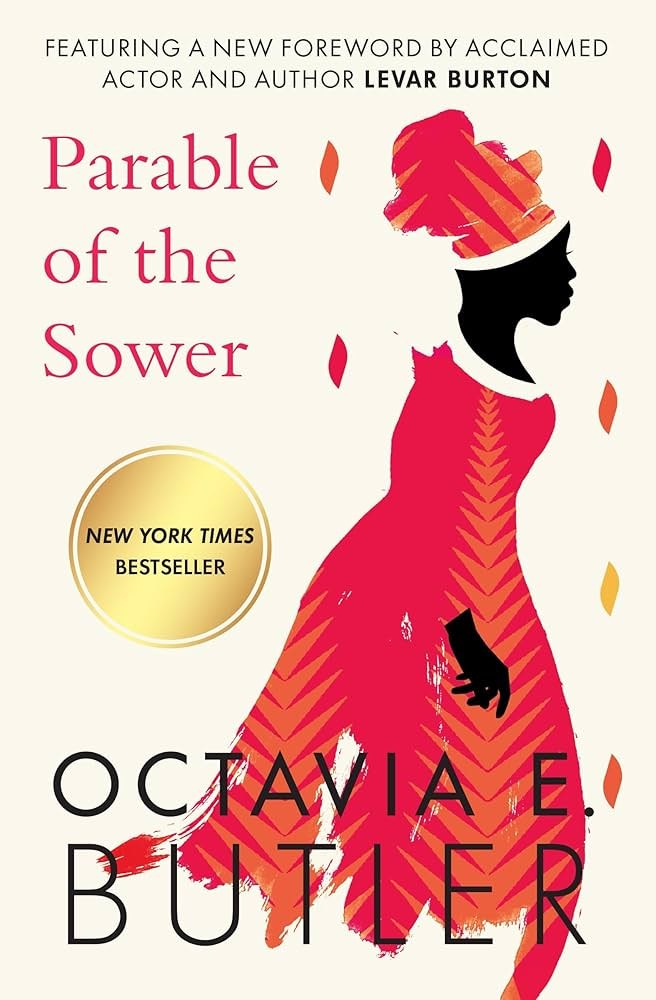
Parable of the Sower book cover by Octavia E. Butler
⏱️
Estimated Read Time
10-13 hours

Parable of the Sower Review

✍️ Book by Octavia E. Butler
Shadab's Rating
β˜…β˜…β˜…β˜…β˜… 4.9 (editorial rating)
Tap to Rate
Published1993-10-01
SeriesEarthseed
GenreDystopian Fiction, Science Fiction
LanguageEnglish
PublisherFour Walls Eight Windows (original); Grand Central edition
ISBN-100446675504
ISBN-139780446675505

πŸ“Parable of the Sower β€” My Honest Review

Written and reviewed by . The opinions and rating in this review are my own.

Summary:

Teenager Lauren lives in a collapsing near-future California and develops a belief system centered on change after her community is destroyed. Lauren's hyperempathy makes violence physically costly, while her practical leadership prevents compassion from becoming passivity. The plot uses that situation to examine change, climate, inequality, faith, leadership, community, capitalism, and survival without illusion, especially when a private choice begins affecting people who had no say in it.

βœ… What I Liked

I liked the plausible social collapse, journal voice, road experience, and gradual formation of a new community. Lauren's hyperempathy makes violence physically costly, while her practical leadership prevents compassion from becoming passivity. Those details gave Parable of the Sower a distinct emotional shape, and the writing trusted the scenes instead of explaining every idea twice.

❌ What Could Be Better

My main problem was that the bleakness is sustained, and some members of the traveling group remain lightly developed. Parable of the Sower remained readable, but those choices reduced the force of scenes that should have landed harder.

I expected a strong idea tested through people from Parable of the Sower, though the pressure around change mattered more to me than the genre label.

Teenager Lauren lives in a collapsing near-future California and develops a belief system centered on change after her community is destroyed. What interested me was the gap between the rule of the story and the private price of change, visible most clearly in the plausible social collapse.

The emotional center becomes clear once the characters begin paying for change, often through the plausible social collapse. Lauren's hyperempathy makes violence physically costly, while her practical leadership prevents compassion from becoming passivity. I could see fear and habit behind the behavior, especially when climate was at stake.

The larger subject is change, climate, inequality, faith, leadership, community, capitalism, and survival without illusion. I appreciated that change is tied to money, family, work, and the plausible social collapse rather than left as an abstract idea.

The weaker stretch comes from the fact that the bleakness is sustained, and some members of the traveling group remain lightly developed. The problem matters because the surrounding chapters handle change, particularly the plausible social collapse, with much more control.

The material I kept returning to was the plausible social collapse, journal voice, road experience, and gradual formation of a new community. Whenever the plausible social collapse appears, the book stops arranging ideas and starts observing people.

One brief exchange about climate, tied to the plausible social collapse, did more for me than the longer explanations around it.

I ended up at 4.9/5. The book's final hold came from the plausible social collapse, a specific choice rather than a general message.

πŸ’‘ Context Behind The Book

Butler often asks how communities form under pressure and which hierarchies people recreate even while intending to build something better.

πŸ“ŠShadab's Rating

4.9
β˜…β˜…β˜…β˜…β˜…
Editor Rating Β· No community ratings yet

No community ratings yet. The score shown above is the editor's rating. Be the first reader to rate this book.

Tap a star to rate this book

🎭Vibe Check

What's the vibe of this book?
πŸ’¬ Join the Readers' Discussion

Read spoilers, debates, and detailed user reviews in our discussion room.