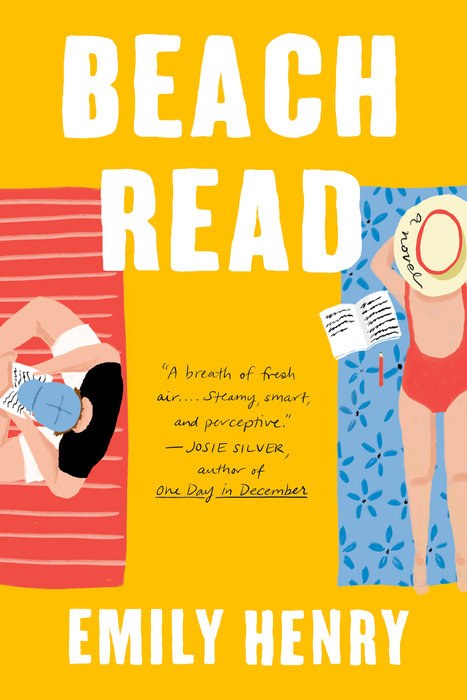
whose cover features a beach chair.
Augustus Everett turns up next door as her neighbor for the summer. They knew each other at university, where he wrote serious literary fiction and she wrote romance and they had the kind of competitive mutual antagonism that, in retrospect, was always going to tip into something else given enough proximity.
The deal they make, where he tries writing something hopeful and she tries writing something dark, is the engine of the book and it is a clever one because it forces both characters to step outside what they are comfortable doing and be seen doing it. There is real vulnerability in letting someone watch you try something you are not sure you can pull off and Henry uses that vulnerability to build the relationship between them in a way that feels earned.
The banter is excellent. I want to say this clearly because good banter in a romance novel is genuinely rare and Henry has it. The back and forth between January and Augustus sounds like two people who are well matched intellectually and who find each other annoying in the specific way you only find someone annoying when you also find them compelling. It is funny and it has real edge to it and it made me read several exchanges twice just to enjoy them again.
The death cult section of the book is a complete tonal departure from everything around it and it works brilliantly. Augustus takes January to interview survivors of a religious cult that ended badly, as research for her darker novel, and the whole sequence is equal parts genuinely unsettling and darkly comic and strangely moving. It is also the moment where January and Augustus become real to each other rather than just interesting opponents and Henry times it perfectly.
Where the book loses a little ground is in the final third. The conflict that drives the last act feels slightly like a problem the characters could solve with one honest conversation, and there is a stretch of maybe forty pages where i was impatient in a way i was not during the rest of the book.
Augustus also remains slightly more of a romantic ideal than a full person by the end. You know who he is through January's eyes and through his interactions with her but you want a little more access to his own interior life than the first person narration from January's perspective allows.
These are small complaints about a book that does most of what it is trying to do very well.
Four stars. It is warm and funny and smarter than its premise suggests, and January's grief gives the whole thing an emotional grounding that makes the romance land harder than it would without it. If you want to understand why Emily Henry became such a big deal in contemporary fiction this is the right place to start.
Book Summary
January Andrews is a romance writer who has just discovered that her father, who recently died, was having a long affair, and now the happy-ever-after endings she has built her career on feel hollow and impossible to write.
She moves into his old beach house to sort through his things and sell it and discovers that her neighbor for the summer is Augustus Everett, a literary fiction writer she knew from college and did not particularly get along with.
They make a deal. He will spend the summer writing something with a happy ending and she will write something dark and serious. Nobody is supposed to fall in love. That part does not go according to plan.
What I Liked
The banter between January and Augustus is genuinely funny in a way that a lot of romance novels aim for and miss.
Henry writes dialogue that sounds like two smart people who actually challenge each other rather than two characters performing attraction at each other, and that difference matters a lot in how believable the slow burn between them feels.
January is also one of the more emotionally complicated protagonists i have read in this genre. She is grieving her father while also being furious at him, which is a real and specific kind of grief that Henry handles with more care than i expected from a book with this kind of setup.
The meta element of the story, two writers arguing about what makes a good book while falling in love, is handled with a light touch and gives the book a playful self-awareness that never tips into being smug about itself.
And the death cult research trip they go on together is one of the funnier set pieces i have read in a romance novel in a long time.
What Could Be Better
The pacing in the second half dips a little when the story becomes more serious and some of the emotional beats that Henry is building toward arrive slightly before the relationship feels ready to support them.
The conflict that creates the final act tension felt slightly manufactured to me, the kind of misunderstanding that real people in a real relationship would probably clear up in one conversation rather than letting it derail everything for fifty pages.
Some readers will also find January's grief over her father resolved a little more neatly than something that complicated probably deserves.
And Augustus, while charming and well written, is occasionally more of a romantic ideal than a fully rounded person. You understand who he is in relation to January but you want a little more of who he is on his own.
Context Behind the Book
Emily Henry is known for contemporary romances that combine high-concept setups with grief, friendship, family history, witty dialogue, and storytelling itself.