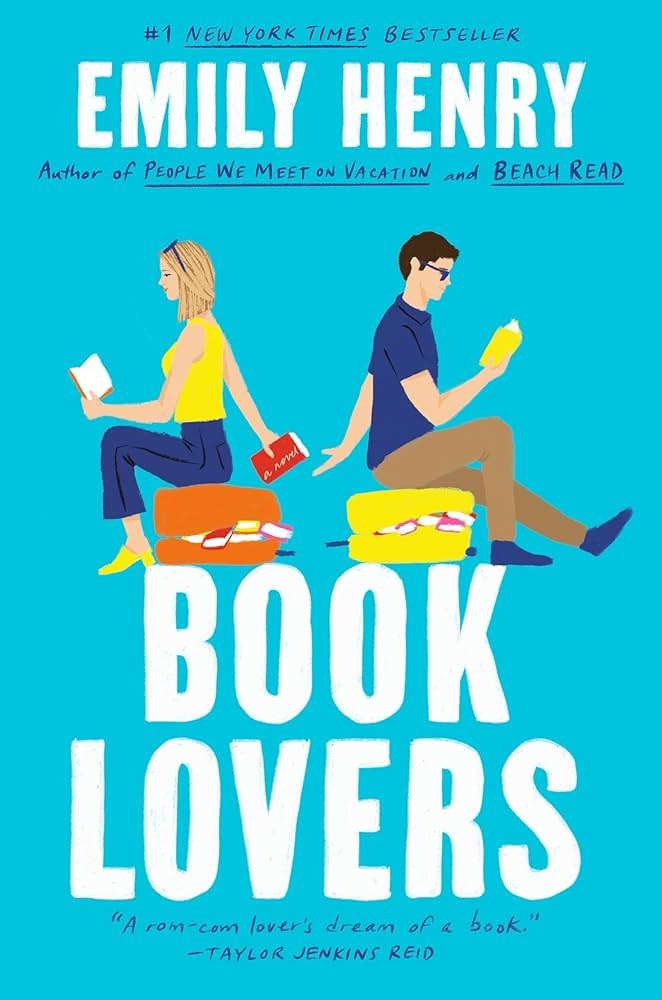
Book Lovers book cover by Emily Henry
⏱️
Estimated Read Time
8-10 hours

Book Lovers Review

✍️ Book by Emily Henry
Editorial Rating
★★★★★ 4.6
Epiloguely review by Shadab Alam
Reader Rating
☆☆☆☆☆ 0.0
No reader ratings yet
Rate This Book
A written review is optional
Published2022-05-03
SeriesStandalone
GenreRomance, Contemporary Fiction
LanguageEnglish
PublisherBerkley
ISBN-100593334833
ISBN-139780593334836

📝Epiloguely Editorial Review

Written and reviewed by .

Book Lovers worked best for me when it trusted the chemistry between Nora and Charlie and let their publishing-world conversations do the work. The setup is familiar enough: Nora Stephens, a successful literary agent, travels to a small town with her sister and repeatedly runs into Charlie Lastra, an editor she already knows professionally. What makes the story more interesting is that neither of them fits neatly into the kind of romantic role these books usually reward. Nora is ambitious, intimidating when she needs to be, and deeply attached to her work. Charlie understands that kind of personality because people have made similar assumptions about him.

The publishing setting gives their relationship a sharper edge than a more generic enemies-to-lovers setup would have had. Nora and Charlie speak the same professional language, and their banter often comes from the fact that both of them are good at what they do. They understand deadlines, manuscripts, difficult authors, commercial pressure, and the compromises involved in turning a book into something that can actually be published. I liked those scenes because the attraction grows out of mutual competence as much as irritation.

Nora herself is probably the strongest part of the novel. She knows that other people often see her as cold, overly ambitious, or difficult, and she has learned to live with that reputation. What the story gradually reveals is how much of her identity has been shaped by responsibility, especially toward her younger sister. Her devotion to work is real, but it is tied to family just as strongly as ambition. That makes her more complicated than the standard career-focused heroine who simply needs to learn how to relax.

Her relationship with her sister gives the book most of its emotional weight outside the romance. Nora has spent years seeing herself as the person who keeps things together, and that role has become so familiar that she does not always notice what it costs her. The book is strongest when it allows that family dynamic to exist alongside the romance instead of treating it as a separate subplot.

Nora is not only trying to decide whether she wants Charlie. She is also being forced to reconsider the version of herself she has built around being useful, dependable, and necessary.

Charlie works well opposite her because he understands what it feels like to be misread. He is often treated as distant or difficult, but much of that coldness is really restraint. Once Nora begins seeing the person behind the professional reputation, the romance becomes less about opposites attracting and more about two people recognizing familiar defenses in each other.

I liked that the book plays with romance conventions instead of simply using them. Nora is very aware of the kind of story she appears to be living in, especially once she arrives in a small town that seems ready-made for a cozy romantic transformation. There are charming local businesses, eccentric people, and the kind of setting where another heroine might abandon city life and discover what really matters.

Nora is not that heroine.

That is part of the joke, and often part of the appeal. She does not secretly hate her career. She does not need to be rescued from ambition. The book allows her to want work, city life, family, and love without pretending those desires cancel one another out.

The small-town setting is less convincing for me when it becomes too obviously part of the genre joke. At times, the town feels less like a real place and more like a collection of recognizable romance props arranged so the novel can comment on them. I understood what Henry was doing with the satire, but I occasionally wanted the setting to feel less self-aware and more lived-in.

The sister conflict also became more predictable than I wanted. The emotional tension between the two women is believable, especially because Nora has spent so much of her life acting from responsibility, but the resolution depends on a hidden truth that arrives in a fairly familiar way. I could see the shape of that revelation before the story reached it, which reduced some of its impact.

Even so, the relationship between the sisters stayed important because it explains so much about Nora’s choices. Her ambition does not exist separately from family. Her need for control, her instinct to plan, and her tendency to solve problems before anyone asks are all connected to the role she believes she has to play. The quieter scenes between them often reveal more about Nora than the larger confrontations do.

That is something the book handles especially well: work and family are not presented as separate parts of life. Nora’s professional identity, grief, responsibility, and sense of home are all tied together. She has built a life that works for her, but she has also built that life partly around protecting other people. The novel becomes more interesting when it asks whether she can keep the parts she genuinely wants without continuing to carry every responsibility alone.

The romance with Charlie benefits from that same tension. He does not ask Nora to become softer, less ambitious, or easier to understand. He is attracted to many of the qualities other people find intimidating. That made the relationship feel more satisfying than if the story had simply transformed her into a more conventional romantic heroine.

The banter is still the part I remember most clearly. Nora and Charlie are funniest when they are talking about books, authors, or the publishing business because those conversations feel specific to who they are. Their chemistry comes through language first, and that gives the romance a strong foundation before the more openly emotional moments arrive.

I do think the novel becomes less subtle when it steps away from those conversations and leans harder on its own genre commentary. The jokes about small-town romance conventions are enjoyable, but there are times when the book seems so aware of what it is doing that I could see the structure behind the story. The emotional material works better when it forgets to be clever for a while.

What stayed with me was the idea that being difficult in someone else’s story does not make you the wrong person in your own. Nora has spent years being cast in a role: the ambitious woman, the intimidating agent, the sister who handles everything. Book Lovers is strongest when it lets her question those roles without asking her to reject the parts of herself that are real.

I would recommend it most for the publishing-world banter, the relationship between Nora and Charlie, and the way Nora’s family responsibilities complicate her idea of success. The small-town setting occasionally feels more like a deliberate romance construction than a place, and the sister conflict resolves a little too neatly, but those weaknesses did not undo what I liked. The book understands that ambition does not have to be something a heroine gives up in order to deserve a love story, and that is where it feels freshest.

Book Summary

Literary agent Nora travels to a small town with her sister and repeatedly encounters editor Charlie, a man who shares her role as the difficult professional. At the center of the book, Nora's devotion to work and family gives the familiar setup a fresh center, while Charlie understands the cost of being cast as cold. Its main concerns include work, family roles, grief, home, ambition, love, and who gets to be the heroine of a story, though the plot keeps those ideas tied to relationships and consequence.

What I Liked

The best material for me was the publishing-world banter, sister relationship, small-town satire, and playful use of romance conventions. I also responded to the way Nora's devotion to work and family gives the familiar setup a fresh center, while Charlie understands the cost of being cast as cold. Together, those choices made the people in Book Lovers feel more important than the premise.

What Could Be Better

I was less convinced because the town can feel like genre props, and the sister conflict resolves through a familiar hidden truth. I could understand the intention in Book Lovers, yet the execution felt easier than the surrounding material.

Context Behind the Book

Emily Henry often begins with recognizable romance tropes and then asks which people and desires those stories usually leave outside the happy ending.

Reader Reviews

0 published written reviews · Reader star ratings remain separate from the editorial rating.

No reader reviews yet Be the first reader to share a thoughtful review of at least 100 words. A quick star rating can still be submitted separately above.

📊Reader Rating Breakdown

0.0
★★★★★
No reader ratings yet

No reader ratings yet. Be the first reader to rate this book using the separate quick-rating stars above.

🎭Vibe Check

What's the vibe of this book?
💬 Open Reader Comments & Discussion

Use the separate comment-style discussion room for spoilers, endings, characters, theories, questions, and replies. Formal reader reviews stay on this page.