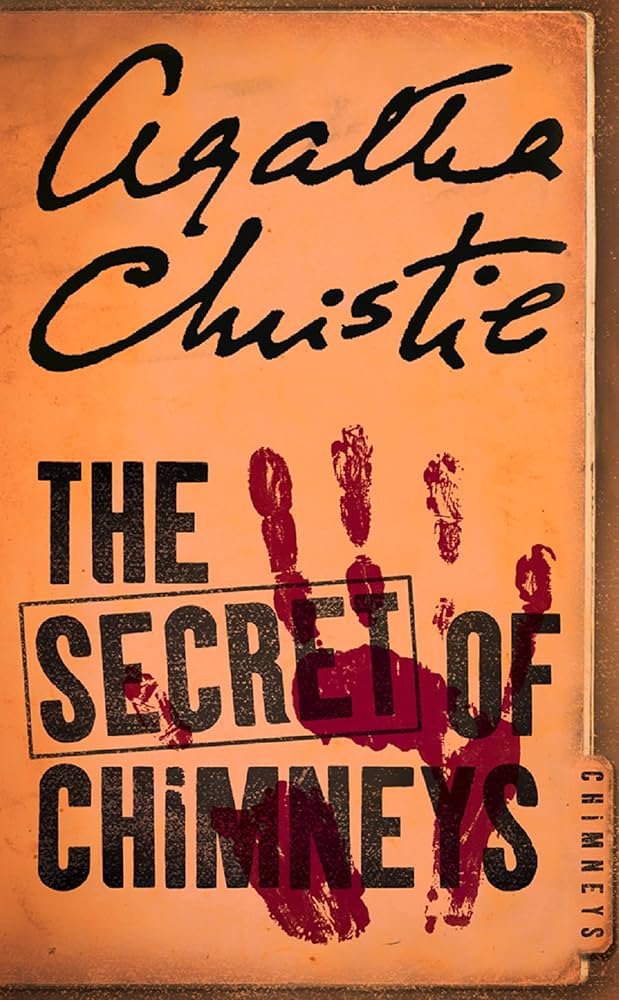
Christie was clearly having fun writing Anthony, and that fun is contagious.
The plot itself is, by the standards of her later work, magnificently ridiculous. There are political assassinations, a disputed royal succession, a legendary jewel thief operating under multiple identities, a missing diamond hidden in ways that defy probability, and a cast of characters who arrive and depart and reappear in unexpected configurations with a cheerful disregard for plausibility. Christie expert John Curran described it as an enjoyable but preposterous romp littered with loose ends, and that is both accurate and beside the point, because the looseness and the preposterousness are inseparable from the book's particular pleasure. It moves at a pace that simply does not allow you to sit still long enough to notice the logical gaps.
Superintendent Battle appears here for the first time, and he is an interesting creation precisely because he seems, on every initial reading, so unimpressive. He is large, solid, patient, and utterly without flair. He does not have Poirot's wit or his theatrical quality. He makes no speeches about the little grey cells. He simply watches, and waits, and listens, and arrives at the truth through a process that is entirely unhurried and entirely invisible until it is complete. Christie would use him again in The Seven Dials Mystery and several other novels, and he rewards the patience the reader has to invest in him.
The love story woven through the adventure is pleasant without being particularly deep, and the romantic resolution is signaled early enough that it does not really function as a surprise. This is the book's biggest concession to the thriller genre rather than the mystery genre, and in the hands of a less accomplished writer it would feel mechanical. Christie makes it work through sheer likeability of character, even if the emotion underneath it is not especially convincing.
Chimneys itself, the great country house of the title, is one of Christie's best settings. It has the quality of a house with genuine history and personality, full of concealed passages and inherited secrets and rooms that seem to lead somewhere unexpected. Christie uses it as both a physical location and a kind of structural metaphor, a place where surfaces conceal interiors, where the official version of events and the actual version of events are two different things occupying the same space.
What The Secret of Chimneys lacks, compared to Christie's mature work, is the precision. The clues are not planted with the surgical control of, say, After the Funeral or Evil Under the Sun. Several plot threads are resolved in ways that are more expedient than satisfying, and the central revelation about the identity of the mysterious jewel thief King Victor, while clever, requires a fairly significant suspension of disbelief to accept.
Book Summary
Anthony Cade is a young, charming, footloose adventurer with no fixed address and no particular ambitions, drifting through southern Africa when a friend asks him a simple favor. Could he deliver a set of memoirs to a publisher in London? The memoirs belong to a former minister of the fictional Balkan kingdom of Herzoslovakia and are apparently worth a great deal to certain interested parties. Anthony agrees without much thought and almost immediately finds himself in the middle of something considerably more serious than a delivery job.
What I Liked
Anthony Cade is one of the most purely enjoyable protagonists Christie ever wrote, an effortlessly charming adventurer whose good humor makes even the more preposterous plot developments a pleasure to follow. The pace is relentless in the best possible way, never pausing long enough to let you question the logic. Chimneys itself is a wonderful setting. And Superintendent Battle, introduced here for the first time, has a quiet, unhurried intelligence that becomes more impressive the more attention you pay to it.
What Could Be Better
The plot has more loose ends than Christie's later work would tolerate, and several resolutions feel hurried or convenient rather than properly earned. The central mystery of King Victor's identity requires a significant suspension of disbelief. The romantic subplot is signaled so early and so clearly that it functions more as decoration than as narrative tension. And readers who come to this book expecting the precise, controlled plotting of Christie's mature period will find it considerably messier than they are used to.
Context Behind the Book
Agatha Christie wrote The Secret of Chimneys in 1925 under the terms of her original publishing contract with The Bodley Head, a contract she had signed without representation and had come to resent deeply. It was the last book published under that contract before she moved to Collins, where she would remain for the rest of her career. The Chimneys mansion was inspired partly by Abney Hall, her brother-in-law's house, which she visited often and which appeared as a setting in several of her novels across the decades.