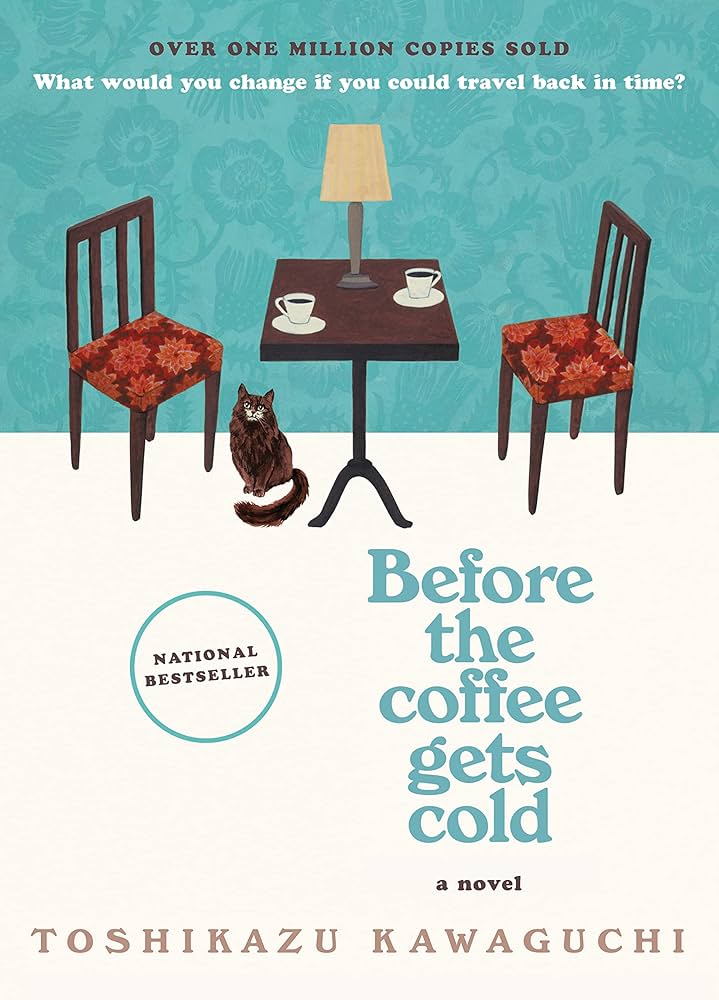
Before the Coffee Gets Cold book cover by Toshikazu Kawaguchi
⏱️
Estimated Read Time
5-7 hours

Before the Coffee Gets Cold Review

✍️ Book by Toshikazu Kawaguchi
Editorial Rating
★★★★☆ 4.1
Epiloguely review by Shadab Alam
Reader Rating
☆☆☆☆☆ 0.0
No reader ratings yet
Rate This Book
A written review is optional
Published2019-09-19
SeriesBefore the Coffee Gets Cold
GenreMagical Realism, Contemporary Fiction
LanguageEnglish
PublisherPicador
ISBN-101529029589
ISBN-139781529029581

📝Epiloguely Editorial Review

Written and reviewed by .

Before the Coffee Gets Cold has one of those premises that sounds more complicated than the book actually is.

In a small Tokyo café, there is one particular seat that allows a person to travel into the past.

There are rules.

A lot of rules.

You cannot change the present. You can only meet someone who has visited the café. You cannot leave the chair. And, most importantly, you have to return before the coffee gets cold.

At first, I thought the rules themselves would be the main attraction.

They were not.

What kept me reading was the idea that someone would choose to go back even knowing they could not fix anything.

That changes the usual time-travel question completely.

If the past is fixed, why return at all?

The book answers that through a series of people carrying unfinished conversations.

Some want to say what they should have said earlier. Some want to understand a choice that hurt them. Others simply want one more moment with someone who is no longer available to them in the present.

That is where the novel became much more personal for me.

The café itself helps.

Because the travelers cannot leave the seat, the scenes remain small. There are no attempts to prevent disasters, change careers, or create an alternate future.

Most of the tension comes from conversation.

Someone sits down.

Coffee is poured.

Time starts running.

And suddenly a few minutes matter enormously.

I liked that restraint.

The book is strongest when it accepts that regret is not always about wanting a different outcome. Sometimes you already know the outcome cannot change. What you want is to understand it differently.

That distinction gives several of the stories their emotional force.

The limited seat is especially effective because it creates physical pressure without needing conventional suspense. A character can finally be speaking to the person they needed to see, but the coffee is cooling.

There is no dramatic explosion waiting.

Just time running out again.

That worked for me.

The travelers also keep the premise from becoming too abstract. Each one brings a different kind of regret into the café, which helps the book avoid making one universal statement about grief.

At its best, the novel understands that closure is not the same thing for everyone.

For one person, it may mean apologizing.

For another, hearing something they were never told.

For someone else, simply sitting across from a person one last time.

Those differences matter.

My main frustration came from how often the book explains its own rules and emotions.

The time-travel conditions are repeated so frequently that I sometimes felt the novel did not trust me to remember them. I understand why the ritual needs to feel consistent, but after a point the repetition started working against the intimacy of the stories.

The emotional writing can have the same problem.

There are moments where a gesture or a line of dialogue already says enough, then the narration continues to explain why the moment is sad, meaningful, or painful.

I usually found the quieter version stronger.

A pause worked better than an explanation.

A character holding back worked better than a paragraph telling me what they were holding back.

The structure itself may also feel repetitive because each story returns to the same café, the same seat, and the same ritual. For some readers, that repetition will probably feel comforting.

For me, it depended on the chapter.

When the character was strong, the repetition gave the story shape.

When the emotional situation was less convincing, I noticed the machinery much more.

Even so, I never thought the book was empty.

Its central question stayed interesting because the answer is not as obvious as it first appears.

If nothing can change, is going back pointless?

I do not think the novel believes it is.

The past may remain exactly the same, but the person returning to the present does not.

That is the idea I carried away from the book.

Not that regret can be erased.

Not that grief can be solved.

But that sometimes one conversation can change the meaning of something you have already lost.

I still think Before the Coffee Gets Cold overexplains itself, and I wish it trusted silence more often. But the café ritual is memorable for a reason.

It turns time travel into something smaller and, in some ways, more painful.

You get one seat.

One cup of coffee.

A few minutes.

And whatever you were too late to say the first time.

Book Summary

A small Tokyo café allows visitors to travel to the past under strict rules, including returning before their coffee gets cold. The travelers matter more than mechanics, and every story asks what can change when events cannot. The story examines regret, grief, communication, family, love, time, acceptance, and the value of speaking honestly through choices that become harder once their cost reaches other people.

What I Liked

What worked for me was the café ritual, limited seat, repeated rules, and emotional focus on unfinished conversations. The book also benefits from this character choice: The travelers matter more than mechanics, and every story asks what can change when events cannot. I remembered the scenes around the café ritual more clearly than the larger speeches.

What Could Be Better

The weaker part for me was that the prose can feel repetitive, rules are restated heavily, and emotions are sometimes explained. It did not erase what worked in Before the Coffee Gets Cold, though it made the structure feel more visible than I wanted.

Context Behind the Book

Toshikazu Kawaguchi is a Japanese playwright and novelist; the series grew from a stage play, explaining its contained setting and dialogue-centered structure.

Reader Reviews

0 published written reviews · Reader star ratings remain separate from the editorial rating.

No reader reviews yet Be the first reader to share a thoughtful review of at least 100 words. A quick star rating can still be submitted separately above.

📊Reader Rating Breakdown

0.0
★★★★★
No reader ratings yet

No reader ratings yet. Be the first reader to rate this book using the separate quick-rating stars above.

🎭Vibe Check

What's the vibe of this book?
💬 Open Reader Comments & Discussion

Use the separate comment-style discussion room for spoilers, endings, characters, theories, questions, and replies. Formal reader reviews stay on this page.