📊NEW RESEARCH: Rightscenter's October 20 report analyzed 41,771 adaptation-rights checks from 2019 through the first half of 2026. These were inquiries, not confirmed film or television deals.
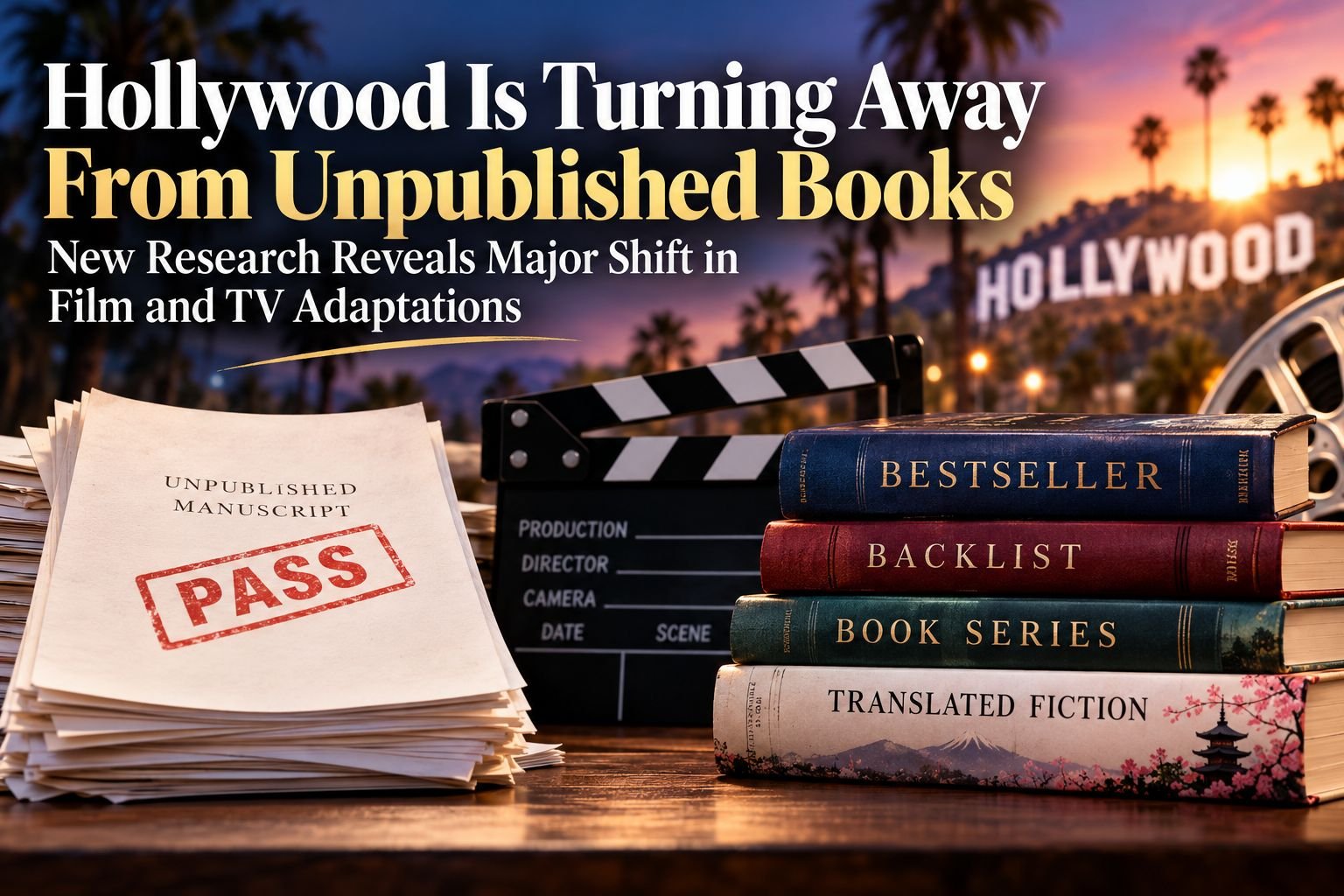
Hollywood's appetite for books has not disappeared. But the type of book attracting early attention appears to be changing. A newly released report from literary-rights intelligence platform Rightscenter finds that film and television professionals increasingly research established titles rather than unpublished manuscripts. The study, Book-to-Screen Marketplace Insights, 2019–2026, draws on 41,771 rights checks involving 26,570 titles, offering an unusual look at the inquiries that can take place long before a studio announces an adaptation.
Among the clearest findings is a sharp contraction in pre-publication interest. Unpublished titles represented 18.3% of rights inquiries in 2021, when streaming competition was intense, but only 5.5% in 2025, according to the detailed reporting in The Bookseller. The same year, previously published backlist titles accounted for 65.3% of inquiries. The report suggests that screen producers are increasingly drawn to books they can assess through reviews, readership, word of mouth and a longer publishing history.
There is a caveat with real consequences for how this story should be read: a rights check is not a sale. It does not mean a production company has bought an option, commissioned a screenplay or secured a release date. The research documents the early stages of interest among Rightscenter clients, not every production deal across Hollywood. Even with that distinction, the scale and consistency of the figures make this a meaningful signal about the changing book-to-screen marketplace.
The central finding
The opportunity has not vanished for new books—but established readership is increasingly attractive
Rightscenter's data show a pronounced move toward previously published titles and series. The shift may matter for publishers, literary agents and authors whose screen-rights strategies have traditionally focused on pitching books ahead of release.
📖
2025 backlist share
65.3%
🎞️
2025 unpublished share
5.5%
📉 Why unpublished books are receiving fewer early inquiries
For years, a compelling premise and a well-connected literary agent could trigger serious film interest before a novel reached bookstores. A manuscript might circulate between editors and producers while its publishing deal was still fresh, creating the possibility of competing bids for adaptation rights. That system has not ceased to exist, but Rightscenter's numbers indicate that unpublished manuscripts make up a much smaller share of the opportunities its clients investigate today.
The decline from 18.3% to 5.5% represents a drop of approximately 70% in share, not proof that the absolute number of unpublished-book deals fell by 70%. The distinction matters because the study measures the composition of rights searches, and the total number of requests can change from year to year. It would be misleading to use the percentage alone to declare the death of the pre-publication adaptation market.
Rightscenter and industry reporting suggest several plausible explanations. Streaming platforms have become more selective about projects, producers may prefer evidence of demand before committing resources, and the speculative bidding atmosphere associated with the earlier streaming boom has cooled. Agents may also be waiting until publication to put books forward for screen consideration. These are interpretations of the pattern, however, rather than proof that any single cause explains every decision.
📚 What exactly counts as a backlist book?
In publishing, backlist generally refers to titles that remain available beyond their initial launch period. Rightscenter's analysis focuses particular attention on established works and describes the older-book category in terms of titles published at least several years earlier. This is not necessarily a return to century-old classics. A successful contemporary novel that has circulated for three or four years can already have the kind of track record that interests an adaptation scout.
The report found that the average age of material attracting inquiries grew from four years in 2021 to eight years in 2025. That change is striking because it suggests producers are looking beyond the newest bestseller lists. A novel that failed to attract Hollywood attention when it launched may become more interesting after finding an audience, earning translations, developing a cult following or benefiting from a later social-media revival.
For readers, this is a useful reminder that a book's cultural life does not end once the original publicity campaign has finished. For publishers, older catalogues may contain commercially overlooked screen properties. And for authors, the results offer an encouraging counterpoint to the familiar pressure to make every new release an immediate sensation: a book can continue gathering potential value over a much longer period.
📺 Series are becoming more attractive to adaptation scouts
The shift is not only about age. Rightscenter reports that series titles accounted for 10% of rights checks in 2019 but 21.8% in 2025, more than doubling their share. The median age of requested series titles has also increased in recent years, indicating that buyers are willing to examine established franchises rather than only the newest multi-book property.
It is not difficult to see the potential attraction. A series may give producers a broader fictional world, familiar recurring characters and several possible seasons of storytelling. Its publishing history can also provide evidence that readers remain attached to the premise across multiple books. Still, not every series offers a straightforward television adaptation, and screen success depends on execution, casting, budgets and audience reception rather than the number of books available.
The study helps place the industry's continuing interest in fantasy, romance, mystery and other serial forms in a broader context. Rather than proving that every producer wants the next giant franchise, it shows that rights professionals are checking series at a substantially higher rate than they did in 2019. What happens after those checks remains a separate question.
🌏 Translated fiction and international stories are gaining attention
One of the most interesting signals from the first half of 2026 is the rising visibility of translated literature. Rightscenter reported that inquiries involving translated works were approximately 3.5 times the level recorded in the equivalent period of 2025. Interest in Japanese titles grew about fourfold over the comparable period, according to The Bookseller.
Those numbers are noteworthy because film adaptation has often been discussed primarily through the lens of English-language bestsellers. International fiction can offer stories with unfamiliar settings, different narrative traditions and audiences that span multiple territories. For producers searching for fresh material without gambling exclusively on untested manuscripts, a successful translated book may combine originality with a visible readership.
The figures should not be mistaken for evidence that translation rights automatically produce screen success. A production may face complex questions around language, cultural representation, rights ownership and the intended audience. The inquiry trend does, however, suggest that literary agents and publishers working with translated books have reason to follow the adaptation market more closely.
🎮 Female protagonists and LitRPG emerge as 2026 signals
Rightscenter's first-half 2026 analysis also examines the characteristics of stories attracting more than one inquiry. Books centered on female protagonists accounted for 48% of titles with at least two requests in the period, the largest grouping when compared with male-led and mixed-ensemble stories. This is a measure of a defined subset within Rightscenter's database, not a claim that women lead 48% of Hollywood productions.
The report highlights LitRPG, a form of speculative fiction that incorporates role-playing-game systems, character progression and game-like rules into its storytelling. Rightscenter says LitRPG inquiries in the first half of 2026 were 1.6 times the combined volume recorded over the preceding five years. What was once considered an especially niche form of fiction appears to be entering more mainstream development conversations.
Taken together, the findings suggest two trends can coexist. Buyers may favor proven books, yet remain open to forms of storytelling that feel relatively new on screen. The important commercial question is not merely whether a genre is popular, but whether a particular story offers characters, structure and a visual world that can survive the move from page to screen.
🔍 Which books are attracting attention?
The report's list of frequently viewed titles includes The Retreat by Sarah Pearse, Demon Copperhead by Barbara Kingsolver, The Midnight Library by Matt Haig, Yellowface and Babel by R. F. Kuang, The Secret History by Donna Tartt and Fourth Wing by Rebecca Yarros. These books span mystery, literary fiction, historical fantasy and romantasy, reflecting a market that is not limited to one genre.
A separate ranking of frequently requested books includes Exhalation by Ted Chiang, A Little Life by Hanya Yanagihara, Legendborn by Tracy Deonn, The House in the Cerulean Sea by T. J. Klune and Ninth House by Leigh Bardugo. The distinction between viewing a title and requesting rights information is relevant: these are different forms of platform engagement, and neither independently establishes that a new adaptation has been commissioned.
The lists are revealing precisely because they do not follow a single formula. Some titles have long-established literary reputations; others were strengthened by genre readerships, online discussion or broad commercial success. Their presence does not prove that those factors caused each inquiry, but it illustrates how many routes a book can take toward attracting attention from entertainment professionals.
⚖️ A rights inquiry is not an option deal, and an option is not a film
The most important limitation of the report is also the easiest to overlook. Rightscenter helps industry clients identify who controls screen rights, whether those rights may be available and the history of previous options. A producer can request that information simply to assess whether a project is worth discussing. The inquiry may end immediately, develop into negotiations or eventually lead to a formal agreement; the underlying dataset does not tell us that every inquiry resulted in a purchase.
Even an option agreement is only one step in the process. A company might acquire a temporary exclusive right to develop a book, commission scripts, approach actors and seek financing without ever beginning production. Announcements often arrive long before a movie is filmed, and some projects remain in development for years. Treating rights checks as completed adaptations would vastly overstate what the research actually demonstrates.
In fact, Publishing Perspectives reports that nearly 75% of requested titles attracted interest from only one Rightscenter user. That finding challenges the idea that most books are pursued through intense bidding wars. It also demonstrates why the number of requests should not be equated with the number of screen projects expected to reach audiences.
📝
How to read the data: Rightscenter analyzed activity among its own clients, not every studio, streaming service or producer in the world. Its dataset covers rights checks from 2019 through the first half of 2026; the 2025 and 2026 figures should be compared only where the reported time periods are made explicit.
✍️ What the shift could mean for authors, agents and publishers
For an author publishing a debut novel, the numbers might initially seem discouraging. If more attention goes to books with established readership, how can a new voice compete? The research does not mean debut writers have been shut out. Instead, it suggests that a strong publication campaign, sustained discovery and a book's ability to keep reaching readers may become even more valuable when adaptation conversations happen months or years after launch.
Literary agents may have a reason to revisit older titles in their clients' catalogues rather than concentrating adaptation pitches only around the next release. Publishers, meanwhile, can assess whether existing series, translated books and overlooked backlist titles are being presented effectively to rights buyers. That does not require treating every novel as future intellectual property; it means recognizing that screen-rights opportunities can arrive at different points in a book's life.
There is also a broader creative tension. A marketplace built around recognizable properties can reduce the perceived risk of investment, but it may leave less room for unusual or experimental stories that have not yet demonstrated commercial demand. Conversely, a years-old novel that never received a major advertising push may gain the chance to find a new audience. The research describes how interest is distributed; it cannot determine which of these outcomes ultimately dominates.
🎬 Does this mean Hollywood has stopped taking creative risks?
Not necessarily. Choosing an established novel is not identical to choosing an easy adaptation. Literary fiction may demand substantial structural changes, older series can carry expectations that are difficult to satisfy, and translated works can require sensitive decisions about language and culture. A well-known property may help a project get noticed while offering no guarantee that its screen version will be commercially successful.
The more persuasive conclusion is narrower: within Rightscenter's observed marketplace, producers have been spending a larger share of their early research on proven literary properties. The report describes a change in scouting behavior, not a total retreat from original storytelling. Screenwriters continue to create original film and television projects, and the data cannot measure the creative quality of any individual adaptation.
For book lovers, perhaps the most intriguing possibility is that older books may be getting another chance. A novel discovered years after publication can still feel new to a producer—or to a viewer encountering it on screen for the first time. Hollywood may be looking backward more often, but the stories it finds there can still surprise audiences.
🗓️ How the research unfolded
2019–2021
Pre-publication interest climbs during the streaming boom
Rightscenter records unpublished books reaching 18.3% of rights inquiries in 2021.
2025
Backlist and series establish a stronger position
Backlist titles account for 65.3% of checks, while the unpublished share falls to 5.5%; series account for 21.8%.
First half of 2026
International fiction and LitRPG attract attention
The study records increased inquiries concerning translated literature, Japanese titles and game-influenced speculative fiction.
October 20–23, 2026
Report released and industry coverage expands
Rightscenter releases its marketplace analysis, followed by reporting in Publishers Lunch, The Bookseller and Publishing Perspectives.
The report's lasting significance may be less about predicting the next blockbuster than about changing the way literary properties are evaluated. The publishing industry is accustomed to celebrating a book's opening week, first sales figures and earliest publicity. Rightscenter's data suggest the screen market may increasingly reward something harder to manufacture on demand: a story that remains interesting after the initial excitement has passed.
🔗 Sources & References
📌
Editorial note (October 24, 2026): The figures represent searches and rights checks within Rightscenter's platform; they do not measure all Hollywood adaptations or confirm screen rights were purchased. The reported 70% decline is a relative fall in unpublished titles' share of requests between 2021 and 2025.
Follow the Stories Behind the Screen
Explore literary adaptations, publishing-industry research and the novels shaping film and television.
More Literary News