⚠️
full spoilers for the Fight Club novel (1996), the David Fincher film (1999), Fight Club 2 (2015 graphic novel) and Fight Club 3 (2019). if you have not read or watched the original, go do that first and then come back here. this article will still be here.
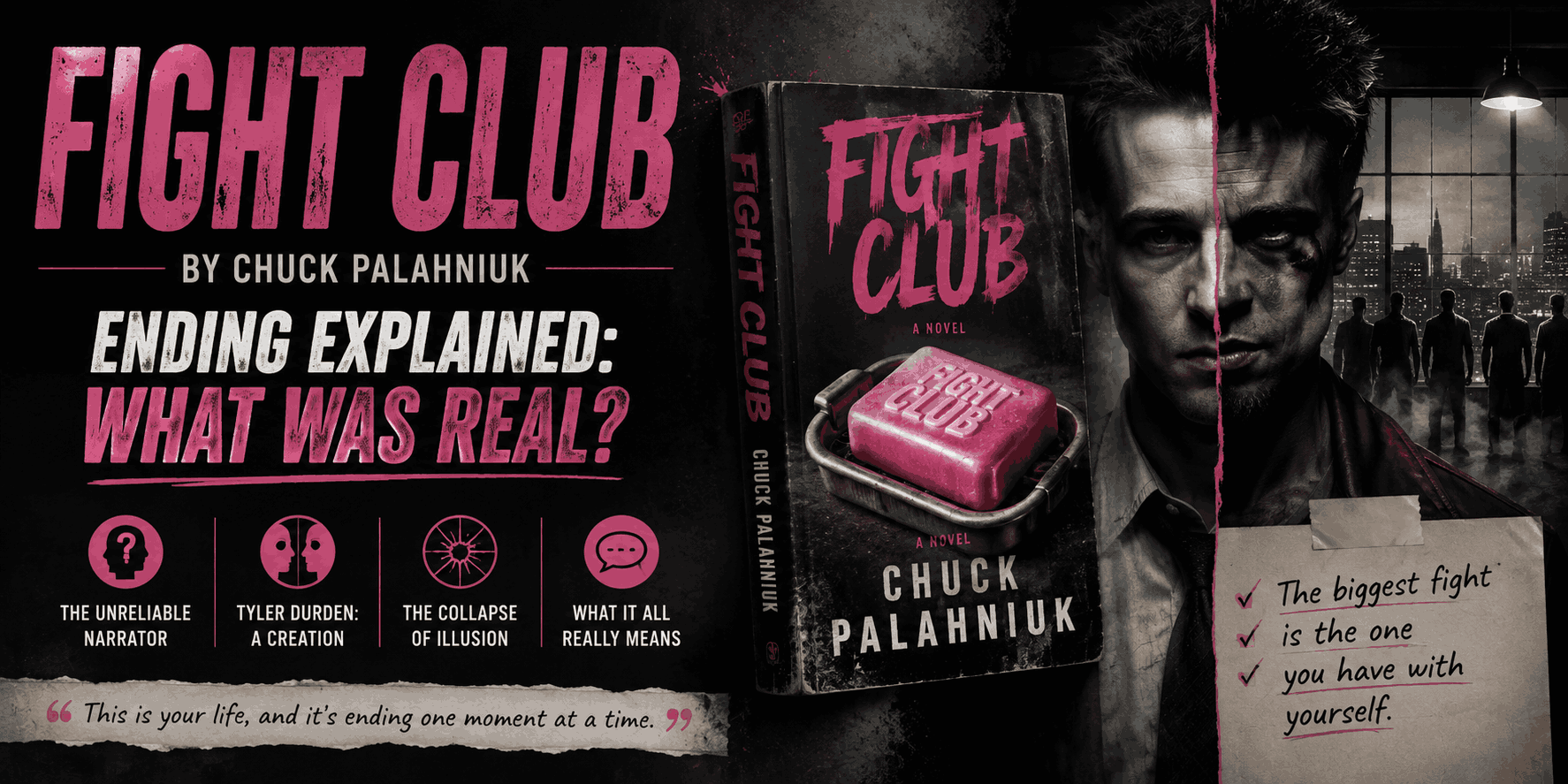
the first time i read Fight Club i got to the reveal and turned back about forty pages immediately. i needed to check. i needed to see if Palahniuk had actually left all the clues in plain sight or if he had cheated and just announced the twist and expected you to accept it. he had not cheated. the clues are everywhere. they are in almost every scene. once you know what you are looking at the whole book reads like a magic trick being slowly undressed.
the question i want to answer here is not just whether Tyler Durden was real — he was not, and the novel is very clear about this — but something harder and more interesting. what did the Narrator actually do during the months he thought he and Tyler were two separate people? what was real, what was imagined, and what was real but caused by someone who was imagined? and then there is the ending itself, which is much stranger and more unsettling in the novel than in the film, and which most people who only know the movie have never encountered. the book ends in a psychiatric hospital with members of Project Mayhem visiting to tell the Narrator they are still out there waiting for Tyler to come back. that is not a resolution. that is a warning.
📖
Published
1996 by Chuck Palahniuk
🎬
Adapted
David Fincher film, 1999
🧠
The twist
Tyler Durden is the Narrator's alter ego
💣
Book ending
Bombs fail. Narrator wakes in a hospital.
🎥
Film ending
Bombs succeed. Narrator watches with Marla.
👥
What is real
Marla is real. Tyler is not. The damage is.
you did not know it at the time, but every time Tyler appeared, you were looking at the same man. every conversation was the Narrator talking to himself. every fight was the Narrator beating his own face. every terrible thing Tyler did, the Narrator did.
what the reveal actually means for everything that came before it
1996
year Fight Club was published — Palahniuk was rejected by several publishers before it sold
600K+
copies of the novel sold since publication — it was a slow burn that became a cult classic
30
chapters in the novel structured almost entirely as flashback from the opening scene
1
actual person — Tyler and the Narrator share one body. only one of them is ever in control at a time.
🔎 Breaking Down the Ending — Section by Section
Book and Film
Identity
before you can understand the ending you have to understand what Tyler actually is. Palahniuk is writing about dissociative identity in a way that is not clinical or sympathetic but raw and almost mythological. the Narrator has chronic insomnia. he cannot feel things. he cannot cry. he cannot sleep. his life is a collection of furniture catalogues and airplane routes and a job he hates. Tyler Durden is what he builds in his mind as an escape from all of that. Tyler is blond and reckless and charming and has no fear and does not care what anyone thinks of him. Tyler is everything the Narrator cannot let himself be. Palahniuk describes Tyler as the Narrator's unconscious made physical — the wish fulfilment of every repressed desire the Narrator has been carrying around in his carefully ordered life. the key thing to understand is that the Narrator did not invent Tyler deliberately. Tyler emerged. he was not a choice. he was a symptom. and by the time the Narrator starts to understand what is happening it is already very late.
Palahniuk said in interviews that he sees Tyler as something the Narrator made and then could not control. that is the horror of it. Tyler is not a villain from outside. Tyler is the Narrator's own desire for destruction given a face and a name and room to operate.
Full Spoilers
Close reading
this is the part of rereading Fight Club that makes you feel slightly embarrassed about how obvious it all is. Palahniuk does not hide the clues. he puts them right in front of you and the book's tone is so relentless and strange that you just do not stop to examine them on a first read. here are the main ones that i keep coming back to.
🧳 The Briefcase
on the plane in the film, both the Narrator and Tyler appear to have identical briefcases. in the novel the meeting is more ambiguous but the duplication is there. two versions of the same man, two versions of the same object.
📞 The Phone Call
after his apartment explodes the Narrator calls Tyler. there is a moment where Palahniuk notes the phone cannot call itself. the Narrator calls a number that is essentially his own number. nobody questions this because the Narrator does not question it.
🏠 The Apartment
Tyler destroys the Narrator's apartment. the Narrator later discovers that Tyler did this. in retrospect the Narrator destroyed his own apartment. he did it to himself to force a change in his life. the bomb was his own hands.
😴 The Sleep Switching
whenever the Narrator falls asleep Tyler takes over. whenever Tyler is in control the Narrator is unconscious and remembers nothing. the insomnia that opened the book is the mechanism that allows Tyler to exist. sleep is the border between the two selves.
💋 Marla and Tyler
Marla has sex with Tyler but not with the Narrator. she recognises them as different though she is sleeping with the same body. later she addresses the Narrator as Tyler on the phone. she has always known there is something strange here even if she could not name it.
🪞 "Mr. Durden"
when the Narrator goes looking for Tyler at bars and clubs every bartender calls him Sir, then Mr. Durden. he thinks they are just confusing him with someone else. they are not. to everyone else he has always been Tyler Durden.
Palahniuk structures the whole novel in flashback specifically so you read the clues after the fact. the book opens with the Narrator already at the end with Tyler's gun in his mouth. everything you read before that moment is unreliable memory filtered through a fractured mind.
Book and Film
Full Spoilers
this is the part that i think is most underexplored in how people talk about Fight Club. once you accept the twist the natural response is to say oh Tyler was not real, none of it was real. but that is wrong. everything Tyler did was real. the Narrator did all of it. he built fight clubs across the country while unconscious and Tyler drove his body. he recruited members, gave speeches, organised Project Mayhem, set bombs, attacked people, destroyed property, had sex with Marla, blackmailed his boss and eventually planned the demolition of credit card company buildings. when he wakes up from these Tyler episodes he has injuries he cannot explain and projects he has apparently started and knows nothing about. the Narrator is not an innocent bystander in his own story. he is the perpetrator. Tyler is the name he gave to the part of himself that was capable of all of it.
Palahniuk is asking something uncomfortable here. if you do terrible things while in a dissociative state, who is responsible? the Narrator tries to distance himself from what Tyler did but he cannot. the body that did all of it is his body. the anger that created Tyler was his anger.
Popular Theory
Novel Focus
there is a popular theory that Marla Singer is also a figment of the Narrator's imagination, a second alter ego who represents a different kind of self-destruction. i understand the theory and i think it is wrong. here is why. in the novel Palahniuk writes a specific moment where Marla arrives on the rooftop with members of the support groups and Tyler simply disappears. Palahniuk makes the reason explicit — Tyler was the Narrator's hallucination and not Marla's. this means Tyler cannot exist in the same space as Marla because she is perceiving reality independently of the Narrator's fractured mind. if Marla were also a hallucination this scene would make no sense at all. additionally the Narrator asks Marla to observe his behaviour when Tyler is in control and report it back to him. she does this accurately and her reports match what other real people like police officers and Project Mayhem members also observed. a hallucination cannot independently corroborate evidence from other real sources. Marla is real.
Palahniuk confirmed this in Fight Club 2, the graphic novel sequel he wrote in 2015. Marla and the Narrator get married and have a physical child together. their son is named Junior. you cannot have a child with a hallucination. Marla was always real.
Novel Only
Full Spoilers
this is the ending most people have never encountered because the film changes it almost completely. in the novel the Narrator discovers Tyler's plan to blow up a skyscraper and collapse it onto a nearby museum, killing himself and the Narrator together so Tyler can die as a martyr and a historical figure. Tyler wants to be remembered. he wants his destruction to mean something. Marla arrives on the rooftop with members of the support groups and Tyler disappears because she is real and he is not. the Narrator is alone. he waits for the bomb to go off. and then it does not. the explosives fail. Tyler used paraffin instead of proper explosive material and the bomb simply malfunctions. this is not a heroic act by the Narrator. it is not even a clever plan. the thing just does not work. the Narrator, feeling a sense of control for the first time in a very long time, turns the gun on himself. he does not shoot himself in the mouth as in the film. in the novel he shoots himself through the cheek. he survives.
he wakes up in what he believes is heaven. it is not heaven. it is a psychiatric hospital. and this is the moment that the novel does something the film does not and cannot. the hospital staff come to his bedside and reveal themselves to be members of Project Mayhem. they tell him they are still out there. they tell him they are expecting Tyler to come back. they are watching over the Narrator not out of care but out of anticipation. they want Tyler to resurface. the Narrator has not won. Tyler has not been destroyed. the movement the Narrator helped build is still running and it is waiting for its leader to return through the Narrator's body. the novel ends there. not with buildings collapsing and Marla's hand in yours. with Project Mayhem members sitting by a hospital bed and smiling.
this is a much darker and more honest ending than the film gives you. the film wants to resolve the identity war and give you a moment of connection between the Narrator and Marla. the novel is not interested in resolution. it is interested in the fact that the system the Narrator built does not care whether the Narrator wants it anymore.
📊 Book Ending vs Film Ending — The Key Differences
David Fincher's film is extraordinary and stays very close to the novel for most of its running time. but the ending is where the two versions split hardest and the split matters. Palahniuk himself has said he was not a fan of one specific change the film made.
| 📖 The Novel (1996) |
vs |
🎬 The Film (1999) |
| Tyler wants to blow up one building and collapse it onto a museum nearby — a symbolic destruction rather than a financial one |
target |
Tyler plans to blow up multiple buildings housing credit card company records to erase consumer debt across the country |
| The bombs fail because Tyler used paraffin — they simply do not go off. the destruction does not happen. |
bombs |
The bombs succeed. multiple buildings collapse in one of the most iconic shots of 1990s cinema while the Narrator and Marla watch. |
| Marla arrives with the support groups and Tyler disappears because she is real and he is not. no ticking countdown. no confrontation. |
Tyler's end |
The Narrator shoots himself in the mouth. the bullet path kills the Tyler personality. Tyler physically disappears in the Narrator's vision. |
| The Narrator wakes up in a psychiatric hospital believing it is heaven. Project Mayhem members visit him and tell him Tyler will return. |
aftermath |
The Narrator holds Marla's hand and they watch the skyline fall together. a moment of connection and dark catharsis. something closer to an ending. |
| No resolution. Tyler is not destroyed. Project Mayhem is still active. the Narrator is a patient in a facility run by his own movement. |
meaning |
Personal resolution at the cost of public catastrophe. the Narrator wins his identity war. Project Mayhem wins the physical one. both things are true. |
| Palahniuk felt the ticking bomb device added to the film was a cliché — he called it "obviously such a trope" though he has said he has grown to accept it. |
author view |
Palahniuk has said that ironically Tencent's censored Chinese version of the film ending was in some ways closer to his book's resolution than Fincher's original ending was. |
💬 What the Ending Actually Means
Thematic reading
Book and Film
the thing that i think both the book and the film are saying, and that the book says more explicitly, is that you cannot put back what you have let loose. the Narrator wanted to destroy his old life and in doing so he created something that took on a life entirely outside his control. Project Mayhem does not need Tyler anymore. it does not even need the Narrator. the Narrator lies in a hospital bed and the movement he built is still running in the world outside the window. his recovery, whatever that might mean, is happening inside a system run by his own followers. there is no clean exit from the thing you made.
Palahniuk wrote the novel after a camping trip where he was beaten up and came back to work with injuries nobody at his job asked about. they just pretended nothing had happened. the novel is partly about the male culture of silence and partly about what men build when they have no language for what is hurting them.
Thematic reading
Cultural critique
this is the uncomfortable thing about Fight Club that i think a lot of readings want to skip over. Tyler's diagnosis of what is wrong with consumerist masculinity in the 1990s is not entirely inaccurate. he is right that the Narrator was hollow and disconnected and sleepwalking through a life built from catalogue furniture. he is right that a lot of men are performing an idea of themselves rather than living an actual life. he is right that the support group scenes where the Narrator finally cries in Bob's arms feel more real than anything in his corporate existence. the problem is not that Tyler is wrong about the disease. the problem is that his cure is catastrophic and the logic of destruction he uses as therapy is simply violence dressed up as liberation. Palahniuk does not let the reader feel comfortable hating Tyler. he makes sure you understand why the Narrator made him. that is what gives the book its staying power.
the reason Fight Club became a cult text for a certain kind of young man is exactly the reason it needs to be read carefully. Tyler seduces because he is partly right. the seduction is the point.
Sequel Material
Full Spoilers
in 2015 Palahniuk published Fight Club 2, a graphic novel sequel illustrated by Cameron Stewart. the Narrator now has a name — Sebastian. he and Marla are married and have a son called Junior and Sebastian is on medication to suppress Tyler. the novel reveals that Tyler is not merely a dissociative alter that can be killed by a gunshot. Tyler is something older and more mythological — a kind of recurring figure who has been passing through generations, inhabiting hosts. Sebastian's grandfather was a host. Sebastian is a host. and Junior is slowly becoming one too. this changes the meaning of the original novel's ending retroactively. when the Project Mayhem members sit by the hospital bed and say they are waiting for Tyler to return, they are not wrong. Tyler was never simply a symptom of one man's alienation. Palahniuk is suggesting something much bigger and stranger — that what Tyler represents cannot be destroyed, only temporarily suppressed, because it is not personal. it is cultural and generational.
you do not have to accept the sequel's mythology to understand what Palahniuk is doing with it. the point is that the original ending was always open. the Narrator did not win. he stabilised. those are not the same thing.
📖 Final Thoughts — Why the Ending Still Holds
i have read Fight Club three times now. the first time as a teenager who thought Tyler was cool. the second time as an adult who understood the seduction was the point. and the third time very recently specifically to write this piece. each time the ending does something different. the first time it felt like a twist. the second time it felt like a tragedy. the third time it felt like a question.
what Palahniuk asks at the end of the novel is not whether the Narrator survives. he does, physically. what the ending asks is whether survival inside a system you built and cannot dismantle counts as freedom. the Narrator lies in a hospital room and the hospital staff are his followers. he is protected and watched over by the people he made. he cannot leave what he created any more than you can leave your own name. the psychiatric hospital is just the latest room he has woken up in and been unable to get out of.
the film gives you buildings falling and Marla's hand and something that feels like resolution even while being catastrophic. that is a valid and powerful ending and Fincher earns it. but the novel's ending is darker and stranger and asks more of you. it does not let you feel relieved that Tyler is gone. it tells you that Tyler was always waiting and that the people Tyler made are still waiting with him.
a note on reading Fight Club as a book if you only know the film
the novel is significantly different from the film in tone and texture even though the plot is largely the same. Palahniuk's prose is aggressive and fragmented and funny in a way the film can only approximate. the second-person address — "you do this, you feel that" — pulls you into the Narrator's dissociation in a way that no camera can replicate. if you have only ever seen the film it is genuinely worth reading the novel. it will change what you think you know about the story and it will change it in a direction that is more uncomfortable and more interesting.
📚 Explore More Book Analysis
Fight Club is one of the most discussed novels of the last thirty years. Explore more reviews and ending explanations for books that stay with readers.
Explore More Blog Posts →