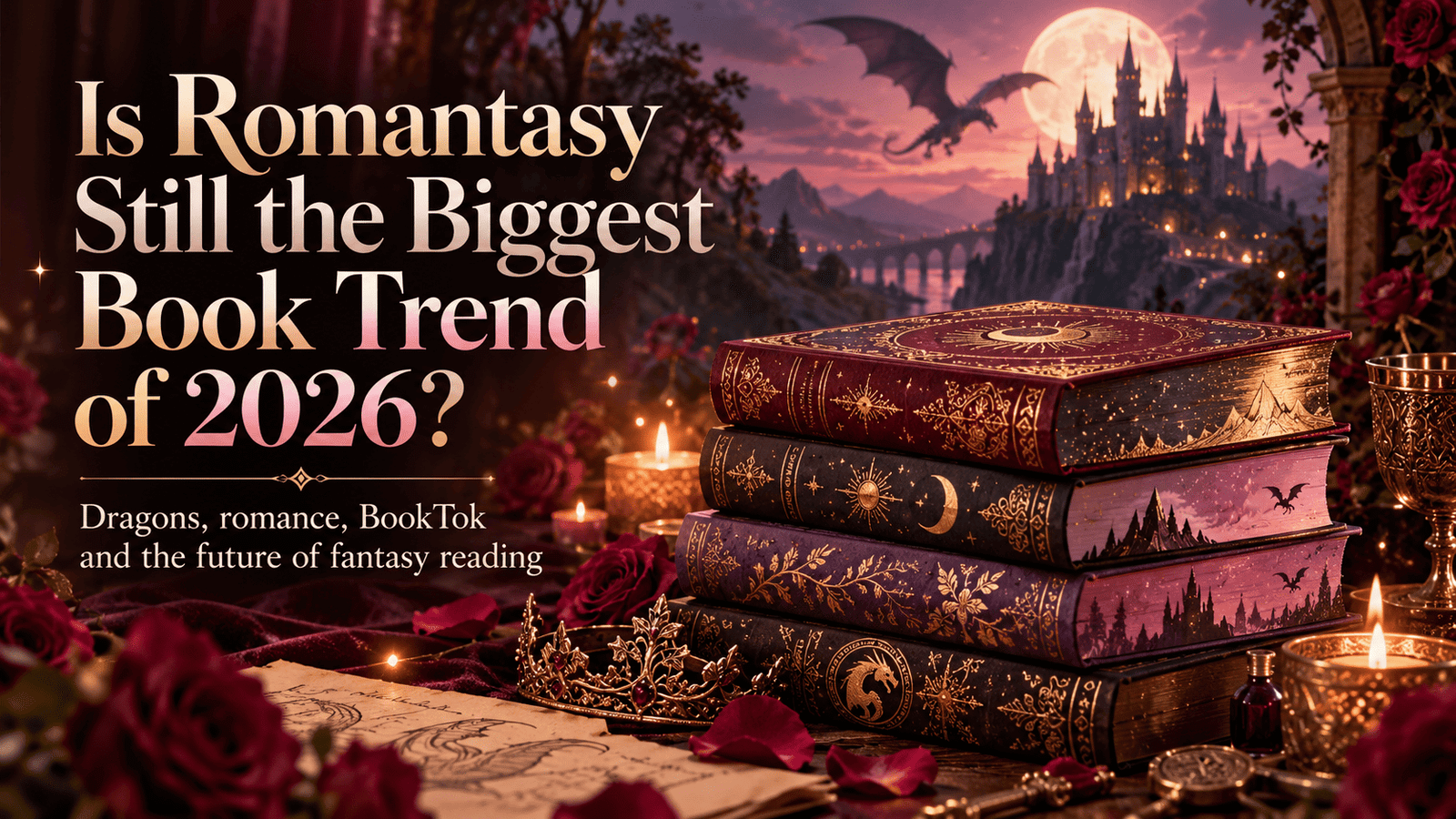
Is Romantasy Still the Biggest Book Trend of 2026?
Dragons, fae courts, dangerous love interests and sprayed-edge hardbacks are still everywhere — but underneath the blockbuster sales, romantasy is beginning to change.
There was a moment when “romantasy” sounded like a convenient internet label. Take fantasy, add a central romance, give readers a dangerous magical world and an emotionally unavailable love interest, and the recommendation practically wrote itself.
By 2026, that description no longer captures what has happened. Romantasy has become a publishing ecosystem. It has bestselling authors, midnight launch parties, deluxe editions, subscription boxes, fandom vocabulary, adaptation interest, dedicated bookstore tables and a visual identity that is instantly recognisable on social media.
Sarah J. Maas and Rebecca Yarros remain the names at the centre of the phenomenon, but the category is now far bigger than two blockbuster authors. New writers are entering through traditional publishing, self-publishing and digital-first imprints. Readers are moving between fantasy romance, dark romantasy, paranormal romance, epic fantasy and increasingly genre-blurred books that do not fit neatly into one shelf.
In commercial fantasy publishing, it is still one of the dominant forces — especially in the UK and international markets — but 2026 also shows signs of maturation. Romantasy titles dominate major SFF bestseller lists, yet broader U.S. romance and fantasy categories have softened. Readers are becoming more selective, publishers are flooding the market, and adjacent genres such as epic fantasy, LitRPG, horror and science fiction are growing quickly. The boom is alive; the easy-growth phase may be ending.
The sales still look enormous where romantasy is strongest
The clearest evidence that romantasy has not simply disappeared comes from the UK trade. In an August analysis of the autumn publishing season, The Bookseller reported that science fiction and fantasy had generated £63.5 million through NielsenIQ BookScan's Total Consumer Market so far in 2026, up 16 percent on the same point in 2025 — itself described as the category's all-time high year.
More strikingly, 39 of the top 50 SFF books of 2026 were identified as romantasy. Of 368 SFF hardbacks scheduled for the autumn season, a little more than 200 fell into the romantasy camp.
Those are not the numbers of a genre that publishers have quietly abandoned. They are the numbers of an industry still putting enormous shelf space, marketing money and production attention behind the category.
If more than half of a major season's SFF hardbacks are romantasy, the question is no longer whether publishers believe in the genre. It is whether they may believe in it too much.
The saturation questionInternational data points in the same direction. NielsenIQ's October 2026 overview of book markets described romantasy authors including Rebecca Yarros and Sarah J. Maas as important growth drivers in global fiction, with BookTok continuing to play a role in discovery among younger and increasingly international readers.
Sarah J. Maas is about to test the ceiling again
Few releases explain the current strength of romantasy better than Sarah J. Maas's A Court of Splintered Harmony, the sixth novel in the A Court of Thorns and Roses series, due October 27.
Bloomsbury says Maas has sold more than 75 million books worldwide across ACOTAR, Throne of Glass and Crescent City. The publisher has treated the new release less like an ordinary fantasy publication and more like an entertainment event, while booksellers have organised midnight launches and themed celebrations around it.
That matters because a mature trend usually begins to depend on franchises. The first stage of a boom is discovery: readers find something that feels fresh. The second stage is infrastructure: publishers build dependable release calendars, premium editions and fandom events around established names.
Romantasy is clearly in that second stage now.
Rebecca Yarros proves the audience follows worlds, not just individual books
Rebecca Yarros's Empyrean series has become the other obvious pillar of modern romantasy. Fourth Wing was named the first European #BookTok Bestseller of the Year in October 2026, according to a ranking released by TikTok and Media Control.
That result is especially interesting because Fourth Wing is not a brand-new title. Its continuing position shows how the current romantasy market works: a series does not disappear after release week. New readers enter through recommendation videos, special editions, fandom discussion and later instalments, keeping earlier books commercially alive.
Yarros also released Threshing Day on September 29, 2026, a collection of thirteen stories set around the Empyrean world. That is another sign of a fandom economy becoming deeper rather than simply wider. Once readers care about the universe, publishers and authors can create side stories, companion material and collectible editions without needing to begin from zero each time.
In other words, romantasy increasingly behaves like franchise entertainment.
But the U.S. numbers complicate the “unstoppable boom” story
If you look only at viral shelves and UK SFF charts, it is easy to assume every fantasy-romance metric must still be climbing. The U.S. print market tells a more complicated story.
According to Circana BookScan figures reported by Publishers Weekly, total U.S. print book sales were essentially flat through the first nine months of 2026. Adult fiction was strong, up 7.7 percent, and science fiction surged 93.1 percent. Horror and graphic novels also posted significant growth.
But the broader fantasy category was down 8.8 percent and romance was down 8.6 percent from the same period in 2025.
That does not prove romantasy itself is collapsing. BookScan does not have a clean “romantasy” bucket, and successful titles can be classified differently between romance and fantasy. International results are also clearly stronger in some markets. What the U.S. data does show is that it is becoming harder to describe 2026 as a simple story where every book adjacent to fantasy romance automatically grows.
A few enormous authors can remain cultural phenomena even while the surrounding categories cool. Romantasy may be moving from a broad rising tide into a star-driven market where readers concentrate attention on fewer books, series and authors.
Six ways romantasy is changing in 2026
Readers want more than “fantasy plus spice”
When a genre becomes crowded, the easiest ingredients become easier to imitate. Dragons, enemies-to-lovers tension, magical trials, shadow-wielding men and elaborate courts can attract attention, but familiarity eventually stops feeling like novelty.
BookTok discussions in 2026 increasingly emphasise “yearning” — tension, longing and emotional build-up — rather than treating explicit content alone as the attraction. That shift suggests readers are not necessarily leaving romance-heavy fantasy; they are asking it to work harder emotionally.
Dark romantasy still has momentum
Industry conversations at the 2026 Frankfurt season suggest overall appetite may be softening in some corners even while dark romantasy remains strong. Horror and romance are also increasingly bleeding into one another.
This is what successful genres often do: they stop being one thing. Romantasy can now mean cosy fantasy romance, brutal dragon-school adventure, gothic folklore, morally dark romance, paranormal stories or full epic fantasy with a central love story.
Epic fantasy is pulling some readers deeper into fantasy
BookTok creators interviewed by The Bookseller at the start of 2026 predicted that readers who entered fantasy through romance-heavy titles could migrate toward epic fantasy and science fiction. Titles such as Red Rising and The Will of the Many were frequently part of that conversation.
This is not necessarily bad news for romantasy. A gateway genre can change the entire market even if some of its readers eventually spread outward.
LitRPG and “guy-fi” are becoming real competitors for SFF attention
The Bookseller identified Matt Dinniman's Dungeon Crawler Carl books as the largest SFF breakthrough in the UK in 2026, behind only Maas and Yarros by author sales at the point of its autumn analysis. That is a meaningful shift.
For several years, much of the conversation about commercial SFF focused on female-led romantasy. The rise of LitRPG, renewed space opera interest and other forms of male-skewing fantasy gives publishers another rapidly growing audience to chase.
Special editions have become part of the business model
Sprayed edges, foil, alternate covers, signed runs, retailer exclusives, deluxe hardbacks and subscription editions are no longer occasional bonuses in this part of publishing. For major fandom books they can be central to launch strategy.
The visual nature of those editions fits perfectly with BookTok and Bookstagram. A beautiful edition is both a product and content: it can be unboxed, photographed, displayed and compared with other versions.
The risk is obvious. When almost every release is “special,” collectors can become exhausted and price-sensitive. The Bookseller has already questioned whether the special-edition boom can keep escalating indefinitely.
Self-publishing and social media keep refreshing the pipeline
Romantasy has an unusually porous boundary between indie and traditional publishing. A self-published book can build a social audience, prove sales, attract an agent and later receive a major publishing deal.
Publishers Weekly traced one 2026 example in Jaysea Lynn, whose “Hell's Belles” TikTok sketches grew into self-published fiction and then a three-book deal. Stories like that make the market difficult to control from the top down because readers can help create demand before a traditional publisher enters the picture.
Is reader fatigue finally becoming real?
Yes — but “fatigue” is often misunderstood.
Readers do not usually wake up one morning and collectively stop liking dragons or romance. What wears out is predictability. If too many books use the same cover language, the same character archetypes, the same handful of tropes and the same marketing promises, discovery becomes harder because every new title begins to resemble the previous one.
There are already signs that agents and scouts are noticing some cooling. In a September 2026 interview with The Bookseller, literary agent Felicity Trenchard said appetite for romantasy appeared to be diminishing somewhat, although dark romantasy remained strong. Earlier in the year, London Book Fair scouts described romantasy as still firmly on publishers' radars but broadening in scope.
Those two observations fit together. A trend rarely dies at the moment it becomes overfamiliar. It fragments. Readers become pickier. Editors stop buying the weakest copies of last year's success. The stories that survive tend to have a clearer identity.
That is probably where romantasy is in late 2026.
BookTok still matters — but it cannot make every book a phenomenon
BookTok remains deeply connected to romantasy's visibility. TikTok and Media Control's 2026 European ranking placed Fourth Wing first among the year's BookTok bestsellers, and NielsenIQ specifically points to BookTok as a contributor to the international reach of authors such as Yarros and Maas.
But BookTok is not a vending machine where publishers insert an attractive cover and receive a bestseller. The platform is crowded. Readers recognise obvious marketing. Recommendation communities can accelerate enthusiasm, but they can accelerate disappointment too.
The books that travel furthest tend to offer moments people want to talk about: a shocking betrayal, a relationship that inspires debate, a world readers want to inhabit, or a character whose choices divide the audience.
That same dynamic is reshaping Hollywood. Our article From BookTok to the Big Screen looks at how visible reader fandom can move from social discovery toward adaptation interest.
And if you want a broader picture of what readers are buying right now, see our guide to the most anticipated new books of October 2026.
So what comes after peak romantasy?
More genre blending
Expect fantasy romance to mix more aggressively with horror, mystery, mythology, science fiction and contemporary social themes. The broad “fae court” template will not disappear, but it will have more competition inside the category.
Fewer automatic breakouts
Simply fitting a popular trope stack may no longer be enough. The market is crowded enough that voice, concept and fandom connection matter more than they did when fewer books were competing for the same readers.
More franchise publishing
The biggest authors will increasingly behave like entertainment brands, with companion books, premium editions, event launches, adaptation interest and long-running fictional universes.
A wider fantasy readership
Some romantasy readers are already moving toward epic fantasy, science fiction, horror and LitRPG. Even if romantasy's market share eventually falls, it may leave SFF permanently larger than it was before the boom.
Romantasy's biggest achievement may not be that it created one giant trend. It may be that it taught a generation of readers to treat fantasy as mainstream entertainment again.
My final viewSo, is romantasy still the biggest book trend of 2026? In parts of the trade, absolutely. No other current fiction movement combines bestseller power, BookTok visibility, collector culture and blockbuster authors quite the same way.
But the answer is less clean than it was a year or two ago. U.S. category sales show cooling. Agents are talking about selectivity. Epic fantasy, science fiction, horror, graphic novels and LitRPG are capturing more attention. Readers are asking for greater emotional depth and more distinctive stories.
That does not look like the end of romantasy. It looks like the end of romantasy's simplest phase.
The genre has become too large to disappear overnight. The more likely future is that it stops behaving like a trend and starts behaving like romance itself: a permanent commercial category with dozens of subgenres, giant stars, loyal communities, periodic booms and enough variety that no single formula can define it.
Sources & References
The Bookseller — Autumn 2026 deep dive for UK SFF sales, the 39-of-50 romantasy bestseller figure, autumn publishing volume, special-edition trends and the rise of LitRPG.
NielsenIQ — International Book Market 2026 for international market trends and romantasy's role as a growth driver through authors including Rebecca Yarros and Sarah J. Maas.
Publishers Weekly — Print Sales Stay Flat Through September for Circana BookScan's U.S. 2026 sales figures across adult fiction, science fiction, horror, fantasy and romance.
TikTok Newsroom — 2026 European #BookTok Bestseller of the Year for Fourth Wing's ranking and current European BookTok context.
Bloomsbury — Sarah J. Maas for Maas's worldwide sales milestone and the 2026–27 ACOTAR release schedule.
Bloomsbury — A Court of Splintered Harmony for the October 27, 2026 publication date and official book details.
Rebecca Yarros — Threshing Day for official Empyrean release information and the thirteen-story collection format.
The Bookseller — BookTok 2026 genre predictions for creator perspectives on romantasy's staying power and readers moving toward epic fantasy and science fiction.
The Bookseller — Yearning or spice? for 2026 BookTok creator discussion about stronger demand for emotional tension and longing in romance and romantasy.
The Bookseller — MTLS and Fox Literary interview for the late-2026 industry view that overall romantasy appetite may be softening while dark romantasy remains strong.
Publishers Weekly — From TikTok Skits to a Three-Book Deal for Jaysea Lynn's path from TikTok storytelling and self-publishing into a traditional multi-book deal.
The dragons are not leaving yet
Explore more book trends, publishing news, adaptations, new releases and reading culture on Epiloguely.
Explore Epiloguely