Some books belong to the time in which they were written. Others somehow manage to escape it.
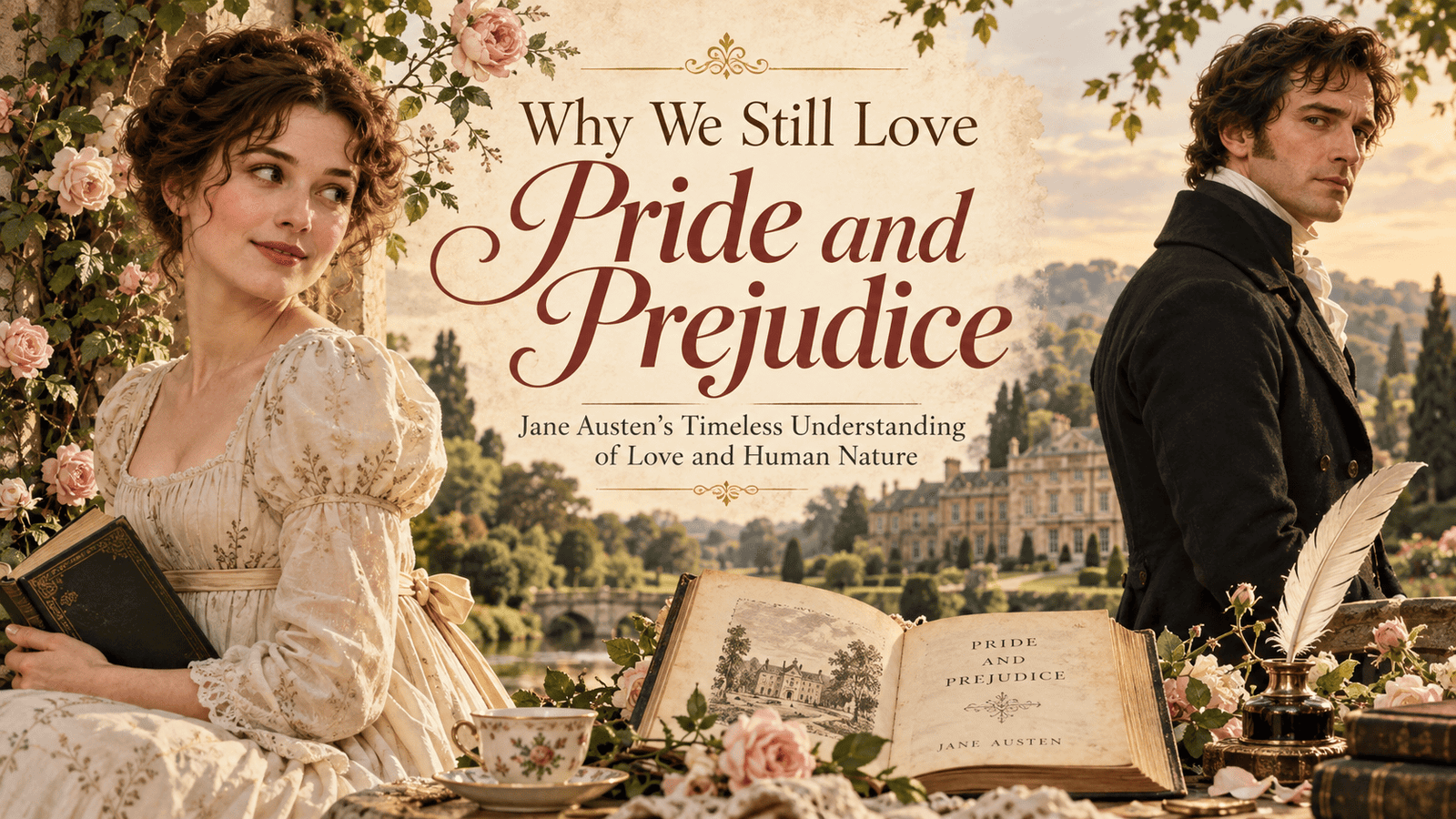
Jane Austen's Pride and Prejudice is one of those rare novels that continues to feel remarkably alive, even more than two centuries after its original publication.
On paper, the story sounds fairly straightforward. A young woman meets a wealthy gentleman, dislikes him almost immediately, misjudges his character, and eventually discovers that love is considerably more complicated than her first impression suggested.
There are country estates, elaborate social gatherings, awkward conversations, interfering relatives, and an extraordinary amount of concern over who should marry whom.
Yet somewhere between Elizabeth Bennet's sharp observations and Mr Darcy's painfully awkward attempts at expressing affection, Austen created something that transcends its historical setting.
Perhaps that is because Pride and Prejudice was never simply about finding a suitable husband. It is a novel about how confidently people misunderstand one another, how easily pride disguises insecurity, and why falling in love sometimes requires admitting that you were wrong.
And really, how much has that changed?
A Love Story That Almost Didn't Exist
Before Elizabeth Bennet and Mr Darcy became two of literature's most recognisable characters, their story existed under a different title: First Impressions.
Jane Austen began drafting the novel in 1796, when she was just twenty years old. Her father attempted to interest a publisher in the manuscript in 1797, but the offer was declined.
Austen eventually returned to the story, extensively revising it during 1811 and 1812. On January 28, 1813, the finished novel was published by Thomas Egerton under the title we know today: Pride and Prejudice.
Interestingly, Austen's original title tells us quite a lot about the story she wanted to tell.
First impressions are practically responsible for everything that goes wrong between Elizabeth and Darcy. Their earliest encounters leave both convinced that they understand the other person perfectly.
They do not.
And watching them slowly discover this becomes one of the novel's greatest pleasures.
Elizabeth Bennet: A Heroine Who Refuses to Be Convenient
One reason Pride and Prejudice remains so engaging is Elizabeth Bennet.
She is intelligent, funny, outspoken, occasionally stubborn, and far from interested in making herself agreeable simply because society expects her to.
What makes Elizabeth especially compelling, however, is that Austen does not present her as flawless.
Elizabeth prides herself on understanding people. She believes she can recognise insincerity, arrogance, and foolishness almost immediately.
Unfortunately, her confidence in her own judgement becomes one of her greatest weaknesses.
When George Wickham offers her an explanation of Darcy's supposedly unpleasant character, Elizabeth is quick to believe him. His charm fits comfortably with what she already wants to think.
Darcy, meanwhile, struggles to escape the impression created by his own social awkwardness and apparent arrogance.
It is a wonderfully human situation.
How often do we accept information simply because it confirms an opinion we have already formed?
Elizabeth's journey is not about abandoning her independence or becoming a different person for the sake of romance. It is about developing enough self-awareness to recognise when her judgement has failed her.
Austen allows her heroine to be perceptive and mistaken at the same time.
That makes her much more interesting than a character who is always right.
Mr Darcy and the Appeal of a Difficult Character
If Elizabeth provides much of the novel's energy, Fitzwilliam Darcy provides its tension.
At first, he is hardly an obvious romantic hero.
He appears distant, excessively conscious of social position, and thoroughly unimpressed by the people around him. His behaviour at the Meryton assembly gives Elizabeth very little reason to think kindly of him.
Yet Darcy gradually becomes one of the most interesting characters in the book, not because Austen reveals that his faults never existed, but because he is forced to confront them.
His disastrous first proposal is especially revealing.
Darcy believes he is declaring his love, but he manages to express it while simultaneously drawing attention to Elizabeth's inferior social connections and the difficulties of marrying her.
It is spectacularly poor romantic communication.
Elizabeth's refusal forces him to recognise something uncomfortable: good intentions do not excuse hurtful behaviour, and believing yourself honourable is not the same as treating others well.
What follows is a quieter, more convincing form of character development.
Darcy begins to change his behaviour without expecting Elizabeth to immediately reward him for doing so.
He becomes more considerate toward her relatives, handles difficult family circumstances with discretion, and demonstrates qualities that his original manner had concealed.
The eventual romance works because both characters must reconsider themselves before they can properly understand each other.
Love is not presented as a magical cure for their shortcomings. It becomes possible through their willingness to acknowledge them.
Marriage Was Never Just About Romance
It is easy to approach Pride and Prejudice as a charming historical romance and overlook the financial anxiety beneath its elegant surface.
For the Bennet sisters, marriage is not merely a matter of finding someone attractive.
Their family estate, Longbourn, is entailed away from the daughters, meaning they cannot inherit it under the arrangement governing the property.
Their futures are consequently uncertain, especially given the limited economic independence available to women of their social position.
Mrs Bennet's endless obsession with marrying off her daughters may be funny, but her anxiety has a very real foundation.
This context makes Charlotte Lucas one of the novel's most fascinating characters.
Charlotte accepts Mr Collins's proposal despite recognising that he is hardly an ideal romantic partner.
Elizabeth is shocked by her friend's decision. She cannot imagine willingly marrying someone she does not love.
Charlotte, however, understands her own circumstances differently.
At twenty-seven, without considerable wealth or especially promising marriage prospects, she views the arrangement as an opportunity for stability.
It is tempting to dismiss Charlotte's choice as unromantic, but Austen makes the reader confront a more difficult question.
How freely can someone choose love when financial security depends upon marriage?
Elizabeth's idealism and Charlotte's pragmatism exist side by side. Neither woman is foolish for understanding her circumstances through a different lens.
That tension gives the novel a social depth that is sometimes lost when the story is reduced to pretty dresses and romantic declarations.
Jane Austen Understood the Comedy of Human Behaviour
Austen's humour deserves far more attention than it sometimes receives.
She has an extraordinary ability to expose a character's personality through conversation alone.
Mr Collins, for example, is almost painfully convinced of his own importance. His admiration for Lady Catherine de Bourgh is so excessive that practically every interaction becomes an opportunity to remind everyone of his influential patroness.
Lady Catherine herself is another wonderfully constructed personality.
She considers her opinions authoritative, her social position unquestionable, and other people's personal affairs entirely appropriate subjects for her intervention.
Then there is Mr Bennet, whose dry humour makes him entertaining company, even as his habit of withdrawing from family responsibilities reveals a less admirable side.
Austen rarely needs dramatic confrontations to expose people's absurdities.
Sometimes all she needs is an uncomfortable dinner conversation.
Her characters remind us that self-importance, vanity, gossip, social climbing, and the desire to appear more sophisticated than everyone else are hardly exclusive to nineteenth-century England.
Change the setting from an English drawing room to a modern social gathering, and many of these personalities would fit in without much difficulty.
Why the Romance Still Works
Modern romantic fiction frequently draws on misunderstandings, contrasting personalities, emotional restraint, and gradual changes in relationships.
Pride and Prejudice contains all these elements, but Austen's treatment of them is particularly satisfying.
Elizabeth and Darcy do not immediately understand each other. Their relationship grows through uncomfortable conversations, conflicting assumptions, embarrassment, and moments of unexpected kindness.
Even the famous first proposal is not a moment of romantic triumph.
It is a disaster.
That matters because it prevents their eventual reconciliation from feeling automatic.
The affection between them becomes more convincing as they begin to see beyond the versions of each other they initially imagined.
Austen also understands the importance of conversation in romantic storytelling.
Their exchanges are rarely empty. A seemingly casual remark can reveal wounded pride, attraction, amusement, or resentment.
There is a constant sense that both characters are listening for something beneath the words being spoken.
And perhaps that is one reason readers become so invested in their relationship.
The romance is not built solely on grand gestures. It develops through attention, understanding, and changed behaviour.
The Book Is About More Than Pride or Prejudice
The title invites us to think about two distinct faults, but Austen is far too observant to assign one neatly to each protagonist.
Darcy is proud, certainly, but Elizabeth is not immune to pride herself.
Similarly, Elizabeth's prejudice against Darcy becomes obvious as the story progresses, yet Darcy also makes assumptions about people according to their family, manners, and social standing.
Both characters are guilty of allowing their existing beliefs to interfere with their ability to see clearly.
Their eventual growth depends on recognising that problem.
This is what elevates the novel beyond a straightforward romance.
Austen is interested in the sometimes uncomfortable process of learning that our understanding of other people may be incomplete.
She also reminds us that intelligence does not automatically make someone fair-minded.
A clever person can still be deceived.
A wealthy person can still be insecure.
A charming person can still behave dishonestly.
And someone who makes a terrible first impression may have qualities that are not immediately visible.
These observations have lost remarkably little of their relevance.
Why New Readers Should Still Pick It Up
For someone who has never read Austen, Pride and Prejudice can initially seem intimidating.
Its reputation as a major literary classic, its historical language, and the enormous amount of discussion surrounding it can create the impression that reading it must be some kind of academic undertaking.
It really doesn't have to be.
Approach it as a social comedy about an outspoken young woman, an awkward wealthy gentleman, and a family determined to complicate everyone's lives.
Pay attention to the dialogue.
Notice how often Austen allows a character to reveal more than they intended.
And don't worry about admiring Elizabeth or Darcy immediately. Part of the pleasure lies in allowing your opinion of them to develop alongside the story.
The novel also rewards rereading.
A first reading may focus heavily on the central romance. A second can reveal how carefully Austen constructs the surrounding relationships, particularly Charlotte's marriage, Jane and Bingley's gentler romance, and the contrasting personalities within the Bennet family.
There is far more happening beneath the surface than the familiar love story might suggest.
A Literary Legacy That Continues to Grow
Austen did not live to witness the full extent of her novel's cultural influence.
She died in 1817, only four years after Pride and Prejudice appeared in print.
Since then, her characters have travelled far beyond the pages of the original novel.
The story has inspired numerous adaptations, reinterpretations, and modern retellings, including the celebrated 1995 BBC television adaptation and the 2005 film starring Keira Knightley and Matthew Macfadyen.
Every generation seems to find another reason to return to Elizabeth Bennet and Mr Darcy.
Some readers come for the romance. Others appreciate Austen's wit, her observations about class, or the independence of her heroine.
The interesting thing is that the book comfortably accommodates all these interpretations.
You can enjoy Pride and Prejudice as a love story without ignoring its social commentary. You can appreciate its literary craftsmanship without turning every chapter into an academic exercise.
That flexibility is one of its greatest strengths.
Final Thoughts: Some Stories Simply Understand Us
What makes Pride and Prejudice special is not that its characters are unusually perfect or that its romance offers an escape from every difficulty.
Quite the opposite.
Its characters are proud, insecure, opinionated, occasionally ridiculous, and often mistaken about the people around them.
They worry about their futures. They want to be respected. They struggle to communicate what they feel, and sometimes confuse what they want to believe with what is actually true.
Jane Austen understood these contradictions and wrote about them with extraordinary warmth and precision.
Perhaps that is why the distance between 1813 and the present can seem surprisingly small when we open her novel.
The clothes have changed. So have the social rules and expectations surrounding marriage.
But the experience of meeting someone, deciding we know everything about them, and discovering how wrong we were?
That remains as familiar as ever.
And somewhere in that uncomfortable space between pride, prejudice, and genuine understanding, Austen found a story that readers continue to make their own.
Sources / References
Publication history and literary context were checked against these references. Interpretive commentary is Epiloguely's editorial analysis.
- Jane Austen's House — Pride and Prejudice — Historical context and themes.
- Jane Austen's House — How First Impressions Became Pride and Prejudice — Draft, revision and publication history.
- Jane Austen's House — The Brilliance of Pride and Prejudice — John Mullan on dialogue and characterisation.
- Project Gutenberg — Pride and Prejudice — Original novel text.
- Jane Austen's House — Publication — First edition and publisher context.