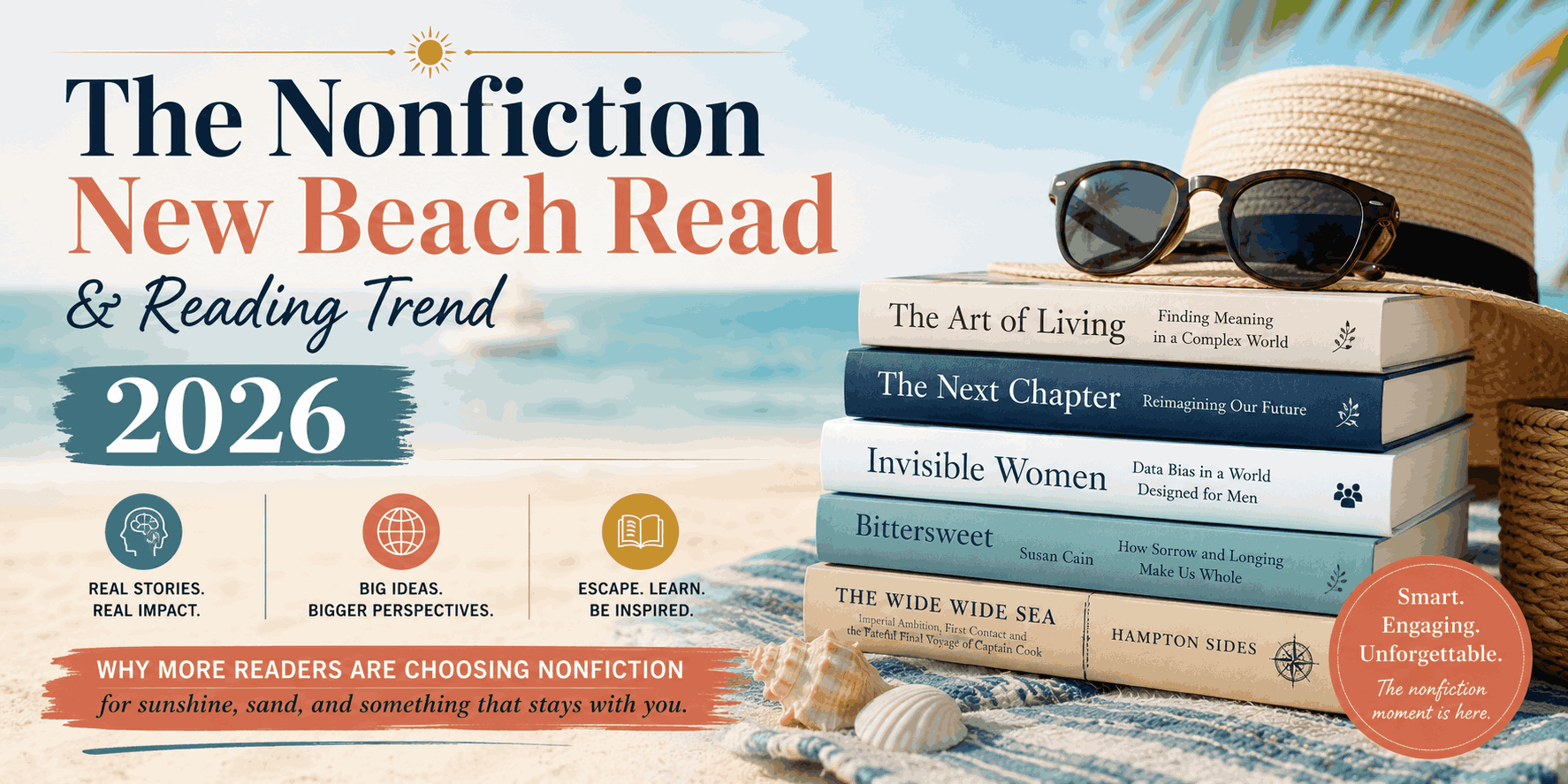
i want to tell you about something i noticed last summer. i was at a beach on the west coast of India, the kind of place where everyone used to be reading a thriller or a romance novel. and i looked around at what the people nearby had in their hands. a history of the Ottoman Empire. a memoir about a chef who spent a year in Japan. a book about the science of sleep. and someone, i swear, was reading a 400-page narrative history of the spice trade and they looked extremely happy about it.
something is shifting in how people choose what to read and i do not think it is subtle any more. the old story was simple — fiction for pleasure, nonfiction for work or self-improvement. you read a novel on holiday and a business book on a flight to a meeting. but that division is breaking down and it has been for a while, and in 2026 it feels like we have crossed some kind of line. nonfiction is not homework anymore. it is entertainment. it is the thing people want when they have actual free time.
i have been thinking about why this is happening and i think the answer involves attention spans and algorithms and the world feeling overwhelming and a generation of writers who figured out how to make true things as gripping as invented ones. this piece is my attempt to work through it. it is not an argument against fiction. it is a look at what is actually happening in reading culture in 2026 and what it might tell us about what people need from books right now.
📈
The shift
Nonfiction gaining ground on bestseller lists globally
🧠
New category
"Intellectual entertainment" replacing light reading
🏖️
The trend
Nonfiction appearing on summer and beach read lists
📖
Genres rising
Memoir, narrative history, essays, popular science
🌍
Who is reading
Younger readers aged 25 to 40 driving the shift
💬
Driven by
Social media, world events, attention economy fatigue
nonfiction used to feel like vegetables. you ate them because you were supposed to. somewhere along the way people started actually wanting them. and now the vegetables are getting rave reviews on BookTok and showing up at the beach.
on why the fiction vs nonfiction divide is collapsing
15%
increase in fiction sales in the UK in 2025, driven by BookTok and romantasy
11/19
territories where book revenue grew in 2025 according to NielsenIQ data
80%
of first graders chose nonfiction when picking their own books in a US study
2026
the year nonfiction started appearing regularly on summer beach read lists
🔥 8 Reasons Nonfiction Is the Read of 2026
Cultural shift
Key driver
i think this is the root of it. there is a feeling among a lot of readers that reality has become so chaotic and strange and fast-moving that invented stories feel almost tame by comparison. when the actual news contains things that would have been rejected as too implausible in a thriller manuscript, readers start turning to nonfiction not as an escape but as a way to understand what is actually happening. books about political history, about how institutions fail, about the psychology of belief and manipulation — these feel useful in a way that a lot of contemporary fiction does not. i am not saying fiction cannot do this too. but nonfiction has a different relationship with fact and readers right now are hungry for something grounded. they want to understand the world they are actually living in and nonfiction is where you go for that.
the current moment is producing some extraordinary narrative nonfiction precisely because there is so much to make sense of. writers like Robert Caro showed a generation that political history could be as gripping as any novel. that lesson has been taken seriously.
The craft shift
Publishing trend
the nonfiction of twenty years ago was often exactly what people feared — dry, structured, informational. you read it to learn something specific and you put it down when you had. the nonfiction being written now is different. writers like Casey Cep, Patrick Radden Keefe, Katherine Boo and Michael Lewis figured out how to take true stories and structure them like novels — with characters and tension and scenes and an ending that lands. this is not a gimmick. it is a set of craft decisions that makes the reading experience feel completely different from what nonfiction used to be. when a book about a financial scandal reads like a thriller, or a memoir about a family's secrets reads like a literary novel, the old genre labels start to feel pretty meaningless.
the best narrative nonfiction writers right now are doing something technically very difficult — telling true stories with novelistic momentum while keeping the facts intact. that combination is what the market is rewarding.
Say Nothing
Patrick Radden Keefe
a true crime book about the Troubles in Northern Ireland that reads like a novel. one of the best things i have read in years.
Behind the Beautiful Forevers
Katherine Boo
Pulitzer Prize-winning nonfiction about life in a Mumbai slum that feels more vivid than most fiction i have read about India.
The Feather Thief
Kirk Wallace Johnson
a true story about a man who broke into a natural history museum to steal Victorian fly-tying feathers. completely absurd and completely gripping.
Backed by data
Slow reading movement
there is a pattern i keep seeing in how people talk about why they read now and it goes something like this. they spend most of their day in short-form content. videos, posts, threads, clips. everything optimised for the first three seconds. and after enough of that a lot of people find themselves wanting something that asks them to stay. to sit with an idea for more than a paragraph. to follow an argument over a hundred pages and see where it goes. nonfiction tends to reward this more explicitly than fiction does because you finish a nonfiction book and you feel like you learned something, understood something, held something new in your mind. that feeling is increasingly valuable to people who feel like their brain has been in shallow water all day. slow and intentional reading has become almost countercultural and nonfiction is where a lot of that impulse is landing.
reading trend reports from late 2025 noted that readers across multiple markets were seeking longer, more reflective books as a conscious counter-move against constant digital noise. nonfiction fits that impulse very naturally.
Genre explosion
Social media effect
if i had to point to one nonfiction genre that single-handedly dragged the whole category into the mainstream it would be memoir. not celebrity memoir — though that has its own huge market — but personal writing by non-famous people about lives that turned out to be more interesting and more universal than fiction. Educated by Tara Westover. When Breath Becomes Air by Paul Kalanithi. Hunger by Roxane Gay. Between the World and Me by Ta-Nehisi Coates. these books sold millions of copies and they were talked about on social media the same way novels were. they had moments and passages that went viral. they made people feel seen in a way that a lot of contemporary fiction was not managing. and they opened a door for a whole generation of writers to tell their own true stories with real literary ambition behind them.
the success of memoir as a crossover genre proved that readers do not need a story to be invented for it to feel intimate and surprising and necessary. that is the whole argument for nonfiction in one genre.
Educated
Tara Westover
raised by survivalist parents in rural Idaho with no school, she went on to get a PhD from Cambridge. one of the most remarkable life stories i have read.
When Breath Becomes Air
Paul Kalanithi
a neurosurgeon diagnosed with terminal cancer writes about mortality, meaning and what makes life worth living. devastating and beautiful.
The Glass Castle
Jeannette Walls
a memoir about growing up with wildly irresponsible parents that manages to be funny and tragic in equal measure. i read it in one day.
Social reading
Conversation starter
this sounds a bit cynical and i do not mean it to be. but there is something real here about why people read nonfiction that does not always get named directly. when you read a great nonfiction book you end up knowing something. you come away with facts and arguments and a framework for thinking about something that you did not have before. and that is genuinely useful in the social world. it gives you things to say, references to make, ideas to introduce. reading a history of the Roman Empire or a book about how the human brain forms memories is pleasurable and it also fills you with material you can use. that is not a shallow reason to read. the desire to understand the world better and be able to talk about it is a good and human thing and nonfiction serves it more directly than fiction does.
the most recommended nonfiction on social platforms tends to be books that give you a new framework for something — a new way to see history, or science, or your own psychology. that transferability is a real part of the appeal.
Genre evolution
Reaction to hustle culture
for a long time self-help was the part of nonfiction that made other nonfiction readers slightly embarrassed about the whole category. books that promised to change your life in five steps were everywhere and most of them were essentially the same book with a different cover. what has happened in recent years is that a more nuanced and honest version of self-help has grown up alongside that. books that blend personal essays with psychology research, that admit to uncertainty, that respect the reader's intelligence enough to not offer easy answers. reading trend analyses for 2026 describe readers wanting self-help that is calm and realistic rather than prescriptive and hype-driven. that is a meaningful shift and it has produced genuinely good books that sit somewhere between essay collection, memoir and popular science in a way that feels exciting and new.
the overlap between essay writing, psychology, memoir and what used to be called self-help is producing some of the most interesting nonfiction being written right now. the genre label is almost beside the point at this stage.
Science communication
Growing category
popular science has been getting better for decades and i think we are now in a golden age of it. books that take genuinely difficult ideas about physics, neuroscience, evolution, climate, mathematics and make them not just understandable but actually exciting and literary. writers like Oliver Sacks showed one generation this was possible. Carlo Rovelli, Mary Roach, Ed Yong, Siddhartha Mukherjee — these are writers who bring the same care to their sentences that novelists bring to theirs. a book like The Gene by Mukherjee or I Contain Multitudes by Ed Yong is not a simplified version of the science for people who cannot handle the real thing. it is the real thing made into literature. and readers are finding these books and recommending them with a real passion that does not feel like obligation.
if you have not read popular science in a while go find Ed Yong or Carlo Rovelli or Mary Roach. these are writers who will make you feel the same way a great novel makes you feel and you will also understand something about the world you did not understand before.
I Contain Multitudes
Ed Yong
about the microbes that live in and on every living thing. reads like a thriller. completely changed how i think about what an organism even is.
Seven Brief Lessons on Physics
Carlo Rovelli
80 pages. explains the biggest ideas in modern physics in a way that is genuinely beautiful and does not talk down to you once.
The Emperor of All Maladies
Siddhartha Mukherjee
a biography of cancer. Pulitzer Prize winner. sounds heavy and it is but it is also one of the most compelling things i have ever read.
Beach read trend
Culture marker
the clearest evidence that something has changed is what shows up on the beach and holiday reading lists now. these lists used to be entirely fiction — thrillers, romances, commercial novels, the kind of thing you could finish in two days and leave on the sun lounger for the next person. look at what the big curators are putting on their summer lists in 2026 and you will find memoirs, essay collections, narrative histories, popular science and even a few books about the environment and climate that would have been called too serious for a beach list five years ago. the Good Trade's summer reading list this year included David Foster Wallace essays and Roxane Gay's Hunger alongside its fiction picks. that crossover would not have happened ten years ago. the category of beach read is expanding and nonfiction is moving into it with real confidence.
when beach read lists start including essays and narrative nonfiction regularly it is not an accident or an editorial quirk. it is a signal that the readers asking for recommendations have already moved in this direction and the curators are following them.
📊 Fiction vs Nonfiction in 2026 — What the Moment Looks Like
i want to be clear that this is not a competition. fiction is doing extraordinary things right now — the BookTok effect on literary fiction and romance and fantasy has been genuinely remarkable. but the comparison is useful for understanding what each is doing for readers in this specific moment.
| Fiction in 2026 |
vs |
Nonfiction in 2026 |
| Massive BookTok and social media momentum especially in fantasy, romance and romantasy |
reach |
Growing steadily through word of mouth, podcast recommendations and longform cultural writing |
| Offers emotional escape and imaginative worlds when reality feels too heavy |
appeal |
Offers tools to understand and process the actual world readers are living in right now |
| Beach reads, fast reads, serialized reads — high volume and high pleasure |
pace |
Slower, more deliberate, rewards rereading and reflection — fits the counter-movement against fast content |
| Romance and fantasy are the dominant growth categories driven by younger readers |
who reads |
Skews slightly older but the 25 to 40 age group is picking up narrative nonfiction in growing numbers |
| Literary fiction still produces the most critically acclaimed and prize-winning work |
prestige |
Biography and narrative nonfiction have become as prize-worthy as literary fiction — see Plutarch, Baillie Gifford, Pulitzer |
| You carry the story inside you as something you lived briefly rather than something you know |
what stays |
You carry the knowledge, the framework, the argument — something you can use and explain and build on |
💬 What This Actually Means for How You Read
i am not going to tell you to read more nonfiction. you should read whatever makes you want to keep reading and whatever makes you feel something real when you are done. but i do want to push back against the idea that nonfiction is the serious choice and fiction is the fun one. that was always a false distinction and in 2026 it has more or less completely collapsed.
the most pleasurable reading experience i had in the last six months was a narrative history about the construction of the Brooklyn Bridge written in 1983 that reads like a novel. the most educational experience i had was a novel set during the partition of India that taught me more about that event than any textbook i had read. the categories are porous and always were. what matters is the quality of the writing and whether it does something to you.
what i think the nonfiction trend actually represents is not a rejection of fiction but an expansion of what people consider entertaining. readers — especially younger readers who grew up with infinite content competing for their attention — are increasingly asking a single question about a book which is whether it is worth their time. and they are deciding that a beautifully written history of a disease, or a memoir about grief, or an essay collection about race and identity, can be just as worth their time as a thriller or a romance novel. that is a good development for everyone who writes and everyone who reads.
a note on the data — it is more complicated than "nonfiction is winning"
the actual sales picture is genuinely mixed. NielsenIQ data from the first eight months of 2025 showed nonfiction sales declining in many territories even as fiction — particularly crime, thriller and fantasy — surged. in the UK, fiction had its best year ever in 2024 driven almost entirely by BookTok. so if you are looking at raw sales figures nonfiction is not outselling fiction. what is happening is something more cultural than commercial — nonfiction is gaining in perceived status, in summer reading recommendations, in the kind of reading that gets talked about seriously. it is becoming the reading that educated people signal and aspire to in a way it was not five years ago. that is a real shift even if the sales charts tell a more complicated story.
📚 Explore Our Nonfiction Collection
whether you enjoy memoir, narrative history, popular science or essays, explore more nonfiction recommendations and reading guides on the Epiloguely blog.
Explore More Blog Posts →