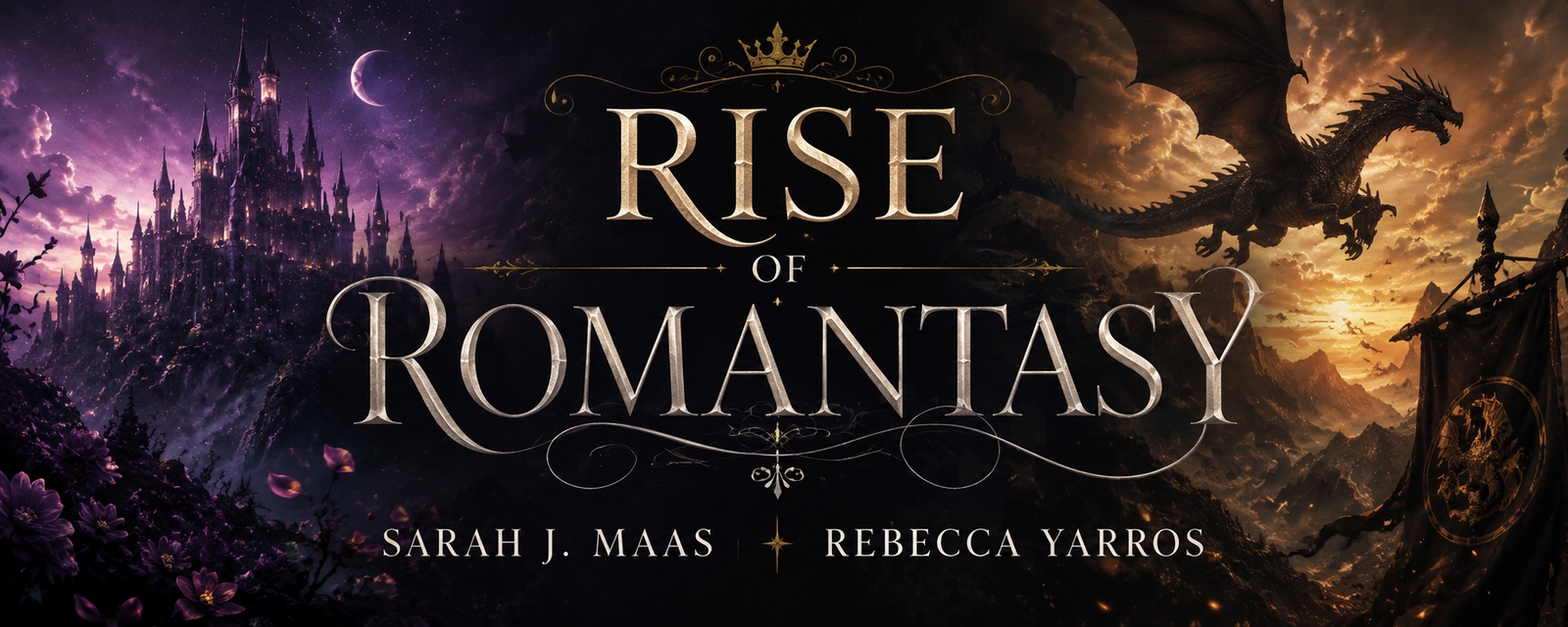
Sarah J. Maas and Rebecca Yarros did not create fantasy romance. Their real impact was making romance a central engine of mainstream fantasy, then proving that readers would turn long fantasy series into social events, collector culture and huge backlist sales.
For years, fantasy books could contain love stories without being sold as romance. Romance novels could use magic without being welcomed fully onto the fantasy shelf. The two readerships met often, but publishing kept trying to separate them. Romantasy gave that overlap a name readers could search, share and recognise in a few seconds.
Sarah J. Maas and Rebecca Yarros became the two names most closely tied to that shift. Maas built a huge, patient readership around fae courts, long emotional arcs and heroines whose desires matter as much as the war around them. Yarros arrived later with dragons, a deadly military academy and the pacing of a modern romance thriller. One built the bridge over many years. The other showed how much traffic was waiting to cross it.
What interests me is not the easy claim that these writers made fantasy sexier. The deeper change is that they altered what readers expect fantasy to do. A magical world is no longer enough for this audience. The relationship must move, wound, heal and change the direction of the plot. At the same time, the romance cannot float in an empty setting. The political danger, magic system and battles must place real pressure on the couple.
Romantasy was here before the label took over
It would be unfair to tell this story as if fantasy discovered romance in the 2010s. Fairy tales have always tied magic to courtship, marriage and danger. Gothic fiction mixed desire with supernatural fear. Writers such as Emma Bull, Anne Bishop, Sharon Shinn, Jacqueline Carey, Nalini Singh and Ilona Andrews were joining fantasy plots with major romantic arcs long before the word romantasy became a marketing shortcut.
The books were simply divided across older labels. Some were called romantic fantasy. Some were paranormal romance or urban fantasy. Some were placed in young adult sections even when much of the readership was older. The current boom did not begin with a new idea. It began when readers, booksellers and publishers started treating the overlap as a category of its own.
The new part was not romance inside fantasy. The new part was the market finally admitting how many readers wanted both at full strength.
Epiloguely editorial viewSarah J. Maas built the bridge
A Court of Thorns and Roses begins with a familiar fairy-tale shape, but the series soon becomes much larger than a single retelling. Its lasting power comes from escalation. Each book widens the world while moving the emotional centre. Alliances change. A relationship that once looked final can be questioned. A side character can move to the front. Trauma is not left behind when the battle ends.
That structure taught publishers something useful. Readers would stay for a long fantasy series when each volume offered both an external conflict and a strong emotional promise. They were not choosing between plot and romance. They wanted the two to push against each other.
Maas also helped make the backlist feel alive. New readers did not need to arrive on publication day. They could discover one scene or one couple online, buy the first book and then move through an entire catalogue. Bloomsbury reported that sales of Maas titles rose 161 percent in its financial year ending February 2024. The publisher now says her books have sold more than 75 million copies and appear in 40 languages.
For me, this is her biggest effect on the genre. She made emotional continuity as important as world continuity. Fans remember courts, creatures and magical rules, but they also remember who felt safe with whom, who betrayed whom and which character finally learned to ask for help. That kind of attachment gives a fantasy series a life far beyond its first release.
Rebecca Yarros turned the boom into an event
Fourth Wing was published on May 2, 2023. Its pitch was easy to understand. A physically vulnerable young woman is forced into a brutal dragon-rider college where failure can mean death. She must survive training, political secrets and a dangerous attraction to a man she has every reason not to trust.
The book did not ask romance readers to study a huge fantasy history before feeling something. Violet's immediate problem is clear, the voice is direct and every chapter carries a threat. The dragons supply wonder. The academy supplies a competitive structure. The romance supplies uncertainty and emotional risk. Yarros made the entry point feel fast even when the book itself was large.
The release pattern added to that urgency. Iron Flame followed on November 7, 2023, only six months after the first book. Onyx Storm arrived on January 21, 2025. Special editions, decorated edges, fan theories and cliffhangers became part of the experience. Buying the book was not separate from joining the conversation.
Publishers Weekly reported in October 2024 that five books by Maas and Yarros sat in the top ten of its overall and adult bestseller lists for the year to that point. Together, the two authors had sold 3.65 million print copies in the tracked period. That number matters because it shows the boom was not attached to one new release. It covered multiple books and older titles at once.
Yarros did for the launch moment what Maas had done for the backlist. She showed that a romantasy sequel could be treated like a major cultural appointment, with readers planning around the release and discussing the ending almost immediately.
Two different engines of the same change
The two writers are often placed beside each other, but their books do not offer the same reading experience. That difference helped the genre grow. Readers could enter romantasy through a lush fae court or a deadly dragon academy and still understand the common promise.
| Area | Sarah J. Maas | Rebecca Yarros |
|---|---|---|
| Reader hook | Fae courts, mythic threats, found family and relationships that change across long arcs. | Dragons, military training, immediate danger, fast attraction and hard cliffhangers. |
| Pacing | Often builds through long emotional and political shifts that reward series commitment. | Uses short-term survival pressure and frequent turns to keep the story moving quickly. |
| Romantic effect | The reader may reassess earlier relationships as the heroine changes and learns more. | Trust and secrecy keep the central relationship unstable even after attraction is clear. |
| Publishing effect | Proved that a large fantasy backlist could keep gaining new readers through fandom. | Proved that romantasy could create rapid sellouts, collector demand and event releases. |
| Gateway reader | Readers who enjoy immersive worlds, long arcs and emotionally connected ensembles. | Readers who want romance pacing, visible stakes and a clear fantasy concept from page one. |
What changed inside fantasy books
Romance became structural
The central relationship is no longer a reward waiting after the quest. It changes alliances, reveals secrets and can decide who survives the larger conflict.
Emotion gained equal weight
A battle can matter as much for what it does to trust as for which army wins. Recovery and intimacy are allowed to take real page space.
Female desire moved to the centre
The heroine is not only chosen, protected or admired. Her attraction, anger, ambition and judgement shape the fantasy world around her.
Fantasy became easier to enter
A clear romantic promise gives new fantasy readers an emotional path through unfamiliar maps, politics, creatures and magic systems.
None of these ideas belong only to Maas or Yarros. Their influence comes from scale. Once millions of readers responded to the same mix, publishers started looking for it more openly. Book descriptions began naming tropes. Covers moved between dark fantasy symbols and romantic luxury. A book could be sold through its magical conflict and its central couple in the same sentence.
What changed outside the books
The romantasy boom is also a story about how books are found. BookTok did not create the readership, but it made emotional recommendation unusually powerful. A short video could focus on a betrayal, a line of dialogue, a favourite character or the feeling of finishing a cliffhanger. The viewer did not need a formal review. They only needed to want that feeling too.
This rewarded series with visible emotional moments and strong fan identities. It also rewarded backlists. A ten-year-old title could sit beside a new release because the algorithm cared about reaction, not publication season. That is one reason Maas became even bigger years after the first ACOTAR book appeared.
The physical book changed too. Decorated edges, alternate covers, exclusive chapters and matching hardback sets turned ownership into part of fandom. Red Tower's official material for the Empyrean books treats edge design and matching editions as details readers actively track. The book is still the main object, but the edition now tells other fans how closely someone follows the series.
By March 2026, coverage of the new official BookTok chart in the UK named Maas and Yarros as central examples of the platform's sales power. That matters because an informal recommendation culture had become organised enough to receive its own chart. The industry is no longer watching from a distance. It is building systems around the behaviour.
The criticism romantasy cannot ignore
Success creates imitation. Once publishers know readers respond to enemies-to-lovers tension, shadow powers, dangerous trials, fae courts and dragons, the market can start repeating the visible parts without understanding why the original book connected. Trope labels can become a substitute for character work. Decorative edges can become more polished than the story inside them.
There is also a risk that one commercial style gets treated as the whole genre. Romantic fantasy can be quiet, queer, funny, tragic, culturally specific or almost free of explicit sex. It can come from writers working far outside the Maas and Yarros model. A healthy shelf should not make every heroine sound the same or every love interest carry the same mix of danger, secrecy and perfect physical power.
A fair concern
Publishers Weekly reported industry worries in 2024 that letting BookTok decide too much could keep the same few books circulating while less familiar voices struggle to be discovered. I think that is the central test for romantasy now. The genre has proved its commercial strength. Its next job is to prove how many different kinds of stories can fit inside it.
The label can help readers find what they love. It can also flatten meaningful differences between fantasy with a romance subplot and a true genre romance set in a fantasy world. Readers do not always agree on where that line sits. That argument is not a weakness. It shows the category is still being formed in public.
Did they really change fantasy forever
Forever is a difficult word when a publishing trend is still moving. Sales can cool. Readers can tire of familiar tropes. In 2025, US print romance sales still grew while fantasy sales dropped from the unusual height reached a year earlier. A boom can settle without disappearing.
The changes that look hardest to reverse are larger than one year's chart. Romance readers are now treated as a core fantasy audience. New adult fantasy has clearer commercial space. A fantasy backlist can become current again through online fandom. Physical editions are designed as community objects. Publishers can no longer assume that epic stakes and open desire belong in separate books.
Maas and Yarros did not replace traditional fantasy. They widened the centre of it. Readers who once felt that fantasy asked them to wait patiently through politics and lore before reaching the emotional story can now find books built around both. Readers who entered for the romance may stay for dragons, maps, courts and war. That exchange is the lasting change.
Maas made readers live in the world for years. Yarros made them rush to the door on release day. Together, they changed what a fantasy phenomenon looks like.
The lasting romantasy effectA final thought
I do not think every fantasy novel needs a central love story, and I do not think every romance becomes richer when magic is added. The useful lesson from romantasy is simpler. Readers do not separate emotion from imagination as neatly as publishing categories once did.
The best romantasy books understand that falling in love inside a dangerous world should change both parts of the story. The magic makes intimacy harder. The intimacy makes power more dangerous. When that balance works, the result is not half romance and half fantasy. It is one story that needs both.
Main research sources
Bloomsbury author page for Sarah J. Maas for current worldwide sales and language figures.
Official A Court of Thorns and Roses series page for the series description and current book list.
Entangled Publishing page for Fourth Wing and the publisher pages for Iron Flame and Onyx Storm for release information.
Publishers Weekly on 2024 romance and romantasy sales for bestseller and print sales figures.
Bloomsbury financial results for the year ending February 2024 for the reported rise in sales of Maas titles.
Publishers Weekly on BookTok and romance publishing for industry context around new adult fiction and the romantasy boom.
Red Tower's Wing and Claw editions information for the role of matching designs and decorated edges in the Empyrean collector experience.
Publishers Weekly on 2025 US print sales for the later movement in romance and fantasy categories.
The Guardian on the official UK BookTok chart for the continued place of Maas and Yarros in social reading culture.
Find Your Next Fantasy Read
Explore more fantasy, romance and literary discussions across Epiloguely when you are ready to enter another world.
Explore More Blog Posts