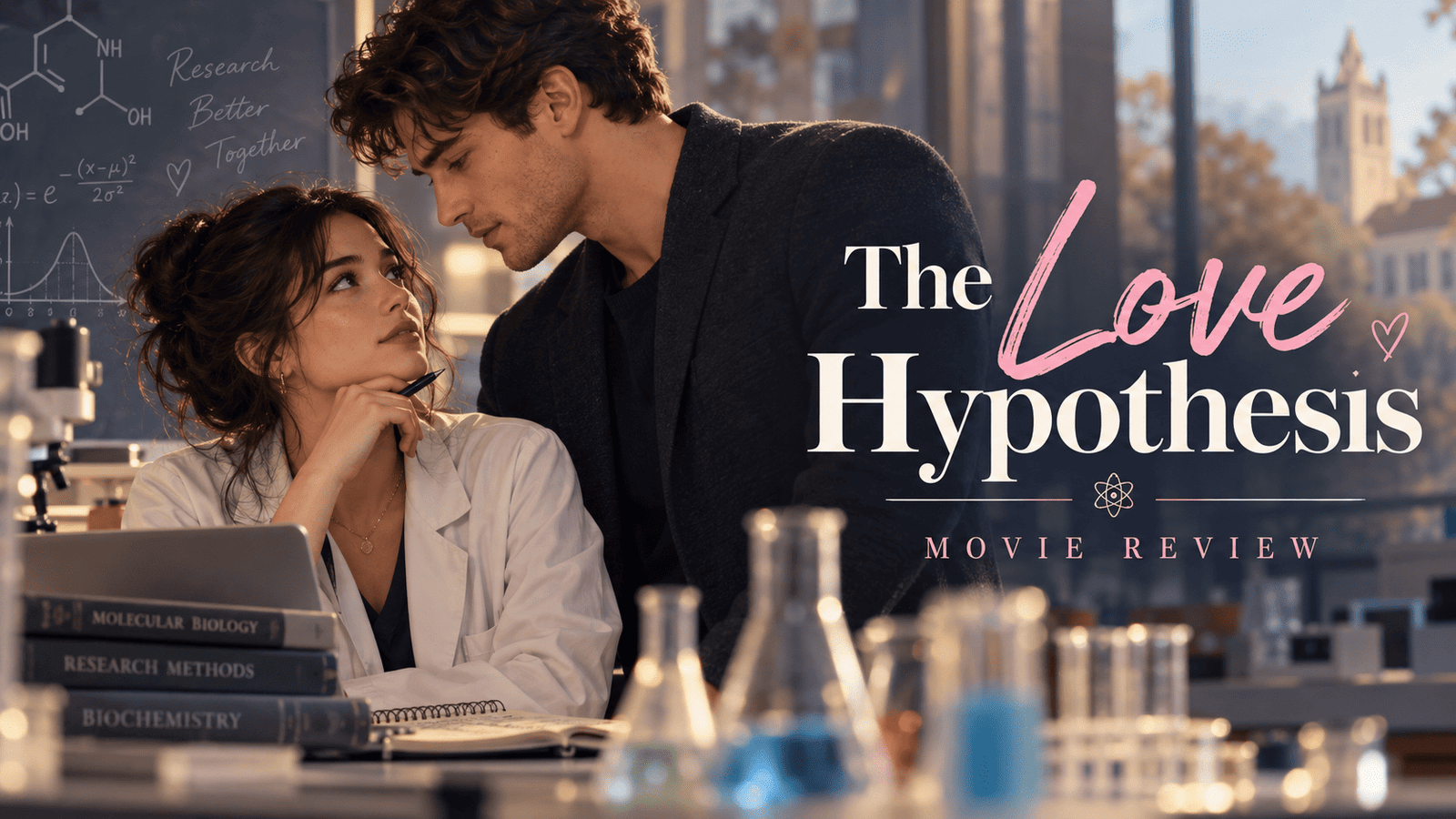
The Love Hypothesis always looked like a romance novel waiting to become a movie. Ali Hazelwood's 2021 bestseller has a clean high-concept setup, a heroine who can overthink a five-second conversation for five pages, an intimidating love interest with a reputation larger than his social skills, and the kind of fake-dating arrangement that practically comes with its own romantic-comedy soundtrack. Five years later, the adaptation has finally arrived on Prime Video.
Released globally on September 23, 2026, the film stars Lili Reinhart as Olive Smith and Tom Bateman as Dr. Adam Carlsen. Claire Scanlon directs from a screenplay by Sarah Rothschild, with the story remaining rooted in Hazelwood's original academic-romance world. The question for readers is not really whether the film remembers the book's famous ingredients. It does. The more interesting question is whether those ingredients still feel convincing once Olive's anxious internal monologue has to become facial expressions, awkward pauses and two hours of screen time.
What Is The Love Hypothesis Movie About?
Olive Smith is a Ph.D. candidate trying to build a future in science while being much less certain about relationships. When she realizes that her best friend Anh is interested in Jeremy, the man Olive had been seeing, Olive wants to make it absolutely clear that she has moved on. Her solution is impulsive, ridiculous and perfectly suited to a romantic comedy: she kisses the first man available.
That man happens to be Adam Carlsen, a professor with a fearsome reputation around the department. He is blunt, intimidating and not exactly known for making students feel relaxed. The kiss should have been one embarrassing moment Olive spends the next decade trying not to remember. Instead, circumstances give both of them a reason to continue pretending that they are together.
From there, the story moves through the familiar fake-dating rhythm: public appearances, carefully negotiated boundaries, inconvenient attraction and the slow realization that a relationship invented for other people is becoming emotionally real for the two people inside it. What gives the premise its particular identity is the academic setting. Labs, conferences, research ambitions and the insecure machinery of university careers are not just decoration. Olive's professional future matters almost as much to her as her romantic one.
The movie works best when it remembers that Olive is not simply waiting to fall in love. She is trying to become a scientist while learning how much uncertainty she can tolerate in the rest of her life.
Lili Reinhart Gives Olive the Right Kind of Nervous Energy
Olive is a tricky character to translate because a large part of her charm on the page comes from being trapped inside her own head. She is smart enough to understand complicated science and somehow still capable of constructing an entire emotional disaster from one half-finished sentence. In prose, readers get direct access to every bad assumption. On screen, that can easily turn into a character who just looks indecisive.
Lili Reinhart solves a good amount of that problem through timing. Her Olive feels bright and capable without suddenly becoming smooth or effortlessly confident. There is often a fraction of a second between something happening and Olive realizing she has made her situation worse, and Reinhart is good at making that tiny delay funny. She also gives the character enough warmth that the comedy does not erase the parts of Olive shaped by loneliness, ambition and fear of depending on other people.
The performance matters because the adaptation belongs to Olive more than anyone else. Even when the screenplay compresses material from the novel, Reinhart keeps the emotional logic visible. You understand why Olive says yes to a bad plan, why she continues it after the original excuse starts to disappear, and why admitting what she actually wants is far more frightening than pretending.
Tom Bateman's Adam Carlsen Has a Different Challenge
Adam is built around contradiction. Everyone else sees the terrifying professor; Olive gradually sees the quieter person beneath that reputation. In a book, that transition can happen slowly through small gestures and Olive's changing interpretation of them. A movie has less time, which means Adam's reserve has to communicate both distance and hidden affection without making him feel blank.
Tom Bateman leans into Adam's physical stillness and dry delivery. That suits the character, especially opposite Reinhart's more visibly nervous Olive. Their contrast produces some of the film's easiest comedy: she fills silence because silence makes her uncomfortable, while he seems perfectly happy to let a silence sit there until it becomes its own character.
Whether the romance completely lands will probably depend on what a viewer wants from this pairing. Readers already arrive with years of affection for Olive and Adam, so a glance or familiar scene can carry extra emotional weight. Viewers meeting them for the first time need the movie itself to build that intimacy. At points, the adaptation moves quickly enough that Adam's interiority feels thinner than Olive's, which makes the relationship slightly more dependent on the actors' chemistry than on what the screenplay gives him to say.
The Academic Setting Is More Important Than It Looks
One reason The Love Hypothesis became such a recognizable romance is that it did not place its love story in a generic office and then occasionally remind us the characters have jobs. Olive's science matters. Research funding matters. Academic hierarchy matters. The anxiety of wondering whether years of work will turn into a stable career matters.
The film keeps enough of that environment to give the romance texture. Rachel Marsh plays Anh, Olive's close friend and fellow Ph.D. candidate, while Jaboukie Young-White appears as Malcolm. Nicholas Duvernay plays Jeremy, and Arty Froushan plays Dr. Tom Benton. Together, the supporting cast prevents the movie from becoming a two-person bubble. Olive has friendships, loyalties and professional stakes that continue to exist when Adam is not in the room.
That is especially useful because contemporary romantic comedies sometimes rush so aggressively toward the couple that every secondary character becomes a delivery system for relationship advice. Here, the friend group helps preserve the feeling that Olive has a life she is trying to protect rather than an empty space waiting for romance to fill it.
How Closely Does the Movie Follow Ali Hazelwood's Book?
The broad shape is immediately recognizable: Olive, Adam, the impulsive kiss, the fake relationship, the Stanford-style academic environment and the emotional tension between professional vulnerability and romantic uncertainty. The adaptation clearly wants readers to feel that they are watching the story they remember rather than a loose reinvention that happens to borrow the title.
But a novel and a film create intimacy differently. Hazelwood can spend pages inside Olive's thought process, repeating a fear until readers understand exactly why she believes it. A movie cannot stop every few minutes for an internal essay, so some of those emotional steps become shorter. Scenes that felt enormous in the book may pass more quickly on screen because the adaptation has to keep moving.
That compression is not automatically a flaw. Some of the novel's appeal comes from repetition: Olive misreads Adam, worries, rationalizes, worries again and eventually reaches a conclusion the reader may have reached long before her. On screen, too much of that could feel static. The trade-off is that readers who loved the slow accumulation of tiny Adam-and-Olive moments may occasionally wish the movie stayed in a scene a little longer.
Fake Dating Still Works — Because the Movie Commits to It
Romance audiences have seen fake dating hundreds of times. The trope survives because nobody actually watches it for the practical logic. We watch it for enforced proximity and emotional irony: two people announce that nothing is real at exactly the moment everything starts becoming real.
The Love Hypothesis understands that pleasure. It does not spend its energy apologizing for being trope-driven or trying to disguise the structure as something more serious. Olive and Adam create rules; the rules become inconvenient; ordinary gestures begin to mean too much; the audience is allowed to know what is happening before at least one of the characters admits it.
There is a comfort to that predictability when the details are enjoyable. A romantic comedy is not a murder mystery. Knowing the destination does not ruin it. The fun is in whether the journey gives the characters enough specific personality that their version of the trope feels worth following.
Where the Movie Is Strongest
The easiest answer is tone. The film generally understands that Hazelwood's story is earnest without needing to become solemn. Science can be stressful, academia can be competitive and relationships can genuinely hurt, but the movie still has permission to be silly. That balance is important. If it treated every emotional beat with prestige-drama seriousness, the fake-dating premise would collapse under its own weight.
The second strength is Reinhart. She gives the adaptation a center even during scenes where the screenplay is moving too quickly. Rachel Marsh also brings energy to Anh and helps sell the friendship that motivates Olive's initial terrible decision. Those relationships make the movie feel less mechanical than a simple checklist of romance tropes.
And then there is the simple pleasure of seeing a BookTok phenomenon become concrete. Readers who have carried a mental version of Olive's lab, Adam's intimidating presence and the book's most quoted situations now get to compare that private adaptation with an official one. That alone will make the film an event for a large part of Hazelwood's audience.
Where It Feels More Rushed Than the Book
The inevitable weakness is compression. A romance built on gradual reinterpretation needs time. Olive has to move from "Adam is terrifying" to "Adam may not be terrifying" to "Adam is unexpectedly safe" before the story can ask her to confront deeper feelings. The novel has room for each stage to breathe.
The movie reaches the same emotional landmarks but sometimes with less space between them. That can make certain transitions feel more functional than lived-in, particularly if you are watching without the book's additional context already in your head. Adam also loses more from that compression because his appeal depends heavily on readers noticing the difference between how he appears publicly and how he behaves around Olive.
The final stretch is another place where the film has a lot to resolve: romance, career pressure, friendship and the consequences of professional power. None of that is minor for Olive, so fitting it into a conventional feature-length ending creates some hurry. The emotional intention remains clear, but readers may feel the difference between turning several chapters and watching a sequence of scenes close those same threads.
What Works
- Lili Reinhart captures Olive's awkward intelligence.
- The fake-dating setup remains playful and easy to follow.
- The science and academic setting give the romance identity.
- Supporting friendships keep Olive's world from feeling too narrow.
- Fans get many of the elements that made the novel a BookTok favorite.
What May Divide Readers
- Internal monologue naturally loses detail on screen.
- Adam can feel less fully developed than Olive.
- Some emotional transitions move faster than in the novel.
- The final act has several story threads to resolve quickly.
- Viewers who dislike familiar rom-com tropes may find it predictable.
Is The Love Hypothesis Worth Watching If You Have Not Read the Book?
Yes, especially if your idea of a good movie night involves a comfortable romantic comedy rather than a story trying to surprise you every ten minutes. You do not need any knowledge of the novel to understand Olive's situation, and the film introduces its central relationships cleanly enough for newcomers.
What a non-reader may experience differently is Adam. Book readers bring accumulated context to him. They know why certain small moments matter before the film has fully explained them. A first-time viewer has to build that understanding only from Bateman's performance and the screenplay. That makes the movie a useful test of the adaptation: the story still works, but some of the texture that made Adam such a popular romance character lives more comfortably in prose.
Is It Worth Watching If You Loved the Book?
For readers, the more useful expectation is not "Will this replace the novel?" It will not, and it does not need to. Adaptations are most interesting when they reveal what was doing the work in the original. Here, the film makes it obvious how much of Hazelwood's comedy comes from Olive's internal narration and how much of the romance depends on tiny changes in perception.
The movie gives those ideas a different rhythm. Some favorite scenes will inevitably feel shorter than they did in your head. Other moments may work better because an actor can communicate embarrassment or affection in one look that took a paragraph to describe. The pleasure comes from the comparison.
It also arrives at a moment when the book-to-screen pipeline is increasingly shaped by online reading communities. The Love Hypothesis did not become a major adaptation because it quietly sold a respectable number of copies. It became a phenomenon because readers talked about it, photographed it, argued about it, recommended it and turned Olive and Adam into recognizable names well beyond traditional romance spaces. The movie is, in that sense, partly an adaptation of the novel and partly an adaptation of the culture that formed around it.
Why The Love Hypothesis Still Feels So BookTok
The phrase "BookTok movie" can sound dismissive, as though popularity on social media automatically means a story is shallow. What it really describes here is a certain kind of narrative clarity. The hook is easy to explain. The tropes are visible. The characters produce strong reactions. The cover became recognizable. Readers can communicate the appeal in ten seconds and then spend ten thousand words discussing whether Adam is romantic, problematic, misunderstood or all three.
That energy suits film marketing almost perfectly. A fake-dating clip makes sense without context. A tense lab interaction can become a short video. Casting announcements generate instant comparison with fan art. The adaptation therefore arrives with something most new romantic comedies have to build from zero: an audience already emotionally invested in the idea of the couple.
The danger is that familiarity can make an adaptation feel like it is simply reenacting a collection of famous moments. The better stretches of The Love Hypothesis avoid that by giving Olive's career and friendships enough attention to remind us that a romance is more satisfying when the characters have something to lose beyond the relationship itself.
Final Thoughts
The Love Hypothesis movie is at its most enjoyable when it stops trying to race through the checklist and simply lets Olive, Adam and their academic world occupy the screen. Lili Reinhart gives Olive a convincing mixture of intelligence, panic and sincerity, while Tom Bateman plays Adam with the reserve the role requires.
The adaptation cannot reproduce the novel's constant access to Olive's thoughts, and that means some emotional shifts feel faster and Adam occasionally feels less textured than he does on the page. Still, the core appeal survives: two highly educated people create an objectively questionable fake relationship and discover that feelings are the one experiment neither of them can control.
For longtime readers, it is best approached as a companion to the book rather than a replacement for it. For newcomers, it is an accessible, self-aware romance with a setting that gives the familiar fake-dating formula a little more personality.