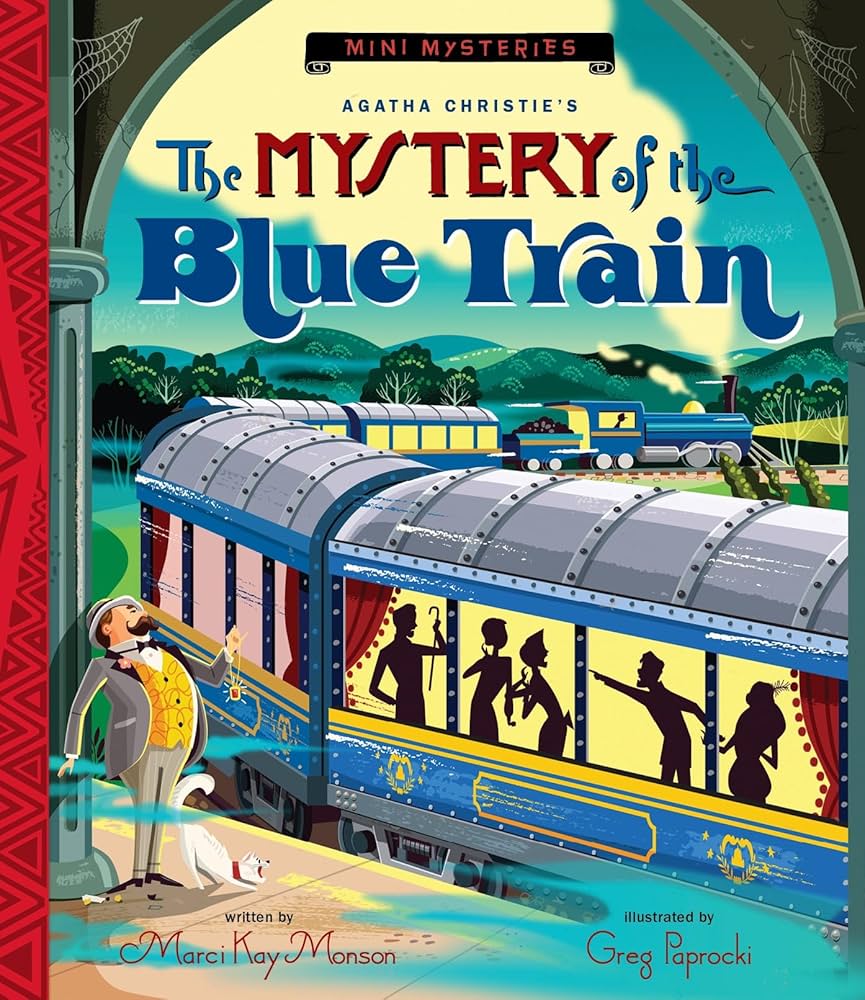
Review: The Mystery of the Blue Train
| Published | 1928-03-29 |
| Series | Hercule Poirot Mysteries (Book 6 of 45) |
| Genre | Cozy Mystery, Crime Fiction |
| Language | English |
| Publisher | William Collins and Sons (UK) |
| ISBN-10 | 0063088002 |
| ISBN-13 | 978-0063088009 |
📝Review: The Mystery of the Blue Train — My Honest Review
Written and reviewed by Shadab Alam. The opinions and rating in this review are my own.
Summary:
The Blue Train, Le Train Bleu, is one of the most glamorous express routes in Europe, carrying the wealthy and fashionable from Paris down to the sun-drenched French Riviera. Among the passengers one evening are Ruth Kettering, an American heiress traveling with a famously valuable collection of rubies called the Heart of Fire, and Katherine Grey, a quiet Englishwoman who has recently come into a small inheritance and is experiencing the world for the first time. Also on board, by chance, is Hercule Poirot. When the Blue Train arrives at Nice the next morning, Ruth Kettering is found dead in her compartment, her face battered almost beyond recognition, her rubies gone. Her estranged husband Derek, who had every reason to want her out of the way, is the obvious suspect. Poirot is not interested in the obvious suspect. He is interested in what actually happened, which turns out to be considerably more complicated and considerably more disturbing.
✅ What I Liked
Katherine Grey is a genuinely appealing protagonist who deserved more novels of her own. The Blue Train setting is atmospheric and well-used. The solution is fair and the restaging scene is memorable. And Christie's portrait of Ruth Kettering's unhappy marriage has an emotional truth that goes beyond what the plot strictly requires.
❌ What Could Be Better
The middle section loses pace considerably, and the business subplot surrounding Ruth's father feels like padding. The central trick, while clever, was more effective at short story length. And Christie's own disengagement from the material is occasionally visible in the flatness of certain scenes, a quality almost entirely absent from her better work.
Knowing that going in changes the experience of reading it in ways that are interesting and occasionally uncomfortable. Because the truth is, The Mystery of the Blue Train is not a bad book. It is not a great Christie. It is not anywhere near her best work. But it is a perfectly competent, often genuinely entertaining mystery that has been somewhat unfairly tarred by its author's own loathing of it, a loathing that had far more to do with the circumstances of its creation than with anything actually wrong with the text.
What the book has going for it is the setting. Christie loved the French Riviera, and even at her most miserable she could not write about it without some of that affection bleeding through. The Blue Train itself is a vivid presence, and the journey from Paris to Nice, through the night and into the morning light of the south of France, is evoked with enough sensory detail to make you feel the particular luxury and slight unreality of long-distance rail travel. There is something inherently atmospheric about murder on a night train, a sense of sealed, temporary community that makes everyone a suspect and gives the investigation a natural pressure.
Katherine Grey is one of Christie's more underappreciated heroines. She is not beautiful in any obvious way, not dramatic, not particularly adventurous. She is a woman who has spent years looking after an elderly relative, watching life from the outside, and who has suddenly been given a little money and a great deal of freedom and is not quite sure what to do with either. Christie gives her a warmth and a quiet intelligence that make her genuinely pleasant company across the novel, and her interactions with Poirot have a refreshing directness. He likes her. You can feel it in every scene they share. She is one of the few people in any Christie novel who treats Poirot with uncomplicated respect rather than condescension or suspicion or performed gratitude.
The mystery itself is constructed with Christie's usual mechanical precision, though the central trick she employs is one she had used in a much shorter form in an earlier short story called The Plymouth Express, and the expansion to novel length does expose some of the limitations of the original conceit. The solution is clever, the final reveal is well-staged, and Poirot's unusual decision to restage the journey with the suspects aboard is a genuinely theatrical touch. But there are stretches in the middle where the pace sags, and the subplot involving Ruth's father and his business affairs is not as interesting as Christie seems to think it is.
The supporting cast is a mixed bag. Ruth Kettering, the victim, is drawn with more psychological depth than Christie usually bothers to give her murder victims, and her unhappy marriage has a real bitterness to it that feels less like a puzzle element and more like observed human experience. Derek Kettering is the kind of charming, financially irresponsible man Christie clearly understood well from life, and she writes him with a sharpness that cuts past stereotype. Others, particularly the various socialites orbiting Lady Tamplin on the Riviera, are thinner and exist mainly as scenery and red herrings.
This is not the Christie to start with. It is not the one to hand someone who has never read Poirot. It is a novel written under duress by a writer in pain, and that shows in the occasional flatness of its rhythms. But it is also a novel written by Agatha Christie, which means the bones of the mystery are sound, the setting is gorgeous, and the solution, whatever reservations you might have about how you got there, is satisfying in the way only Christie can consistently manage. It is a lesser Christie, not a bad one. Those are very different things.
📊Community Rating
🎭Vibe Check
Read spoilers, debates, and detailed user reviews in our discussion room.
Discover Your Next Great Read
Handpicked recommendations from our collection of literary treasures