🏆
WINNER ANNOUNCED Tuesday 19 May 2026 at Tate Modern, London · Prize £50,000 split equally between author and translator
i was not expecting Taiwan Travelogue to be the kind of book i would stay up thinking about after i finished it. But it was. It is the kind of novel that feels like it is doing about four things at once and somehow all four of them are working. Set in 1930s Taiwan under Japanese colonial rule, it follows a young Japanese novelist who arrives on a government sponsored tour of the island and quickly finds that the most interesting thing about her trip is the Taiwanese woman hired as her interpreter. And from there it becomes a love story and a history lesson and a meditation on language and power all at the same time.
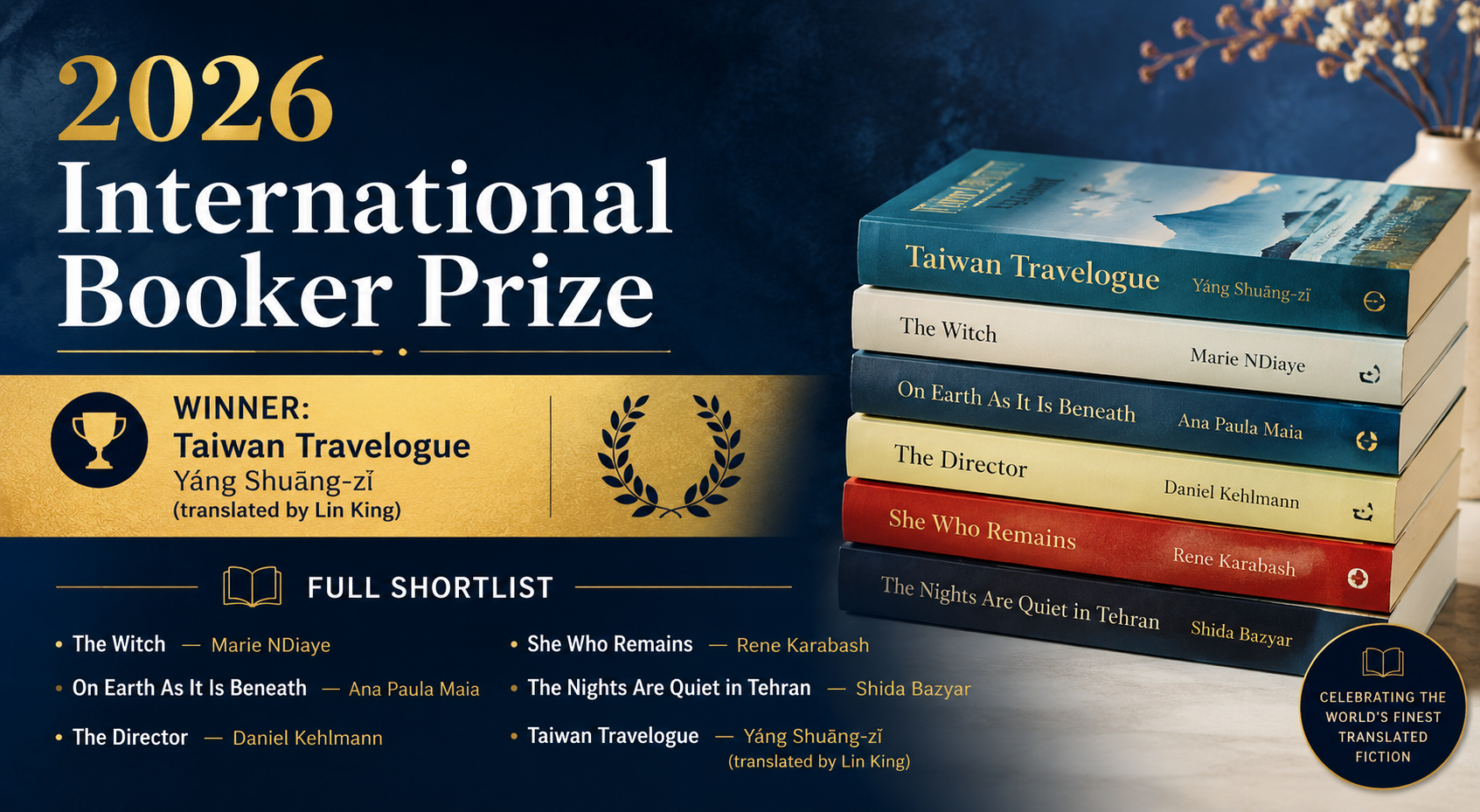
So when Natasha Brown announced at Tate Modern on 19 May that Taiwan Travelogue by Yáng Shuāng-zǐ and translator Lin King had won the 2026 International Booker Prize i was not really surprised. It was the bookmakers favourite going in and it had already won the National Book Award for Translated Literature in the US back in 2024. What did catch me off guard was how emotional the whole room apparently felt. This prize means a lot and this year it felt especially deserved. It is also the prize's 10th anniversary which made the whole thing feel even more significant.
🏆 2026 International Booker Prize Winner
Taiwan Travelogue
by Yáng Shuāng-zǐ · Translated from Mandarin Chinese by Lin King
A bittersweet love story between two women set in 1930s Japanese-occupied Taiwan. The first Mandarin Chinese novel ever to win the International Booker Prize. Described by Chair of Judges Natasha Brown as "captivating, slyly sophisticated" and something that succeeds as both a romance and an incisive postcolonial novel.
🌍
Languages
5 languages represented
💷
Prize
£50,000 split author and translator
📅
Ceremony
19 May 2026, Tate Modern
📖
Submitted
128 books from publishers
"Can love overcome a power imbalance? Taiwan Travelogue teases out the nuances of this question against a backdrop of 1930s Taiwan under Japanese colonial rule. It is captivating, slyly sophisticated and succeeds as both a romance and an incisive postcolonial novel."
Natasha Brown, Chair of Judges, International Booker Prize 2026
10
Years of the International Booker Prize in its current form
128
Books submitted by publishers before six were shortlisted
23
Territories where Taiwan Travelogue rights have been sold
£50K
Prize split equally between author Yáng Shuāng-zǐ and translator Lin King
🥇 Taiwan Travelogue — A Closer Look at the Winner
i have been thinking about why this book works as well as it does and i think it comes down to the layers. There is always something underneath what you think you are reading.
📖 What is it about: May 1938. A young Japanese novelist named Aoyama Chizuko arrives in Taiwan on a trip sponsored by the Japanese government which at the time controls the island. She has no interest in their banquets or their agenda. What she wants is to eat real Taiwanese food and see the real island. A Taiwanese woman is hired as her interpreter and the two of them set off on a kind of culinary tour that slowly becomes something much more personal. The novel is structured like a fictional travel memoir with footnotes and afterwords that add layer after layer to what you are reading.
✍️ About Yáng Shuāng-zǐ: She is a Taiwanese writer of fiction, essays, manga, video game scripts and literary criticism. Taiwan Travelogue was first published in Mandarin Chinese in 2020 and won Taiwan's highest literary honour which is the Golden Tripod Award. In her acceptance speech at Tate Modern she said something that really stayed with me about how literature wields power and acts with steady resolve even when it appears slow. She was talking about what it means to write from Taiwan when the country faces constant geopolitical threat and it made the whole room go quiet.
🌐 About translator Lin King: Lin King is a writer and translator based in Taipei and New York. Her translation of Taiwan Travelogue already won the National Book Award for Translated Literature in 2024 in the US which was the first time a Taiwanese book had won that prize too. The judges this year made a point of noting how the translation adds its own layer to a book that is already deeply about the act of communication across languages. Lin King is also working on her own debut novel called Weeb and based on what she has done here i think that is going to be one to watch.
🏛️ Why it won: The judges read every shortlisted book at least three times. Gaby Wood who runs the Booker Prize Foundation said the judges described how each book changed every time they read it and how the judging discussions themselves shifted their understanding. At the end of all that reading one book rose to the top and they described it as inventive, playful, witty and profound. When a book can survive three re-reads by five very smart people and come out stronger each time that tells you something.
📖 All 6 Books on the 2026 International Booker Prize Shortlist
From 1930s Taiwan to a Brazilian penal colony to the streets of Tehran in 1979 this shortlist took me to places i had never read before. Here is my take on all six.
1️⃣ Taiwan Travelogue by Yáng Shuāng-zǐ, translated by Lin King (🏆 WINNER · Mandarin Chinese · Originally published 2020 · Granta Books UK): This is it. The one that won. A love story set inside a colonial power dynamic in 1930s Taiwan and it never lets you forget for one second how those two things are connected. Yáng writes about appetite and desire and history all tangled together and Lin King's translation brings an extra layer to a book that is already obsessed with the act of translation itself. There are footnotes from fictional translators and real ones and by the end you genuinely do not know where one layer stops and another begins. That sounds like it should be confusing and somehow it never is. ⭐ The first Mandarin Chinese novel to win this prize and honestly long overdue. A book about love and power that will stay with me.
2️⃣ The Nights Are Quiet in Tehran by Shida Bazyar, translated by Ruth Martin (✨ Debut Novel · German language · Set in Iran · Scribe UK): This is a multigenerational saga that follows an Iranian family from the 1979 revolution through exile and return. Bazyar was born in Germany to Iranian parents and that in between position shows up in the writing in a really interesting way. The book is not just about political upheaval it is about what families carry across generations and how much of that weight you can actually put down. i found it completely absorbing. ⭐ One of the two debut novels on the shortlist and it reads like anything but a debut. Deeply humane and quietly devastating in places.
3️⃣ The Director by Daniel Kehlmann, translated by Ross Benjamin (⭐ Established Author · German language · Nazi-era Germany · Quercus UK): Kehlmann is one of those writers where i always know i am in safe hands and The Director does not change that. It is based on the real life of filmmaker G.W. Pabst who made some of the most important films of the Weimar Republic and then stayed in Germany during the Nazi period and kept working. The book does not let Pabst off the hook but it also does not turn him into a simple villain. It is interested in the much harder question of what small compromises add up to over time. Kehlmann and his translator Benjamin were shortlisted together back in 2020 as well. ⭐ Morally complicated and beautifully written. The kind of historical fiction that makes you think about the present.
4️⃣ On Earth As It Is Beneath by Ana Paula Maia, translated by Zoë Perry (⭐ Brazilian author · Portuguese language · Set in a Brazilian penal colony · Charco Press UK): This one is the most unlike anything else on the shortlist and i mean that as a very big compliment. A bloodthirsty prison warden in a Brazilian penal colony and a story that goes to some very dark places with a kind of raw energy that feels completely its own. Maia writes with this brutal directness that makes the whole thing feel almost physical. i would not call it an easy read but i would call it an unforgettable one. ⭐ Nothing else on this shortlist reads like this. Charco Press keeps putting out books that feel like nothing else in British publishing.
5️⃣ The Witch by Marie NDiaye, translated by Jordan Stump (⭐ Established Author · French language · First published in French 1996 · MacLehose Press UK): This one has a unique distinction on the shortlist which is that it was first published in its original French back in 1996 making it thirty years old this year. NDiaye is one of France's most celebrated writers and The Witch is about a suburban woman who may or may not have powers that the world around her refuses to take seriously. It is unsettling in the best way. Reading it now in 2026 it feels sharper and more relevant than when it first came out which says something about both NDiaye's writing and about how much the world has and has not changed. ⭐ Thirty years old and it reads like it was written last year. NDiaye is just brilliant.
6️⃣ She Who Remains by Rene Karabash, translated by Elizabeth Clark Wessel (✨ Debut Novel · Albanian language · Set in northern Albania · Restless Books UK): The second debut novel on the shortlist and in some ways the one that surprised me most. It follows a young woman in a patriarchal Albanian tribal society who escapes an arranged marriage by taking on a sworn virgin identity and building a completely new sense of who she is. The judges called it exquisitely written and i think that is right. It is quiet and devastating in equal parts. ⭐ An extraordinary debut from a writer i had not heard of before this shortlist. i am so glad the prize introduced me to this one.
🧵 What This Shortlist Was Really About
You could set these six books in six completely different worlds and in a way you are. But when i read them together something starts to come through that feels like a shared obsession. Here is what i noticed.
🏛️ History as something you live inside: Taiwan in the 1930s, Iran in 1979, Nazi Germany, colonial Albania. Three of these six books are set at specific moments of political rupture and none of them treat history as just a backdrop. The history is the story in each case.
💬 Language and power: Taiwan Travelogue is the most obvious example but it shows up across the shortlist. Who gets to speak, who is translated, who is heard, and what gets lost or distorted in the process. This feels like a very timely set of questions for a prize that is specifically about translation.
👩 Women making themselves: Almost every book on this list has a woman at the centre of it figuring out who she is inside a system that has strong opinions about who she should be. She Who Remains and The Witch are the most direct versions of this but it is everywhere.
🌍 The world beyond the English speaking one: Taiwan, Iran, Brazil, France, Germany, Albania. The International Booker Prize exists precisely to push back against how narrow English language publishing can be and this year's shortlist felt like a proper argument for why that matters. i read books on this list set in places i had never read about before and came away feeling like i understood something i had not before.
💔 Moral compromise: The Director is the most direct version of this but almost every book here asks what it costs to survive inside a system you did not choose. Bazyar's Tehran novel does it. Maia's prison novel does it. None of them offer easy answers.
⚖️ The 2026 Judging Panel
Natasha Brown chairing this panel felt like a genuinely interesting choice to me. She is a novelist who thinks a lot about power and identity and those feel like the exact themes this shortlist kept returning to. The rest of the panel is also not your usual literary establishment mix.
✍️ Natasha Brown: Chair of Judges · Award winning British novelist · Author of Assembly · Her fiction is known for its precision and its interest in race, power and what goes unsaid
🔢 Marcus du Sautoy: Writer, broadcaster and Oxford University Professor of Mathematics for the Public Understanding of Science · A very unusual choice for a literary prize which i think is what made this panel interesting
🌐 Sophie Hughes: Translator who has herself been shortlisted for the International Booker Prize · Her presence on the panel ensured translation was taken seriously as a craft not just a vehicle
📚 Troy Onyango: Writer, Lolwe editor and bookseller based in Kenya · Brought a genuinely global perspective to the reading and talked in interviews about how translated fiction expands not just our literary horizons but our moral and emotional imaginations too
🖊️ Nilanjana S. Roy: Award winning Indian novelist and columnist · A sharp critical mind and someone who has thought deeply about what it means for a book to travel across languages and cultures
📅 How the 2026 Prize Unfolded
📋 24 February 2026 — Longlist Announced: Thirteen novels announced on the longlist, selected from 128 books submitted by publishers. Works had to be translated into English and published in the UK and/or Ireland between 1 May 2025 and 30 April 2026.
📌 31 March 2026 — Shortlist Revealed: Six novels named as finalists. Chair of Judges Natasha Brown described them as books with narratives that capture moments from across the past century and reverberate with history. Five of the six authors are women. Four of the translators are women.
🏆 19 May 2026 — Winner Announced ✅: Taiwan Travelogue by Yáng Shuāng-zǐ, translated by Lin King, announced as the winner at a ceremony in the Turbine Hall at Tate Modern in London. The prize's 10th anniversary. The first Mandarin Chinese novel to win. The first Taiwanese winner of the prize.
💡
For me personally the most interesting thing about this year is that the winner was also already a prize winner in the US. The National Book Award for Translated Literature in 2024 and now the International Booker in 2026. Taiwan Travelogue has been on a remarkable journey and it is still going. Rights have been sold in 23 territories now which means a lot of readers around the world are about to discover this book for the first time. That feels like what this prize is supposed to do.
📚 Discover More Prize Winning Fiction
Taiwan Travelogue is just the start. Explore more Booker Prize coverage and translated-fiction news across Epiloguely.
Explore More Literary News →