🏛️
WINNER ANNOUNCED May 29, 2026 at the BIO Conference, CUNY Graduate Center, New York City · Prize $3,000 honorarium
i want to be honest here. i picked up Gertrude Stein An Afterlife last autumn not entirely sure what to expect. i knew Francesca Wade's first book Square Haunting and i loved it but Gertrude Stein felt like a subject that had already been written about so many times. What more was there left to say? Turns out quite a lot. Wade does something i have never really seen done in biography before which is she splits the book almost equally between Stein's actual life and what happened to Stein's reputation and legacy after she died in 1946. That second half is where it gets really fascinating.
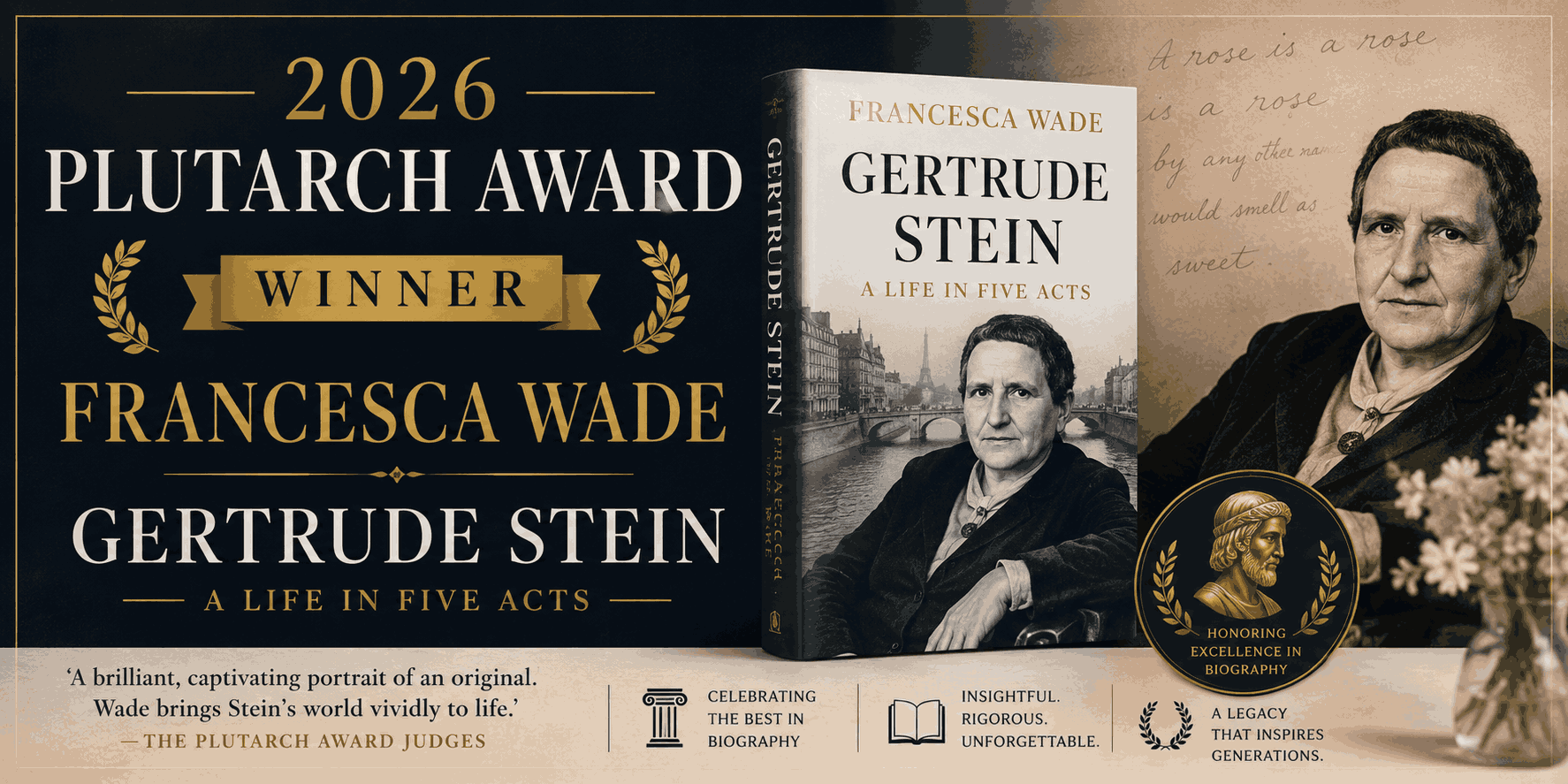
So when the Biographers International Organization announced on May 29 at their annual conference in New York City that Francesca Wade had won the 2026 Plutarch Award for this book i genuinely felt glad. This is the prize that only biographers judge. There is something special about that. When your peers give you this kind of recognition it means the work holds up to people who know exactly how hard it is to do what you did.
🏛️ 2026 Plutarch Award Winner — Best Biography of 2025
Gertrude Stein: An Afterlife
by Francesca Wade · Published by Scribner (US) and Faber and Faber (UK)
A biography of Gertrude Stein that is equally a biography of her posthumous reputation. Wade traces key figures who shaped what the world came to think of Stein after her death in 1946. The judges called it a compelling original approach to Stein's life and work and ultimately to our thinking about biography itself.
📖
Publisher
Scribner (US) / Faber (UK)
📅
Ceremony
May 29, 2026 CUNY Graduate Center, NYC
⚖️
Judged by
5 distinguished biographers
📰
Top 10 lists
Washington Post and NPR Fresh Air 2025
🎖️
Also finalist
Lambda Literary Award for Biography
"Gertrude Stein An Afterlife represents a compelling original approach to Stein's life and work and ultimately our thinking about biography itself. A ground-breaking addition to the literary study of this iconic and controversial figure offering urgent and exciting new insights into life-writing and how we read and interpret another's life."
2026 Plutarch Award Committee, chaired by Mary Dearborn
$3K
Honorarium awarded to Francesca Wade at BIO Conference NYC
5
Distinguished biographers on the judging committee chaired by Mary Dearborn
23
Rights territories sold for Stein An Afterlife since publication in 2025
2020
Year Wade published Square Haunting her acclaimed debut which also won prizes
📖 Gertrude Stein An Afterlife — What It Is and Why It Matters
i have tried to explain this book to a few friends now and i always end up saying the same thing. it is a biography about what happens after the biography ends. That is a strange and brilliant idea and Wade pulls it off.
📚 What the book is actually about: Gertrude Stein died in Paris in 1946. She had spent decades building her own legend. She had written about herself in the third person. She had collected Picasso and Matisse and turned her apartment on the rue de Fleurus into the most famous literary salon in the world. And then she was gone. What Wade is interested in is what happened next. Who got to decide what Stein meant? Who owned the archive? Who controlled how the story got told? The answer turns out to be Alice B. Toklas and the answer turns out to be much messier and more interesting than you would expect.
🔍 The Alice B. Toklas angle: This is the part of the book that really got me. Toklas spent the decades after Stein's death fighting to preserve and protect her partner's work and reputation. She was strategic and devoted and sometimes ruthless about it. Wade draws on letters and personal annotations that had never been used in a biography before. By the end of the book you have a completely different picture of Toklas than the one most people carry around which is basically just Stein's quiet companion. She was not that at all.
✍️ About Francesca Wade: She is a British writer and critic whose essays appear regularly in the New York Review of Books and the London Review of Books. Her first book Square Haunting came out in 2020 and looked at five women writers who all lived in the same Bloomsbury square at different times. It was shortlisted for the RSL Ondaatje Prize. For Gertrude Stein An Afterlife she held fellowships at Harvard Radcliffe Institute and the New York Public Library and the Leon Levy Center for Biography. That kind of deep archival access shows in every chapter.
🏛️ Why it won the Plutarch: The award committee was chaired this year by Mary Dearborn and the five judges all read as practising biographers themselves. They described the book as a ground-breaking addition to the literary study of Stein that also offers something bigger which is a rethinking of what life-writing can do. That phrase urgent and exciting new insights into life-writing is not the kind of language awards committees throw around lightly. They mean it here. Wade is doing something genuinely new with a form that can feel very fixed and settled.
📋 The 2026 Plutarch Award Shortlist
The shortlist this year had two books on it and both of them were doing something interesting with the conventions of biography. i think that theme ended up mattering to the judges.
1️⃣ Gertrude Stein An Afterlife by Francesca Wade (🏆 WINNER · Scribner US / Faber UK): The one that took the prize. A biography of Stein and a biography of Stein's posthumous reputation at the same time. If you have not read it yet this is the moment to pick it up. It is smarter and more personal than the usual literary biography and it will change how you think about the whole question of who gets to tell the story of a life. i genuinely think it is one of the best biographies i have read in years. ⭐ Absolutely deserved. A book that makes you want to read everything Wade writes next.
2️⃣ The Invention of Charlotte Bronte A New Life by Graham Watson (Pegasus Books): The other shortlisted book and one i would strongly recommend too. Watson interrogates how Charlotte Bronte's story came to be written down in the first place which means looking at the first biographers and what they left out and what they invented. The judges described it as riveting and said it shed new light not just on Bronte but on the construction and nature of biography itself. There is that same theme again of questioning who gets to write a life and what they do with that power. ⭐ A brilliant book and an honourable runner-up. Watson asks questions about Bronte that i had never thought to ask.
💡
What i find really interesting about this shortlist is that both books are as much about biography as a form as they are about their actual subjects. Wade questions how a reputation gets built. Watson questions how a life gets recorded. It feels like the judges were drawn to books that take biography seriously enough to interrogate it. That is a good sign for the whole genre.
⚖️ The 2026 Judging Panel and What Makes This Prize Different
The Plutarch is genuinely unusual in the awards world and i think that matters. Every other major prize for nonfiction or biography uses a mixed panel. This one is judged entirely by practising biographers which means the people deciding are the people who know exactly how hard the work is.
🪑 Mary Dearborn (Chair): A biographer herself and the choice to chair the committee this year. Dearborn has written lives of Henry Miller, Norman Mailer and Ernest Hemingway among others. She knows the question of posthumous reputation from the inside and it shows in the kind of book the committee ended up selecting.
🎖️ Previous Plutarch winners give you a sense of the standard: Robert Caro has won it. Hermione Lee has won it. Ruth Franklin has won it. A.N. Wilson has won it. That is not a list where you expect to find faint praise or safe choices. Wade joining that group says a lot.
📍 Where the prize comes from: The Biographers International Organization has been running the Plutarch since 2013. It was always meant to be the one award where biographers themselves get a say in what the best biography of the year actually is. The BIO Conference where the winner is announced is also where working biographers gather to talk about craft and access and archives and all the things that make this form so hard to do well.
📅 How the 2026 Plutarch Award Unfolded
📋 March 2026 — Longlist Announced: The Biographers International Organization announced the full longlist including Francesca Wade's Gertrude Stein An Afterlife and Graham Watson's The Invention of Charlotte Bronte. Both were immediately flagged by critics as serious contenders. Wade's book had already been collecting praise since its publication in October 2025.
📌 April 2026 — Shortlist Revealed: The committee narrowed things down to two finalists. Wade and Watson. Both books asking versions of the same question about how we construct the story of a life. The winner to be announced at the annual BIO Conference in New York.
🏆 May 29, 2026 — Winner Announced at BIO Conference: At CUNY Graduate Center in New York City the 2026 BIO Conference announced Francesca Wade as the winner. The committee chaired by Mary Dearborn praised the book as a ground-breaking addition to biography as a form. Wade was not the only person celebrated that evening but she was the one who went home with the Plutarch.
💡
Before the Plutarch, Gertrude Stein An Afterlife had already been named one of the best ten books of 2025 by the Washington Post Book World and by NPR's Fresh Air. It was also a finalist for the Lambda Literary Award for Memoir and Biography. The Plutarch feels like the moment that cements it. Wade has now written two books and both of them have been recognised as genuinely important contributions to how we think about women's lives and women's legacies.
📚 Explore More Prize Winning Nonfiction
Gertrude Stein: An Afterlife is one of the most discussed biographies of recent years. Explore more literary awards and author coverage across Epiloguely.
Explore More Literary News →