⚡
LATEST UPDATE · 22 JUNE 2026 The Commonwealth Foundation says its month-long review found that AI was not used to write the regional winning stories. The overall winner is due to be announced on 30 June 2026.
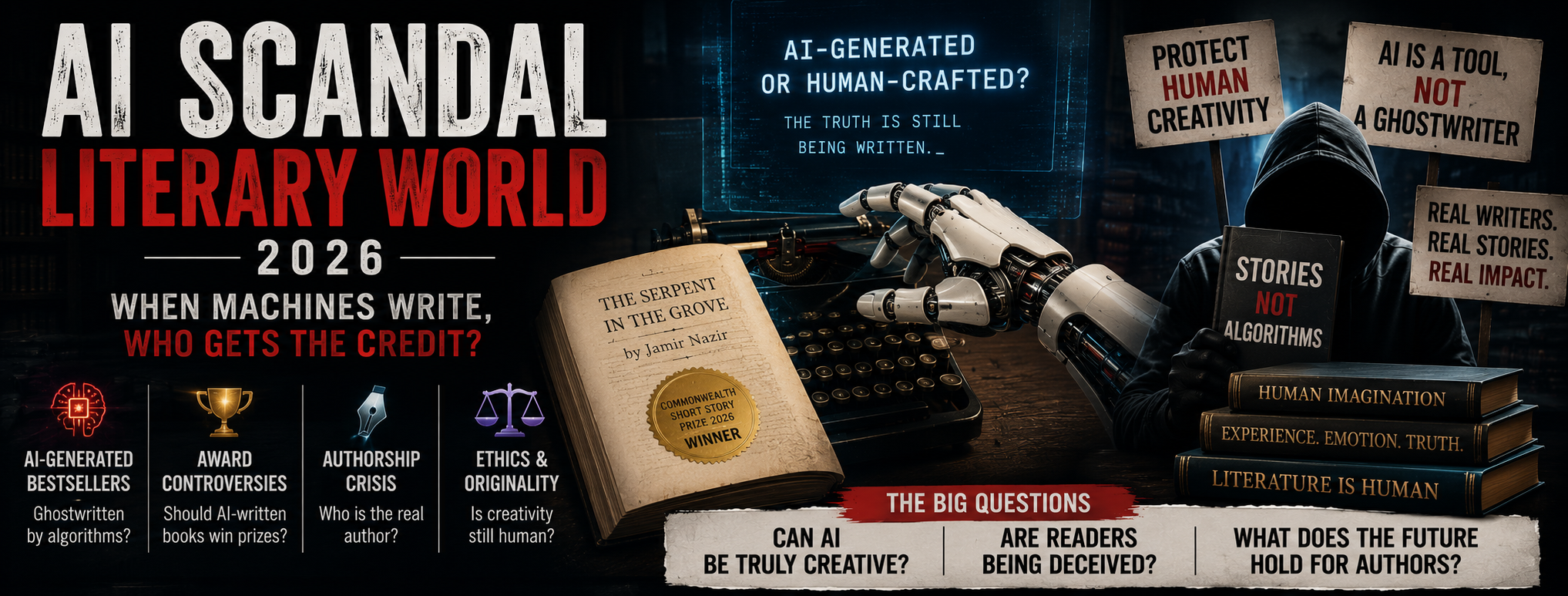
I have seen plenty of arguments about AI and writing, but this one feels different. It is no longer a vague debate about whether a chatbot can make a decent poem. A respected literary prize selected five regional winners, readers questioned whether some of the work sounded machine-made, and one of the best-known literary magazines in Britain ended a publishing partnership that had lasted for more than a decade.
At the centre of the storm is The Serpent in the Grove, a short story by Trinidad and Tobago writer Jamir Nazir. It won the Caribbean region of the 2026 Commonwealth Short Story Prize. Soon after the regional winners were announced in May, readers on X and Bluesky began pulling apart its sentences. Some said the repeated rhythms felt familiar from chatbot writing. Others ran the story through AI detection software and treated the result as proof.
That was only the start. Questions spread to other regional winners. The authors denied using generative AI. The Commonwealth Foundation backed them, then opened a fuller review. Granta made clear that its editors had not chosen the stories and had only copy-edited them before publication. By 20 June, the magazine had decided it would no longer take part in outside publishing arrangements where it did not control the editorial process.
What we know right now
No public evidence has proved that any 2026 regional winner used AI
The Commonwealth Foundation says it examined the writers' creative process and reviewed supporting material. On 22 June it said it was satisfied that the winning stories were not written with AI. Granta has still ended the partnership, saying it must protect its own editorial control.
📝
Entries
7,806 stories from 54 countries
🌍
Regional winners
Five writers selected in May
💷
Regional prize
£2,500 for each regional winner
🏆
Overall prize
£5,000 for the final winner
📚
Partnership
Granta hosted winners since 2012
📅
Next date
Overall winner on 30 June 2026
🔥 How the controversy began
The five regional winning stories appeared on Granta's website in May. Nazir's story quickly became the main target. Critics pointed to its heavy use of comparisons, balanced sentence shapes and repeated patterns such as “not this, but that.” A few lines were copied into social posts and discussed as if they were fingerprints left by a chatbot.
I read the argument before I read the story, which probably changed the way I approached it. Once someone tells you to look for AI, every polished image can start to feel suspicious. A sentence that might have seemed overly worked suddenly looks like evidence. A repeated rhythm starts to feel like a prompt response. That is part of what makes this case so messy.
🔍 Why readers became suspicious People noticed repeated sentence structures and images that felt over-packed. AI detection services also returned strong scores. Those results spread fast because a percentage looks certain, even when the tool behind it cannot see the writer's drafts or explain the full writing process.
📖 Why suspicion is not proof Human writers repeat patterns too. Some people dictate their work. Some revise heavily. Others write in a style that detection software has learned to associate with machines. A strange sentence can be weak writing, deliberate writing or machine writing. The sentence alone cannot tell us which one it is.
⚖️ Why the accusation still mattered This was not an ordinary online writing contest. The Commonwealth Short Story Prize is free to enter, anonymously judged and open across five regions. Winning can introduce an unknown writer to a global audience. Trust in the process matters because the prize can change a career.
What unsettled me most was how quickly the debate moved from “this sounds like AI” to “this writer cheated.” Those are not the same claim.
Shadab Alam
📕 The story at the centre of it
The Serpent in the Grove is set in rural Trinidad. It uses folklore, land and family memory to build a dark story around a grove that seems to remember what happened there. The judges praised Nazir's language when the regional winners were announced. Then the same language became the reason some readers doubted him.
Nazir later denied using generative AI. He said his writing process happens on an Android phone because chronic health conditions make long periods of typing at a desk difficult. He relies on speech-to-text, then makes limited edits on the phone. That detail matters. Dictated prose can create repeated shapes and unusual punctuation. It can also sound different from prose built slowly on a laptop.
I do not think that explanation automatically settles every question. I also do not think strangers should dismiss it because it does not match the way they imagine a writer works. Plenty of writers use accessibility tools. Speech-to-text is not generative AI. Treating every digital aid as cheating would shut disabled writers out of literary spaces.
Why some readers remain doubtful
The story contains patterns that critics connect with chatbot prose. Detection tools produced high AI scores. Granta's publisher said the truth might never be fully known, which kept the doubt alive even after the writers denied the claims.
Why the authors deserve caution
AI detectors are not a court. The writers gave direct denials. The Foundation later reviewed creative material and spoke with every regional winner before clearing the stories. Public suspicion cannot replace a fair process.
♿
Speech-to-text is an accessibility tool. It turns spoken words into typed words. It does not invent the story in the way a generative chatbot can. Any future rule for literary competitions needs to keep that difference clear.
🏛️ What the Commonwealth Foundation found
The Foundation first responded on 19 May. It said every shortlisted writer had personally stated that no AI was used. It also explained why it did not run unpublished entries through AI checkers. Sending private fiction to outside systems raises questions about consent and ownership. The organisation said the available detection tools were not reliable enough to become the final judge.
A longer review followed. On 22 June, the Foundation said it had held detailed talks with all five regional winners. Reviewers looked at working drafts. They also checked time-stamped files and notes connected to the development of the stories. After speaking with the judging panel, the Foundation said it was “satisfied that AI was not used” to write the winning work.
That is the clearest official finding we have. The regional results will stand, and the overall winner is now planned for 30 June. The Foundation also admitted that its process needs to improve. It has begun discussions about how AI checking might be used in future prizes without handing unpublished writing to systems that authors did not agree to use.
✅ The official position The five regional winners remain eligible. The Foundation says the available material supported their accounts of how the stories were written.
🧠 The bigger admission Trust alone is no longer enough for a large literary prize. Organisers need a process that protects writers from false claims while also giving readers a serious answer when concerns appear.
📰 Why Granta walked away
Granta had published the prize's regional winners online since 2012. That gave the competition a respected literary home and gave the writers access to Granta's international readership. The magazine was not part of the judging panel. Its editors received the chosen stories and copy-edited them for publication.
When the accusations began, that separation became a problem. Granta's name sat above the stories, but its editors had not selected them. On 20 June, the magazine said it would stop taking part in outside publishing partnerships where it had no editorial control. It said the choice was made “for the sake of our own editorial integrity.”
The stories will stay online for public reference. The Commonwealth Foundation thanked Granta for providing a home to the winners for more than a decade and said it would look for new platforms. I think this is the part of the story that will matter long after the current argument fades. A publishing relationship survived for years, then one AI dispute exposed a basic question about responsibility. Whose reputation is on the line when one group chooses the work and another group publishes it?
A partnership ends
Granta did not declare the writers guilty
Its decision was about editorial control. The magazine said the accusations were strongly rejected by the authors, but it no longer wanted to publish work selected through a process it did not control.
🤖 Can an AI detector prove who wrote a story
This is where the debate gets uncomfortable. Detection tools can be useful as a warning sign. They can spot patterns across large amounts of text and tell an editor which piece may need a closer look. The problem begins when a score is treated as a verdict.
A detector does not watch the writer work. It cannot see an early notebook page unless someone gives it that page. It does not know whether a repeated sentence came from a chatbot, a speech-to-text error or a writer who simply likes that rhythm. Different tools can also return different answers for the same text.
There is another problem. Once people learn what detectors look for, machine-made writing can be edited to avoid those signals. Human writing can also be falsely flagged. That leaves prizes stuck between two bad choices. Ignore the tools and risk missing cheating. Trust the tools too much and risk accusing an innocent writer in public.
🚨 A score should begin a review It should not end one. A fair check needs human questions, version history and a chance for the writer to explain the work.
🗂️ Process matters more than a screenshot Drafts can show how a scene changed. File history can show when text appeared. Notes can connect the finished story to earlier thinking. None of these alone is perfect, but together they tell us far more than a single percentage.
✍️ Can authors prove they wrote their own work anymore
This question sounds dramatic, but I think writers will hear it more often. A finished document used to be enough. Now a clean manuscript may invite a new demand. Show the drafts. Show the edit history. Explain why this line changed. Prove the voice belongs to you.
That worries me. Writing is private for many people. Some authors delete early versions because they hate clutter. Some write in notebooks, then type the finished piece later. Some dictate. Some move between devices. A writer should not need to turn every rough thought into evidence just to avoid being called fake.
At the same time, prizes need a way to protect honest entrants. A person who writes every word themselves should not lose to someone who enters a lightly edited chatbot response. The answer is not endless surveillance. It is a clear rule that tells entrants what is allowed, what records may be requested and how a review will happen.
📜 Rules need plain language A prize should say whether brainstorming with AI is allowed. It should separately address rewriting, translation and grammar tools. “Original work” is no longer detailed enough.
🔐 Writers need privacy Draft evidence should only be requested when there is a real concern. It should be reviewed privately, stored safely and removed when the case is closed.
🧑⚖️ Appeals need real people No writer should be removed because one detector produced a high number. A review panel should hear the writer's explanation and consider the full record.
🌍 The five regional winning stories
The controversy has sometimes made it sound as though there was only one winning story. There were five regional winners, chosen from 7,806 entries. All five remain in the running for the overall prize.
🌍 Africa Me and Ma'am by Lisa-Anne Julien
🌏 Asia Mehendi Nights by Sharon Aruparayil
🌍 Canada and Europe The Bastion's Shadow by John Edward DeMicoli
🌴 Caribbean The Serpent in the Grove by Jamir Nazir
🌊 Pacific Second Skin by Holly Ann Miller
Some online accusations spread beyond Nazir's story and reached other winners. Sharon Aruparayil publicly denied using AI in Mehendi Nights and said she had a paper trail for her work. The Foundation's final review covered every regional winner, not only the story that first went viral.
🕒 The full controversy timeline
12 May 2026
Regional winning stories appear on Granta
The five stories are published online as part of Granta's partnership with the Commonwealth Foundation.
14 May 2026
Five regional winners are formally announced
Jamir Nazir is named the Caribbean regional winner for The Serpent in the Grove.
Mid May 2026
Readers raise AI allegations online
Sentence patterns and detector scores become the focus of posts on X and Bluesky. The discussion spreads to more than one story.
19 May 2026
The Foundation backs the writers
It says shortlisted authors confirmed that no AI was used and explains why unpublished entries were not sent to AI checkers.
22 May 2026
A full process review is promised
The Foundation says it will examine the allegations and strengthen the prize for future AI disputes.
Late May 2026
Writers give direct denials
Nazir explains his phone-based speech-to-text process. Aruparayil says no AI tool was used in writing or editing her story.
20 June 2026
Granta ends outside publishing partnerships
The magazine says it will no longer join arrangements where it lacks editorial control. The Commonwealth stories remain online.
22 June 2026
The official review clears the winners
The Foundation says it examined creative evidence and is satisfied that AI was not used to write the regional winning stories.
30 June 2026
The overall winner is due to be announced
One of the five regional winners will receive the final £5,000 prize.
💬 My honest take
I understand why readers asked questions. Pretending AI cheating cannot happen would be foolish. Literary prizes are built on authorship, and authorship is the one thing generative AI makes harder to see.
What I did not like was the speed of the public verdict. People used detector scores as if they were lab results. Writers were discussed as guilty before anyone had seen their drafts. The conversation became personal very quickly, and some of it had the ugly excitement of a crowd that wanted a scandal more than an answer.
The Foundation's review is not magic. Readers may still disagree with its finding. Yet it is a better basis for judgment than a viral screenshot. The writers were questioned, their material was reviewed and the judges were consulted. Unless new evidence appears, the fair position is that the winning stories stand.
Granta's exit also makes sense to me. A magazine should control what carries its name. I can respect that choice without treating it as proof against the authors. That distinction has been lost in a lot of the coverage.
The literary world now has a problem it cannot edit away. Writers need protection from machine-made competition. They also need protection from false machine-made accusations. Any system that only solves one side will hurt real people on the other.
📚 Where do you draw the line on AI and fiction?
Should prizes ask for draft history, or would that punish writers with unusual working methods? Read more literary news and share your view with other readers.
Explore More Literary News →