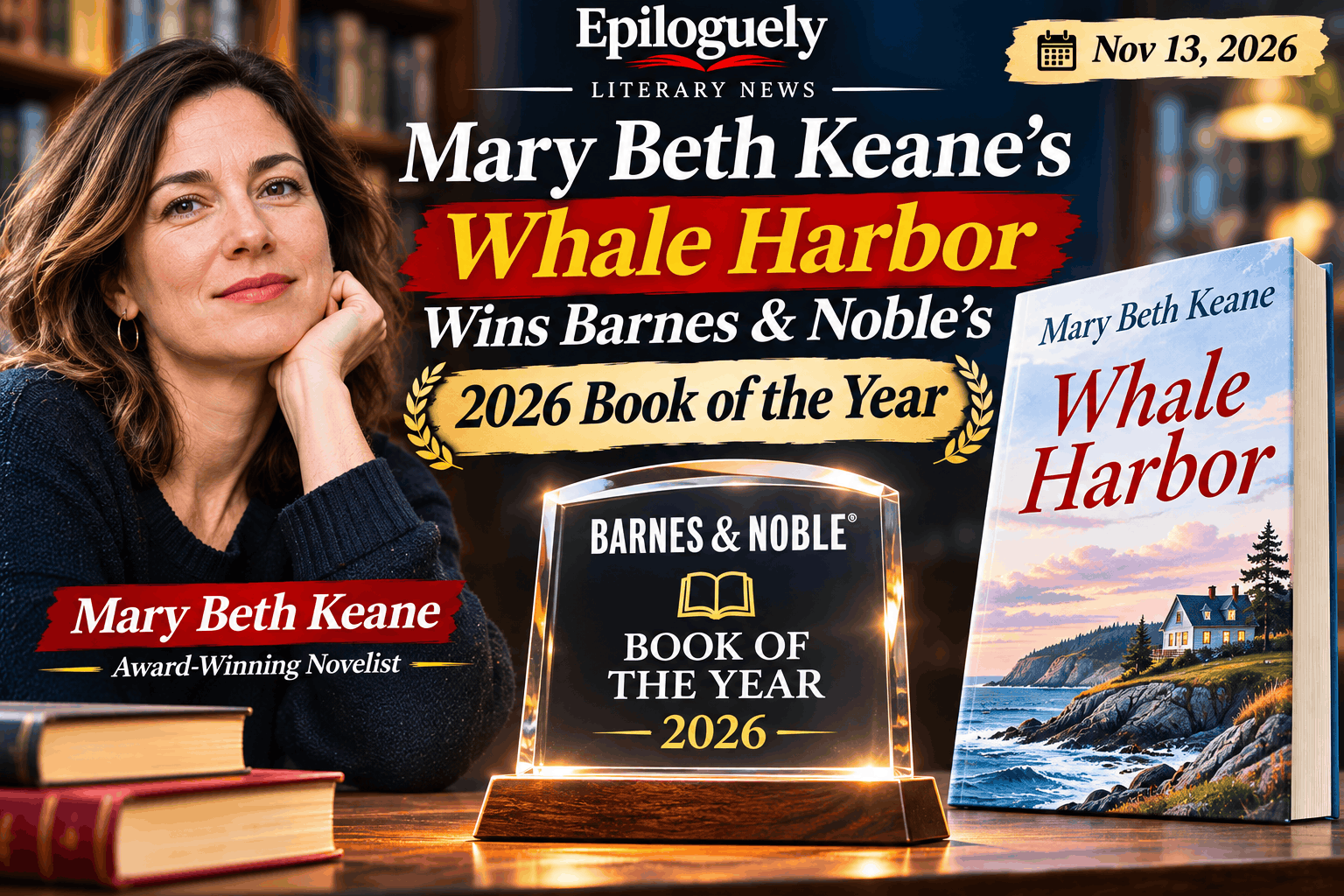
🏆CONFIRMED • 12 NOVEMBER 2026: Barnes & Noble names Mary Beth Keane's Whale Harbor its 2026 Book of the Year and announces three additional category winners.
Mary Beth Keane's Whale Harbor has been named Barnes & Noble's 2026 Book of the Year. The U.S. bookseller confirmed the result on Thursday, 12 November 2026, after staff from stores across the country voted for the titles they most enthusiastically recommended to readers. Published by Scribner, Keane's sweeping novel follows eleven brothers whose lives diverge between Ireland and America, revealing the long consequences of separation, grief and decisions made within one family.
The result arrives at a particularly interesting moment for literary fiction. Among the 16 finalists were major names including Colson Whitehead, Barbara Kingsolver and Maggie O'Farrell. Yet the bookseller's top honour went to a family saga rather than a high-profile franchise or celebrity release. The same announcement recognized three other books spanning children's picture books, middle-grade storytelling and narrative history.
For readers discovering the book today, this is more than a list of winners. It is a rare look at how professional booksellers, rather than a conventional literary jury or an online popularity poll, choose a book they believe deserves to be passed from one reader to another. That difference makes the 2026 result an interesting story about literary taste, recommendations and the influence of physical bookstores.
Official announcement
Whale Harbor is the 2026 Barnes & Noble Book of the Year.
Confirmed 12 November 2026 · Author: Mary Beth Keane · Publisher: Scribner · Selection: votes by Barnes & Noble booksellers in the United States · Three additional category winners announced alongside the main award.
📚
Book of the year
Bookseller-voted
📰 What did Barnes & Noble announce on 12 November?
The official announcement names Whale Harbor as the chain's overall Book of the Year and identifies three further winners: Is This a Plum? by Dan and Finn Ojari as Children's Gift Book of the Year; The Unlikely Tale of Chase and Finnegan by Jasmine Warga as Children's Book of the Year; and This Vast Enterprise: A New History of Lewis & Clark by Craig Fehrman as Nonfiction Book of the Year. Each occupies a different corner of the reading market, from playful visual storytelling to a historical account built on close research.
The selection process matters. According to the company, booksellers at more than 740 Barnes & Noble locations voted for the books they were proudest to sell. An opening round produced nominations and finalists; a further round determined the winner. The company says strong support from several stores helped propel Keane's novel to the top. The award therefore reflects an internal bookseller vote, not a national reader referendum, independent literary jury or measured chart of copies sold.
Keane responded with gratitude to the booksellers who had backed her novel. The company's accompanying remarks emphasized both the book's emotional scale and the enthusiasm with which early copies circulated among its staff. Those comments are evidence of the retailer's confidence in the novel, not proof that the book has already become the year's best-selling work. Keeping those distinctions clear is important when reporting a bookseller award as literary news.
🌊 What is Mary Beth Keane's Whale Harbor about?
The novel begins in 1960s Ireland, in a family shaped by loss and the difficult practical decisions that follow it. A father must consider what opportunities remain available to his eleven sons. Some older brothers leave for work in England, while others stay behind. The second-eldest, Macdara, takes a job on a cattle ranch in Montana, placing an ocean between his new life and the people with whom he grew up.
Macdara's younger brother Rian longs to follow him to America. Mac promises that he will send for Rian when the boy is old enough. But the family is later shaken by news that Rian has disappeared. The mystery becomes an emotional centre of the book, following the brothers as time, distance and new responsibilities push them in different directions. Keane's publisher describes a story moving through Ireland, England, Montana and New York, with the brothers' relationships continuing to shape their choices long after childhood.
This is the kind of premise that invites both a mystery reading and a family-novel reading, although the two should not be confused. The disappearance gives the narrative an urgent question, but the broader story concerns people who have learned to live in separate worlds while carrying an unfinished family history. The central themes include immigration, masculinity, loyalty and the hard-to-measure obligations between siblings. These details come from the publisher's summary; they are not presented here as a review of an advance reading copy.
📌
Reader note: The synopsis above is based on official publisher materials and avoids revealing how the disappearance is ultimately resolved. It does not claim that Epiloguely has independently reviewed the full novel.
✍️ Why the win matters for Mary Beth Keane
Mary Beth Keane is familiar to literary-fiction readers through Ask Again, Yes, a novel that explored the emotional consequences of a long-running conflict between two families. Whale Harbor returns to a related artistic territory without repeating that story: families whose lives are shaped not only by what they say and do, but by what they avoid saying, the memories they share unevenly and the interpretations they give to events years later.
Keane has written an ambitious novel with an unusually large sibling cast. Eleven brothers give a writer tremendous room to explore competing versions of home and responsibility, yet they also create a challenge: each character must feel more substantial than a name on a family tree. The publishing response suggests that readers and booksellers are connecting with the emotional thread that ties the brothers together. That is an interpretation of the novel's appeal, not an invented claim about the author's intentions.
The recognition comes as Whale Harbor also appears as the November 2026 Good Morning America Book Club pick, a separate form of media attention confirmed by the publisher and ABC News. Both selections may introduce Keane to readers who have not encountered her earlier work. They are distinct honours, however, and neither should be misreported as a prize judged by critics or as a guaranteed future sales record.
🏆 The other three Barnes & Noble 2026 Book of the Year winners
Children's Gift Book of the Year — Is This a Plum?, Dan and Finn OjariThe father-and-son collaborators created an interactive peek-through picture book that uses playful visual surprises to challenge first impressions. Its format invites a child to look, guess, turn the page and revise an assumption. Barnes & Noble highlighted the pairing of clever wordplay with illustration and the book's potential as a rereadable gift for families. This is the Children's Gift Book honour, not the separate Children's Book award.
Children's Book of the Year — The Unlikely Tale of Chase and Finnegan, Jasmine WargaWarga's story centres on an unexpected friendship between a cheetah and a dog. Inspired by real examples of animal companionship in zoological settings, the novel considers fear, belonging and the way relationships can help living creatures recover from difficult experiences. The retailer singled out its emotional accessibility to younger readers. The award recognizes the book in a broader children's category, rather than identifying it as the year's children's gift title.
Nonfiction Book of the Year — This Vast Enterprise: A New History of Lewis & Clark, Craig FehrmanFehrman's history returns to the Lewis and Clark expedition through extensive research and perspectives that conventional accounts have often pushed aside. Barnes & Noble described a book that foregrounds participants and witnesses beyond its two best-known historical names, including Sacajawea, York and John Ordway. The appeal lies partly in a familiar historical journey being retold with a wider cast and renewed attention to evidence. It is a nonfiction award, not part of a competition limited to novels.
Taken together, the four winners reveal the kind of variety a national bookselling chain can put on display. They do not all serve the same age group, literary tradition or purpose. The bookseller's announcement offers a family saga for adult fiction readers, an interactive picture book, a moving animal friendship and a revisionist work of narrative history. The range matters more than a simplistic claim that one genre dominated the list.
📚 The distinguished books that Whale Harbor beat
The overall Book of the Year honour followed an earlier shortlist of 16 titles. The competition included Cool Machine by Colson Whitehead, Partita by Barbara Kingsolver and Land by Maggie O'Farrell, alongside fiction and nonfiction from authors such as Caro Claire Burke, Patrick Radden Keefe and Ben Macintyre. It was a notably varied selection, not a list consisting solely of literary novels.
The broader field also featured The Calamity Club by Kathryn Stockett, Yesteryear by Burke, London Falling by Keefe and Redwood by Macintyre. There were memoirs, history, visually driven books and works with established international audiences. When such a range of titles is in contention, the eventual selection says something about the booksellers' current priorities. It does not establish a hierarchy in which one finalist must be artistically superior in every respect to the others.
A common source of confusion is the timing of the announcements. Barnes & Noble revealed its 2026 finalists on 22 October, weeks before the winner. The result reported here is the new 12 November decision, so readers encountering older articles should not mistake a shortlist announcement for the final outcome. At publication, the main winner is confirmed, along with the three additional awards named above.
🏬 How the Barnes & Noble award differs from a traditional literary prize
Awards can look similar in a headline while operating in very different ways. The Booker Prize, for example, uses a formally appointed judging panel and a defined eligibility process. Barnes & Noble's Book of the Year is chosen by the company's own booksellers, whose daily work involves discussing titles with readers and deciding which books they most want to champion. One system is not automatically better than the other; they are designed to recognize excellence through different kinds of experience.
The chain's programme began with the 2019 selection of Charlie Mackesy's The Boy, the Mole, the Fox and the Horse. More recent winners have included Percival Everett's James in 2024 and Thomas Schlesser's Mona's Eyes in 2025. Those examples show how the bookseller's annual choice can range across forms and national literary traditions. The common thread is confidence in a book that staff believe deserves attention, rather than membership in a single literary category.
Bookseller voting has obvious strengths: staff can draw on conversations with actual customers, observations about which books prompt recommendations and firsthand enthusiasm for writing that has stayed with them. It also has limitations. The selection reflects one retail network and its voting process, not every bookseller in America or the preferences of readers worldwide. A credible report should celebrate the winner without turning an in-house award into an unsupported global ranking.
📈 What the announcement could mean for Whale Harbor's readership
A prominent bookseller's endorsement can place a novel before people who might otherwise pass it on a crowded table. Staff recommendations, front-of-store displays and book-club discussions can reinforce one another, particularly as readers look for substantial fiction to read over the holidays. Because Keane's novel includes family history, migration and a central unresolved absence, it also offers material for reading groups interested in discussing characters whose motives may not be easy to judge.
Still, publishing influence needs careful measurement. The official announcement does not establish a specific increase in sales caused by the award, nor does it say that Whale Harbor has become the single best-selling book in the country. Those conclusions would require separately reported sales data. What can be said is that hundreds of professional booksellers selected it for the company's highest annual book honour, which gives the novel unusual visibility at a commercially important time of year.
For readers outside the United States, the story also offers a reminder that literary discovery does not stop at national borders. An Irish-set novel by an American writer can be recommended in bookstores across the United States, selected by a television reading club and discussed internationally. That circulation is not the same as universal recognition, but it helps explain why this result belongs in a publication following books and literary culture beyond one market.
🖋️ Epiloguely's perspective: an award for the books readers carry forward
What stands out about this year's decision is how ordinary relationships are treated as worthy of a large-scale story. Whale Harbor begins with the kind of painful practical choices that many families know in different forms: who leaves home, who stays, who is promised a future elsewhere and who bears the cost when plans fail. A novel about eleven brothers could easily become a catalogue of destinations and events. Keane's central challenge is to make distance itself a source of emotional meaning, so that the changing shape of a family matters as much as the mystery at its centre.
There is also something encouraging about the other winners. The selected nonfiction book asks readers to reconsider a familiar historical account, while the children's titles suggest that play, vulnerability and friendship remain compelling subjects for younger audiences. That is a healthier picture of reading culture than one in which every success must be reduced to a viral genre or a single score. Books can surprise readers in very different ways, and a bookseller's enthusiasm can be one route to finding them.
The central fact is straightforward: on 12 November 2026, Barnes & Noble's booksellers chose Whale Harbor as their Book of the Year. What readers do with that recommendation is the more interesting next chapter. Some will come for the family mystery, others for the portrait of Irish migration, and others because they trust the judgment of the person who handed them the book. If the award has lasting value, it will be measured not simply by attention on announcement day but by the conversations the novel continues to create.
🔗 Sources & References
For other significant literary developments, explore Epiloguely News, our report on Mary Lawson's November Oprah's Book Club selection, and the 2026 Booker Prize result. Those stories show three different routes by which fiction receives international attention.
Discover the stories behind the books
Read original literary reporting, considered criticism and publishing coverage at Epiloguely.
Explore Epiloguely News