⚖️NEW COURT FILINGS: Nearly 300 authors brought individual copyright claims against Meta on October 19, 2026. The allegations remain unproven.
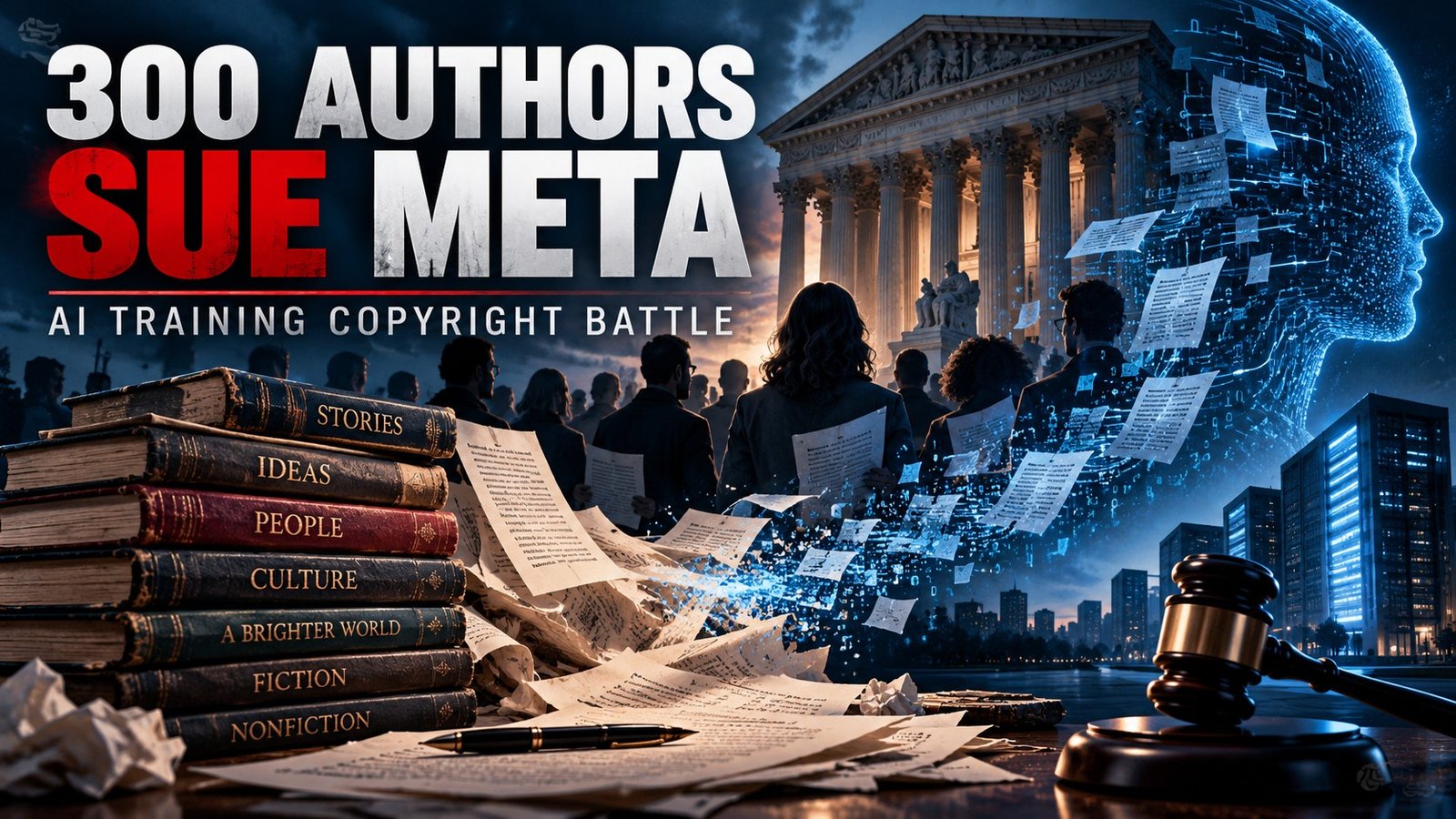
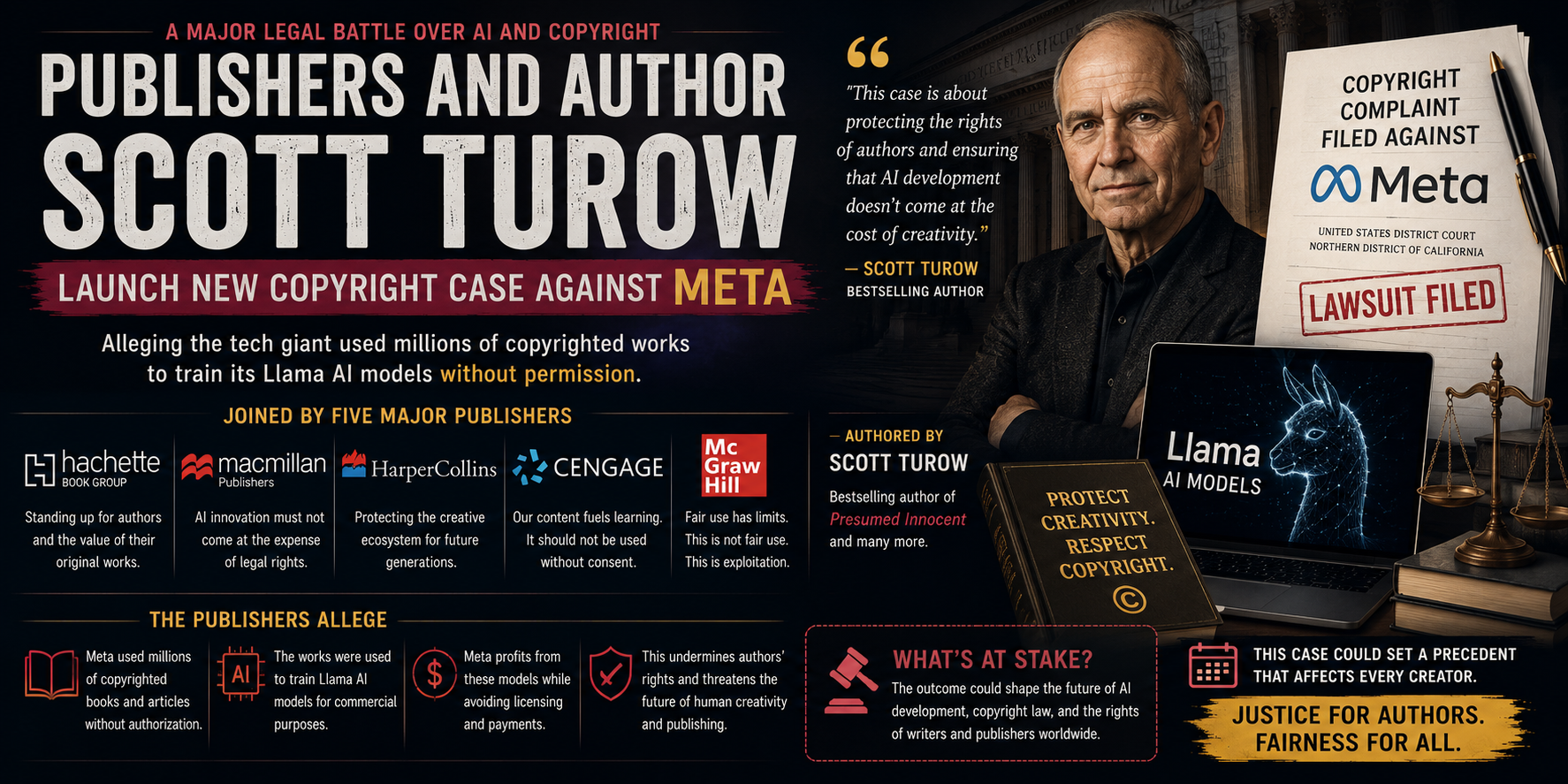
Nearly 300 authors have brought copyright infringement claims against Meta Platforms, accusing the technology company of using copies of their books without authorization to develop artificial intelligence systems. The complaints were filed on October 19, 2026, in the US District Court for the Northern District of California. Their publication this week adds a new dimension to a copyright struggle that has increasingly drawn novelists, publishers and technology companies into federal court.
The claims are not simply a repeat of earlier lawsuits over Meta's Llama models. The writers are pursuing their own claims rather than asking a court to certify a single broad class of authors, and their allegations also describe an internal book-scanning effort called Project Vellum. According to the complaints, Meta acquired printed books, scanned them and used the resulting text for AI training without securing additional licenses. Meta has not been found liable in these proceedings, and allegations in a complaint should not be mistaken for judicial findings.
Reporting by Bloomberg Law on October 20 and Publishers Weekly on October 21 brought details of the filings to a wider audience. The cases have attracted attention not only for the number of writers involved but for the choice to pursue potentially individualized damages. That approach carries significant legal uncertainty, yet it signals that some authors are dissatisfied with the scale of compensation available through large settlements.
The central development
Authors challenge both alleged digital piracy and the scanning of purchased print books
The lawsuits focus on how copyrighted works were obtained and copied for AI training, and whether legal ownership of a physical book permits reproduction of its text. No court has resolved those allegations in these new cases.
👥
Claimants
Nearly 300 authors
⚖️
Court
Northern District of California
📚
Core dispute
Copyrighted books and AI training
📚 Who is suing Meta—and what was filed?
The writers include Jacqueline Winspear, known for her Maisie Dobbs mysteries, memoirist Reyna Grande, novelist Mark Spragg, journalist Rachel Nuwer and other authors working across fiction, memoir, history and nonfiction. This breadth matters. The dispute is not confined to one bestselling series or a single publishing house: the plaintiffs claim that the same methods of obtaining and copying books could affect creative work across very different genres.
The authors are represented by attorneys from Freedman Normand Friedland and Stris & Maher. Publishers Weekly identified five complaints—Winspear, Levine, Reno, Sheard and Older v. Meta Platforms—which group multiple named plaintiffs while allowing them to assert their own rights. That distinction is important: nearly 300 individual claimants does not mean nearly 300 separate lawsuits were filed on October 19. Court docket information independently confirms that Winspear v. Meta was filed on that date.
Attorney Kyle Roche told Publishers Weekly that his firm represents more than 2,200 authors and intends to bring up to 1,000 individual claims by the end of 2026. Those are the lawyers' stated plans, not additional lawsuits already filed. The number of people who ultimately proceed, the claims that survive procedural scrutiny and the eventual outcome of any trial remain open questions.
🤖 What do the authors accuse Meta of doing?
The first allegation concerns digital books allegedly obtained from so-called shadow libraries, including LibGen, Z-Library and Anna's Archive, as well as a dataset known as Books3. The plaintiffs say Meta downloaded or otherwise acquired unauthorized copies and used their contents to develop language models. The complaints also allege the use of BitTorrent, which can involve distributing parts of files to others while downloading, and the removal of copyright-management information from copied material.
The authors argue that training an AI system requires acts of reproduction for which the company lacked permission. That is a legal claim, not an established fact about every work named in the litigation. Meta and other AI developers have maintained in earlier copyright disputes that using copyrighted material to train systems capable of producing new outputs can qualify as fair use under US law. Whether such a defense applies depends on the specific conduct and evidence presented in court.
A second allegation is especially notable because it involves books purchased in print. The writers claim that purchasing a physical copy is not equivalent to receiving permission to make new digital copies for a commercial training program. Buying a novel allows someone to own that particular object; it does not automatically grant every right associated with the text printed inside it. The courts will have to assess how copyright law applies to the activities actually proven in these cases.
🔍 Project Vellum: why the alleged book-scanning program matters
According to the complaints described by Publishers Weekly, Project Vellum was a Meta initiative that began around the middle of 2025 and involved buying printed books in quantity, scanning them and using extracted text for model training. The complaints connect the alleged activity to Meta's Muse models. The program's scope, the precise works involved and any permissions obtained are matters for evidence and legal argument; they should not be treated as independently proven simply because the plaintiffs described them in a filing.
The distinction between acquiring and reproducing a book goes to the heart of the controversy. When a reader buys a book, the transaction ordinarily transfers ownership of that physical copy, not ownership of the author's copyright. A technology company might contend that making copies for machine learning is legally transformative, while writers may argue that scanning thousands of protected works substitutes an unlicensed reproduction process for a market in which publishers and authors could negotiate permission.
That disagreement is precisely why the new claims matter. They ask a court to look not only at what an AI model eventually produces, but at the earlier steps through which a library of training material is assembled. Even if training itself qualifies as fair use in some circumstances, the manner in which source books were acquired could remain legally significant. The answer is not settled merely by labeling a process artificial intelligence.
⚖️ Why the authors are choosing individual claims
Many lawsuits involving authors and AI companies have sought class-action treatment, allowing a smaller group to litigate on behalf of a much larger population. Such cases can be efficient and may ultimately produce settlements that compensate thousands of people. But a class settlement also spreads its proceeds across many claims, sometimes leaving individual writers with relatively modest payments. The new Meta plaintiffs have chosen a different strategy: preserve each author's ability to pursue a separate measure of relief within the coordinated litigation.
Their lawyers point to statutory damages under the US Copyright Act. Where the legal prerequisites are met and infringement is found willful, statutory damages can reach $150,000 per infringed work. That is a statutory ceiling in qualifying circumstances, not the amount any author has already won, and it should not be multiplied by the number of plaintiffs as though a total award were guaranteed. The amount, availability and basis of damages depend on factors including copyright registration, applicable claims and the court's findings.
The plaintiffs' preference for individualized claims also follows the widely discussed Anthropic copyright settlement, which Publishers Weekly describes as providing approximately $3,000 per eligible work. That comparison helps explain their legal strategy, but it does not establish that Meta's alleged conduct is equivalent to Anthropic's or that a court will award higher sums here. Legal victories can turn on narrow differences in proof, timing, model training procedures and the rights attached to each book.
📖 What earlier AI copyright decisions tell us—and what they do not
The new claims arrive in an unsettled legal landscape. In Kadrey v. Meta, a federal judge ruled in Meta's favor on the particular fair-use record presented, noting that the authors had not provided sufficiently persuasive evidence of market harm. That ruling did not establish that all AI training on copyrighted books is always lawful. A decision on a particular factual record is not a universal license to use every protected work without permission.
A separate Anthropic case also distinguished between questions about transformative AI training and the acquisition or retention of pirated book copies. Together, those rulings show why this wave of litigation cannot be reduced to a simple question of whether artificial intelligence is good or bad for literature. The judges will be asked to apply existing copyright principles to very specific acts: downloading, copying, scanning, retaining data and potentially creating outputs that affect markets for original work.
The authors' concerns about market harm extend beyond the original act of copying. Some contend that large volumes of inexpensive AI-generated writing could compete with professionally authored books, weakening demand and undermining the economic value of their work. Whether that argument can be supported with evidence sufficient to affect the fair-use analysis is another question. Predictions about the future book market are not substitutes for proof in an individual legal case.
🗣️ What have Meta and authors' organizations said?
At the time of Bloomberg Law's October 20 report, Meta had not immediately returned its request for comment on the new filings. That absence of a response should not be interpreted as an admission. In earlier AI copyright cases, Meta has argued that model training can constitute fair use. Its position in these newly filed proceedings may develop as the company formally responds to the complaints.
The Authors Guild, meanwhile, has voiced support for writers seeking accountability while also emphasizing the value of collective action. Its chief executive, Mary Rasenberger, welcomed scrutiny of the alleged mass-scanning operation but maintained that well-constructed class actions can protect creators working together. The disagreement is one of tactics rather than an indication that the organization regards unlicensed copying as harmless.
For authors watching from outside the courtroom, the tension is understandable. Individual litigation can promise closer attention to a writer's own work, while collective cases may be more practical for people who cannot afford prolonged legal proceedings. Neither approach automatically guarantees compensation. The courts will still need to examine the rights, evidence and defenses relevant to each claim.
🌍 What could the lawsuits mean for the publishing industry?
These proceedings may influence how authors and publishers negotiate with AI developers. If courts find certain methods of gathering training materials infringe copyright, technology companies could face stronger incentives to license books, document the origin of datasets and establish clearer systems for permissions. Conversely, a broad fair-use ruling on a developed factual record might strengthen the legal position of companies training models on protected text. Neither outcome has occurred in these new cases.
The dispute is also about trust. Writers may accept that their published books can be read, discussed, quoted within legal limits and used as inspiration by other people. Many draw a line when those works are copied at scale into proprietary systems without consultation or payment. Technology companies see large datasets as essential to creating useful general-purpose models. The conflict becomes sharper when neither side agrees about what counts as a transformative use of existing literature.
For readers, the consequences may take longer to become visible. A court ruling will not immediately determine which novels are published next year or whether AI-written books belong on shelves. Yet decisions about sourcing training data can shape which companies bear the cost of creative work, whether publishers develop licensing businesses and how individual authors are compensated when their books contribute to commercial technologies.
🗓️ What happens next?
October 19, 2026
New complaints filed
Nearly 300 authors bring individual copyright claims organized across several multi-plaintiff complaints in federal court in California.
October 20–22, 2026
Details emerge in legal and publishing coverage
Bloomberg Law, Publishers Weekly and The Bookseller report the claims, alleged book-scanning program and strategy behind the lawsuits.
Late 2026 — planned
Potential additional filings
The plaintiffs' lawyers say they intend to bring more claims. Those future cases should not be counted as filed unless confirmed by court records.
2027 — related litigation
Other cases continue toward trial
Related Meta copyright proceedings have trial dates scheduled; the outcome of these new complaints is not yet determined.
The most important developments to watch will be Meta's formal responses, any judicial decisions about managing the multiple claims, and rulings addressing the alleged sources of training material. The plaintiffs have made serious allegations, but the essential questions—what Meta did, whether specific actions infringed copyright and whether any legal defenses apply—remain for the courts to decide.
🔗 Sources & References
📝
Editorial note (October 23, 2026): The plaintiffs' claims about pirated books, BitTorrent and Project Vellum are allegations, not findings of liability. “Nearly 300 authors” refers to individual claimants grouped into several complaints, not 300 separate cases. The $150,000 figure is a potential statutory maximum for qualifying willful infringement of a work, not a judgment or guaranteed payment.
Follow the Stories Changing Publishing
Explore authors' rights, literary industry news and the debates surrounding books and artificial intelligence.
More Literary News