📚
CASE FILED MAY 5 The proposed class action names Meta and Mark Zuckerberg as defendants.
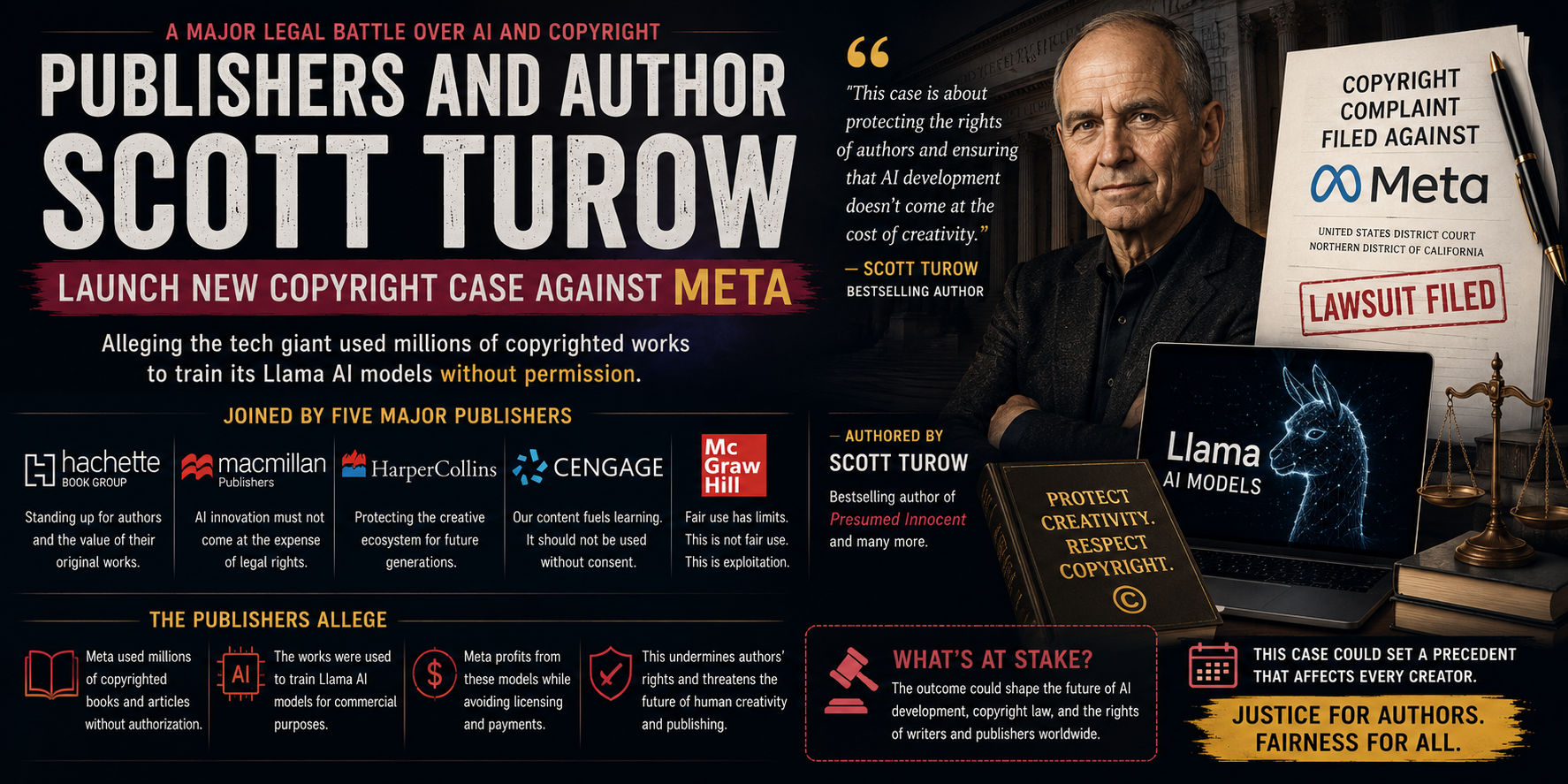
Five major publishers and novelist Scott Turow have opened a new front in the legal fight over books used to train artificial intelligence. The proposed class action, filed in Manhattan federal court on May 5, accuses Meta and Mark Zuckerberg of copying millions of copyrighted works to develop the Llama family of AI models.
The publisher plaintiffs are Elsevier, Cengage, Hachette, Macmillan and McGraw Hill. They say the case concerns literature, textbooks, scholarly writing and scientific material obtained without permission, including works from pirate collections.
Meta rejects the claim and says training AI on copyrighted material can qualify as fair use. No court has decided this new case. That point needs to remain clear because public arguments around AI often move much faster than lawsuits.
Legal status
The lawsuit has been filed, but the claims have not been decided
The plaintiffs seek class-action status and damages. Meta says it will fight the case and relies on fair-use arguments. The court must now work through questions about copying, piracy, licensing and market harm.
🏢
Defendants
Meta and Mark Zuckerberg
📚
Publisher plaintiffs
Five major companies
✍️
Author plaintiff
Scott Turow
⚖️ Who is suing Meta
The case brings together publishers from trade, education and scholarly markets. Elsevier publishes academic and scientific work. Cengage and McGraw Hill are major education publishers. Hachette and Macmillan publish commercial fiction and nonfiction across many imprints.
Scott Turow joins as an author plaintiff. He is known for legal novels including Presumed Innocent, and his presence gives the complaint an individual creator alongside the corporate publishers.
The Association of American Publishers describes this as the first AI lawsuit brought by major publishing houses. That makes it different from earlier cases led mainly by groups of authors, artists or news organisations.
The plaintiffs’ claim Meta copied and used millions of protected works without permission while developing Llama.
The proposed class The lawsuit asks to represent a wider group of copyright owners whose works may have been included.
Meta’s answer The company says courts have recognised that AI training can fall within fair use and says it will defend the case strongly.
📚 What books and materials are involved
The complaint reaches far beyond novels. It covers textbooks, journal articles, educational material and literary work. The plaintiffs argue that Meta benefited from the labour involved in writing, editing, fact-checking and publishing those texts.
Examples named in reporting include N. K. Jemisin’s The Fifth Season and Peter Brown’s The Wild Robot. The point of naming familiar books is not that the case concerns only bestsellers. It is that the alleged datasets crossed many parts of publishing.
The plaintiffs also focus on where the files came from. Their case is not only about what a model learns. It is about the alleged use of pirate libraries as a source for commercial development.
🧠 The fair-use argument at the centre
U.S. copyright law allows some unlicensed uses under fair use. Courts look at several factors, including the purpose of the use, the nature of the copied work, the amount taken and the effect on the market.
AI companies argue that training is analytical and produces a model rather than a replacement copy of each book. Publishers and authors answer that full works were copied, commercial systems were built from them and licensing markets are being bypassed.
The difficult part is that courts have not produced one simple rule for every AI training case. Decisions can turn on how files were obtained, what the model can reproduce and what evidence exists about market damage.
I think the source of the training material may become as important as the abstract question of learning. A company asking for broad fair-use protection has a harder public argument when the complaint says it chose pirate collections instead of licensed books.
The legal debate is not only about whether a machine can learn from a book. It is also about who copied the book, where the file came from and who was excluded from the deal.
Shadab Alam🏛️ Why publishers joining the fight matters
Publishers bring records that individual authors may not have. They can document contracts, edition sales, licensing negotiations, editorial costs and the commercial life of large catalogues.
They also have more money and legal capacity to sustain a long case. That does not make their claims correct by default. It means the evidence may look different from a lawsuit built only around a few named books.
The case may also pressure the industry toward licensing. Publishers want courts and AI companies to recognise that training access has value. Meta wants room to build systems without negotiating separately for every work. The business models are colliding in the courtroom because a shared market rule has not been agreed.
📅 What happens next
The court will consider Meta’s response, possible motions to dismiss, arguments over class certification and evidence about the training datasets. That process can take years.
Readers should be cautious when headlines describe the lawsuit as a victory for either side. Filing a detailed complaint is important, but it is the beginning of the case.
The outcome could affect authors who never appear in the courtroom. A ruling may shape whether future AI developers license large collections, rely on fair use, avoid pirate sources or build systems under new rules. For publishing, that makes this more than another technology dispute. It is a fight over whether books remain part of a market when machines need them at enormous scale.
May 5, 2026
Complaint filed
Five publishers and Scott Turow sued Meta and Mark Zuckerberg in federal court in Manhattan.
Next stage
Meta responds
The company has said it will fight the lawsuit and rely on fair-use arguments.
Later proceedings
Evidence and class questions
The court may examine dataset sources, copying, market harm and whether a wider class can be represented.
🔎 Sources used for this article
📝
Editorial note The complaint contains allegations that Meta disputes. No final ruling has been issued, and the article separates the plaintiffs’ claims from Meta’s response.