📜
NEW AUTHORSHIP STUDY: Researchers associate 23 text segments with Shakespeare and nine with Marlowe; the full study is expected in Shakespeare Quarterly.
For more than four centuries, the name missing from the title page of Edward III has been one of the most intriguing details about the play. The Elizabethan history drama was printed anonymously in 1596, and scholars have long suspected that at least some of its scenes were written by William Shakespeare. Yet the question of who wrote the rest—and how much of the play truly belongs to Shakespeare—has remained open to argument.
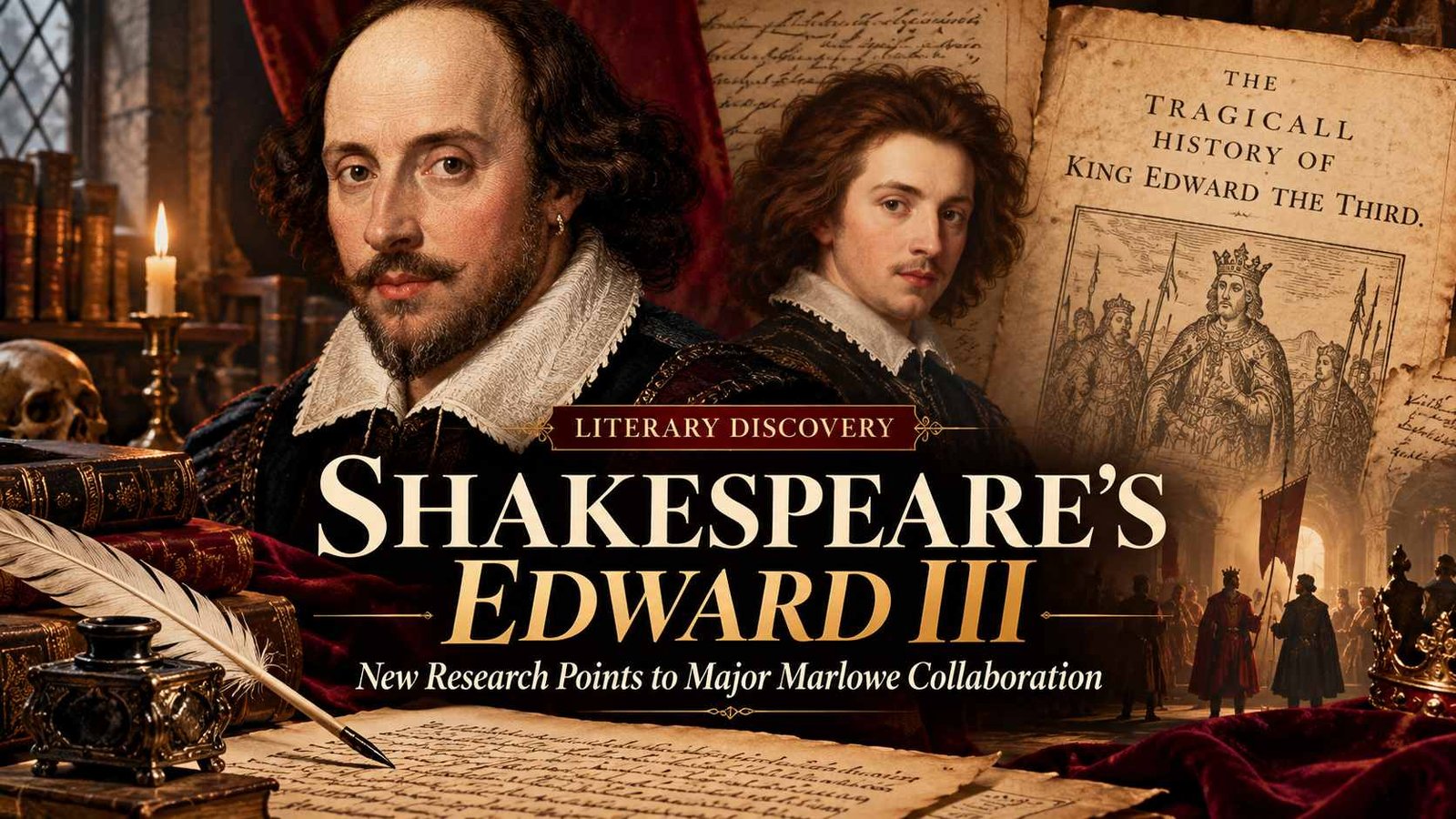
Now, new research by Dr Rory Loughnane of the University of Kent and Professor Brett Greatley-Hirsch of the University of Leeds offers a striking answer. Their computer-assisted study identifies Shakespeare as the play's principal writer and detects a significant contribution from his contemporary Christopher Marlowe, the author of Doctor Faustus. The findings were reported by The Guardian on October 18, 2026, with the scholarly study due to appear in Shakespeare Quarterly.
This is not the discovery of a previously unknown play. Edward III has been available to scholars and audiences for generations. What is new is the researchers' claim that the surviving language provides unusually strong evidence about the scale of Shakespeare's role—and that Marlowe, until now an unexpected candidate for this particular play, was working alongside him.
Research reported · October 18, 2026
A new argument for Shakespeare and Marlowe as major collaborators on Edward III
The researchers' statistical and linguistic comparisons suggest Shakespeare wrote the larger share of the play, while Marlowe made a substantial contribution. The findings are a scholarly attribution claim, not a newly discovered signed manuscript or an already settled consensus.
🗞️
First printed
1596, anonymously
✍️
Shakespeare matches
23 segments in one test
🎭
Marlowe matches
9 segments in one test
🔎 What exactly did the researchers find?
According to the newly reported study, the researchers compared Edward III with works securely attributed to ten dramatists active in the late 1580s and early 1590s. Rather than looking only for an isolated phrase that sounded Shakespearean, they examined recurring linguistic habits across different portions of the text. Such patterns can include characteristic word choices and the way writers distribute words through their verse and dialogue.
One of the reported tests classified 23 segments as Shakespearean and nine as Marlovian. That is the headline finding, but the distinction is important: those figures represent segments identified by a particular method, not 23 whole scenes by one writer and nine whole scenes by the other. They should not be treated as a precise percentage of the play or as direct evidence of which person physically wrote every line.
The evidence becomes more persuasive, the researchers argue, because several approaches point in a similar direction. Greatley-Hirsch told The Guardian that the case does not rest on one verbal resemblance or a single statistical calculation. Different ways of studying the language repeatedly distinguish patterns associated with the two dramatists.
What a linguistic “marker” means One example discussed in the reporting is the word martial, which appears characteristically in Marlowe's plays but is less typical of the other dramatists being compared. A marker is a clue, not a signature: scholars evaluate clusters of such evidence rather than assuming that one distinctive word proves authorship.
Loughnane has characterised the Shakespeare attribution as exceptionally strong. Still, literary attribution works through comparisons, assumptions about surviving texts and competing interpretations. Readers should understand the findings as a significant new research conclusion that other scholars will be able to assess in detail once the academic paper is published.
🎭 Shakespeare in the French camp, Marlowe in the closing scenes
The findings are especially interesting because they do more than attach two famous names to a title. The analysis associates particular dramatic moments with each playwright, offering a possible map of how their voices moved through the work.
A passage near the beginning of scene 13, in which a sudden darkness unsettles the French camp, is identified as Shakespeare's writing. The scene captures a moment of fear on the battlefield and is an example of how the study examines language within an actual dramatic context rather than treating the play as a single undifferentiated block.
Marlowe's contribution is detected in material toward the play's conclusion, where the military conflict reaches its final stages. Reporting on the study also points to Shakespeare's authorship of scenes involving the Countess of Salisbury and to Marlowe's hand in closing scenes concerning the French defeat.
This division may ultimately matter to directors and editors as much as to historians. A play understood as the work of two dramatists invites different questions about pacing, shifts in rhetoric and how various dramatic episodes relate to one another. But none of this means the researchers can reconstruct an Elizabethan rehearsal room or identify exactly when each scene changed hands.
📚 Why Edward III was missing from the First Folio
For many readers, Shakespeare's dramatic output is defined by the plays collected in the 1623 First Folio, published seven years after his death. Edward III was not included in that collection. Its anonymous original publication and absence from the Folio helped give it an uncertain place in the history of Shakespeare's works.
Anonymity was not unusual in the busy commercial theatre of the Elizabethan period, and the absence of a play from a famous collection is not by itself proof that Shakespeare had nothing to do with it. Manuscripts and printed editions were shaped by theatrical companies, publishers, collaborators and the accidents of preservation. The surviving book tells us that the play circulated, but its title page did not identify a playwright.
Modern editors have already explored the possibility of Shakespearean authorship. Loughnane edited Edward III for the New Oxford Shakespeare: Complete Works in 2016, when Shakespeare's contribution to certain scenes was recognised as probable. The play had appeared in other modern Shakespeare-related editions before that. Consequently, the new study does not bring Edward III into discussion for the first time; it dramatically expands the claimed extent of Shakespeare's involvement and adds Marlowe to the picture.
That distinction is central to the news. The most accurate way to describe the discovery is that it strengthens and changes an existing authorship debate. Whether future reference editions adopt the exact Shakespeare–Marlowe division remains a decision for editors and the wider scholarly community.
⚔️ What is the history play Edward III about?
Edward III dramatises episodes from the reign of the English king who ruled from 1327 to 1377, with its central action looking toward the early phases of the Hundred Years' War. The play moves between royal desire, political obligation, military ambition and the demands placed upon a king and his household.
One important strand involves the king's pursuit of the Countess of Salisbury. Another follows the war against France, including battles and the fortunes of the king's son, the Black Prince. These contrasting parts give the drama room to shift between intimate moral conflict and larger displays of military honour.
That mixture has long made the play a compelling problem for attribution scholars. Its changing tone and dramatic focus can be approached as one playwright working across different modes—or as evidence of several writers contributing to the same theatrical project. The new research favours the second possibility and proposes a more specific pair of collaborators.
🤝 Were Shakespeare and Christopher Marlowe collaborators rather than rivals?
Shakespeare and Marlowe are frequently placed side by side in accounts of Elizabethan drama. Both were born in 1564, both became associated with the rapidly expanding London theatrical world, and both helped change what English stage writing could sound like. Yet popular retellings often cast them as rival geniuses, each working independently toward literary immortality.
The reality of the period's theatre was rarely so solitary. Companies needed fresh material, plays could be revised, and writers sometimes shared projects. Scholarship has increasingly paid attention to collaboration as a normal feature of the industry's working life, rather than an embarrassing exception to the idea of individual genius.
Loughnane has already studied evidence linking Shakespeare and Marlowe in the Henry VI plays. A 2022 academic article, Shakespeare, Marlowe, and Traces of Authorship, examines documentary and attribution evidence around their early dramatic work. Against that background, an additional shared project around 1592 would suggest a more sustained professional relationship than the simple rivalry narrative allows.
The dates also explain why the implications are notable. Marlowe died in 1593, aged 29, leaving a remarkably short career behind him. If Edward III was jointly composed before his death, it would place two major dramatists at work together during a formative stage of Shakespeare's development.
Why the distinction matters Finding traces of influence is different from finding evidence of collaboration. One playwright could imitate or learn from another without working alongside him. The new study argues that the linguistic pattern is better explained by substantial writing contributions from both authors, though the precise circumstances of their cooperation are not documented.
💻 Can computers really identify a 400-year-old playwright?
Computer-assisted authorship analysis, often called stylometry, compares measurable features of writing across known and disputed texts. In early modern drama, those features can help researchers ask whether a play resembles one author more consistently than another, even when the title page provides no answer.
The process begins with a reference corpus: texts whose authorship is considered relatively secure. A disputed work is then divided into comparable units and tested against patterns from that corpus. Differences in vocabulary, recurring word combinations and other linguistic habits can provide clues. The new Edward III analysis reportedly used multiple methods and comparison material from ten dramatists.
There are limits. Plays survive through printings and copies that may include revisions. Writers can adapt their style to a scene, genre or collaborator. A text may preserve additions by someone other than its first author. Short passages can also be harder to classify than longer samples. That is why responsible literary scholarship generally considers a mixture of historical context, textual evidence and statistical patterns.
The most important advance here is not simply that a computer produced a name. It is that two researchers report converging linguistic evidence which, in their interpretation, changes the balance of a longstanding scholarly argument.
📰 What happens next for the Shakespeare canon?
The research is expected to be published in Shakespeare Quarterly later in 2026. That publication will give other academics a fuller opportunity to scrutinise its methods, samples and attributions. As of this article's publication, the complete new study had not yet been independently assessed here as a published journal paper; the findings are drawn from researchers' reported statements and the available reporting.
Loughnane's forthcoming book, Shakespeare at Thirty, is also expected to explore the playwright's early career. Meanwhile, the exhibition The Making of Marlowe is running at the Beaney House of Art & Knowledge in Canterbury through November 22, 2026, offering a broader look at Marlowe's world.
For future editions, theatres and classrooms, the question is not whether readers must abandon the Shakespeare they know. It is whether Edward III should be understood more confidently as a major Shakespearean history play—and whether Christopher Marlowe deserves a newly prominent place beside him in its authorship.
The most intriguing outcome may be a change in perspective rather than an addition to a reading list. Shakespeare's early career looks less like the sudden emergence of an isolated genius and more like the story of a playwright developing his craft in a busy, collaborative theatrical world. Edward III, long standing just outside the centre of the Shakespeare canon, may now become one of the clearest places to study that world.
🗓️ Key dates in the Edward III authorship debate
Circa 1592
Proposed period of composition
The newly reported research situates the possible Shakespeare–Marlowe collaboration in the early 1590s.
1593
Marlowe dies
Christopher Marlowe dies aged 29, limiting the period in which the two playwrights could have collaborated.
1596
Edward III is printed anonymously
The surviving early edition gives no named author on its title page.
1623
Omitted from the First Folio
The play is absent from the famous posthumous collection of Shakespeare's dramas.
2016
Modern Shakespeare edition considers partial authorship
The New Oxford Shakespeare includes the play while discussing Shakespeare's likely involvement in some scenes.
October 18, 2026
New research findings reported
The authorship analysis identifies Shakespeare as the principal writer and Marlowe as a substantial collaborator.
Later in 2026
Scholarly study expected
The researchers' full findings are scheduled for publication in Shakespeare Quarterly.
🔗 Sources & References
📝
Editorial note (October 19, 2026): The 23-to-nine result refers to segments classified in one reported analysis, not definitive proportions of the entire play. Authorship conclusions are those of the named researchers. The forthcoming full study had not yet been examined as a published article at the time this report was prepared, and scholarly acceptance of its precise attributions may evolve.
Explore More Literary Discoveries
Follow Epiloguely for original reporting on authors, literary history, major book announcements, publishing trends and the stories changing how we understand literature.
Read More Literary News