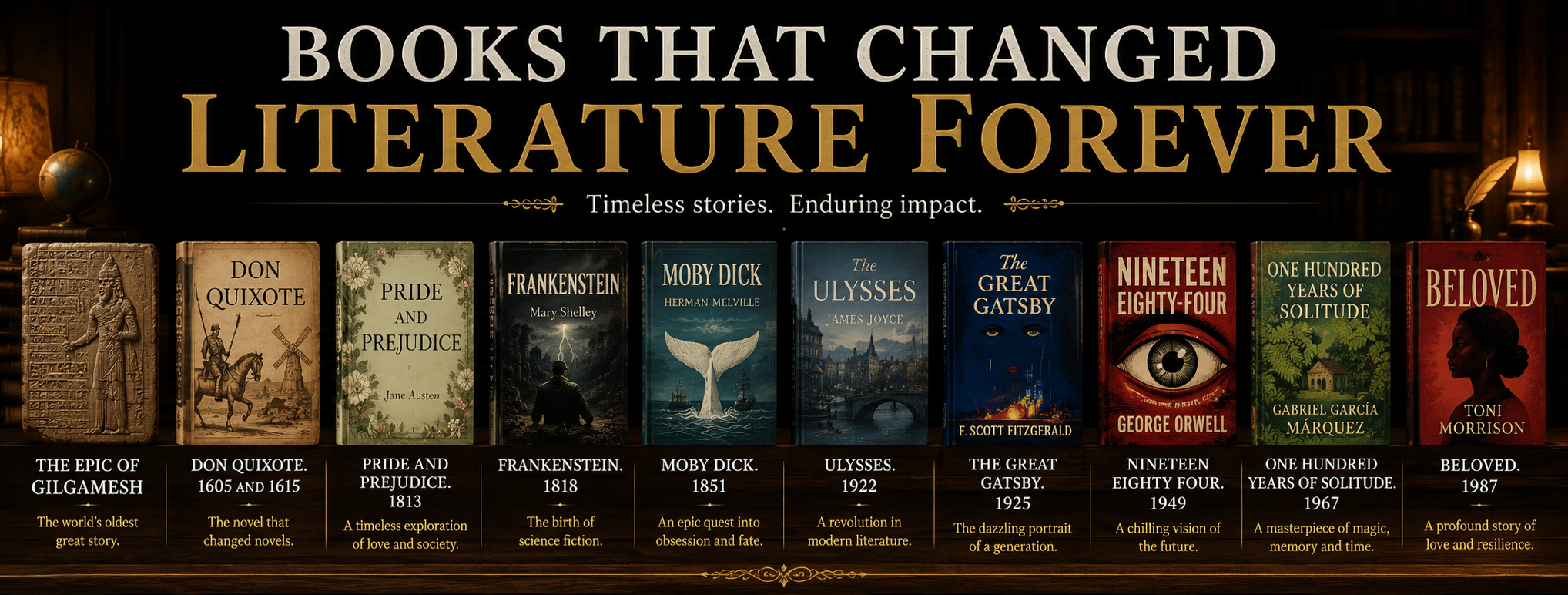
I love reading old books because they remind me that every style we now think is normal had to begin somewhere. At one point a novel about an ordinary person's private thoughts felt new. A story told in a broken order felt risky. A woman creating one of the most famous monsters in literature felt almost impossible.
The books in this article did not change literature in the same way. Some changed the shape of the novel. Some gave a voice to people who had been pushed aside. Some created a new kind of character. Others showed that language itself could be broken, rebuilt and made strange again.
This is not a perfect list of every important book ever written. No list could do that. These are ten works that helped move literature into a new place. Even when I do not personally love every page, I can still see the mark they left behind.
🏺
Oldest work
The Epic of Gilgamesh
⚡
Science fiction
Frankenstein
🌿
Magical realism
One Hundred Years of Solitude
🕊️
Memory and history
Beloved
A book changes literature when later writers cannot write in quite the same way after it appears.
the idea behind this list
10
Books that pushed storytelling in a new direction
4000+
Years of literary history covered by this list
8
Different centuries represented here
1
Question behind every choice. What changed after this book?
📚 Ten Books That Changed the Direction of Literature
Ancient literatureWhy it matters
Long before the modern novel, this poem was already asking questions that still feel familiar. What makes a good life? Why do people fear death? Can friendship change who we are? Gilgamesh begins as a powerful ruler who thinks strength is everything. Loss forces him to see the world differently.
What moves me most is how human it feels. The world around the poem is very far from mine, but the grief does not feel distant. The desire to leave something behind does not feel old. This work reminds me that literature began with the same fears and hopes we still carry.
It helped establish one of literature's oldest patterns. A proud person leaves home, suffers, learns and returns changed.
The modern novelComedy and sadness
Don Quixote follows a man who has read so many stories about knights that he decides to become one. He sees giants where other people see windmills. He turns ordinary inns into castles. At first the idea sounds like a simple joke, but the book becomes much more than that.
Cervantes plays with the difference between stories and real life. He makes fun of old romances while also showing why people need dreams. Don Quixote is foolish, but he is not empty. I laugh at him and feel sorry for him at the same time.
The book helped make room for the self aware novel. It knows it is a story and keeps asking what stories do to the people who believe them.
Social novelVoice and character
I think people sometimes reduce Pride and Prejudice to romance. The romance is important, but the book changed literature because of how closely it watches people. Austen understands pride, money, family pressure and the small ways people lie to themselves.
Elizabeth Bennet feels alive because she is clever and also wrong. She can read other people well, but she does not always read herself clearly. That balance made space for a new kind of heroine. She is not perfect, silent or waiting to be saved.
Austen showed how a drawing room, a dinner and a marriage proposal could reveal an entire social system.
Science fictionEthics
Frankenstein is often remembered as a story about a monster. When I read it, I see a story about a creator who refuses to care for what he creates. Victor Frankenstein wants the glory of discovery, but he does not want the responsibility that follows.
Mary Shelley brought science, fear and moral questions together in a way that still shapes fiction today. Every story about artificial life, dangerous invention or a creator losing control owes something to this book.
The book made scientific possibility part of a serious moral and emotional story.
American literatureObsession
Moby Dick is a sea story, but it is also a book about obsession, work, nature, faith and the limits of knowledge. It contains adventure, long descriptions, philosophy and even chapters that feel like a guide to whales.
I understand why some readers struggle with it. The book keeps changing shape. That is also what made it important. Melville showed that a novel did not have to stay neat. It could be messy, huge, difficult and still feel alive.
Captain Ahab became one of literature's clearest pictures of a person destroyed by the thing he cannot stop chasing.
🖋️ The Books That Changed Modern Writing
ModernismExperimental writing
Ulysses follows people moving through Dublin during one day, but the book does not tell that story in a simple way. Joyce changes styles, enters the movement of thought and turns daily life into something large and strange.
I will be honest. It is not an easy book. There are pages where I feel lost. Still, its influence is hard to ignore. It showed writers that a novel could follow the mind itself, including sudden memories, unfinished thoughts and private connections.
After Ulysses, the inside of the mind became a much wider place for fiction to explore.
Modern classicThe American dream
The Great Gatsby is not the longest or most complicated book here. Its power comes from how much Fitzgerald fits into a small space. Gatsby's parties look bright, but the sadness is always close. The dream looks beautiful because it can never fully become real.
I think this book changed literature through its control. The language is polished, the symbols are easy to remember and the emotional distance makes the tragedy stronger.
It became a model for the short literary novel that uses one private story to question an entire national dream.
Dystopian fictionPolitical language
Few books have added so many ideas to everyday speech. Big Brother, doublethink and thoughtcrime are now used far beyond the novel. That alone shows how deeply the book entered culture.
What still troubles me is not only the cameras or the government. It is the attempt to control memory and language. If people lose the words needed to describe freedom, resistance becomes harder to imagine.
Orwell showed that a novel could become a warning system. Readers still use its language when they feel truth is being changed in front of them.
🌍 Books That Opened New Worlds
Magical realismFamily and history
In this novel, impossible things happen and the characters often accept them as part of life. A woman rises into the sky. Ghosts remain close to the living. Time circles back on itself. The strange and the ordinary sit together without needing an explanation.
That balance changed how many readers around the world thought about realism. The book showed that history, memory, myth and politics could all live in the same sentence.
It helped bring Latin American literature to a much wider global audience and made magical realism one of the most recognised literary forms of the twentieth century.
History and memoryA haunting story
Beloved is one of the books that changed the way I think about historical fiction. It does not treat history as something finished. The past enters the house, the body and the language of the people who survived it.
Morrison writes about slavery through memory, fear, love and haunting. The structure is broken because the characters themselves are carrying broken memories. The form of the novel becomes part of its meaning.
Beloved showed how literary fiction could face historical trauma without making it clean, distant or easy to understand.
🕰️ A Simple Timeline of Their Influence
| Book and date |
Era |
What changed |
| The Epic of Gilgamesh | Ancient | Established lasting themes of friendship, loss and the search for meaning. |
| Don Quixote. 1605 and 1615 | Early modern | Helped shape the self aware modern novel. |
| Pride and Prejudice. 1813 | Regency | Showed how wit, character and social pressure could drive a major novel. |
| Frankenstein. 1818 | Romantic | Brought science, ethics and horror together in a new kind of fiction. |
| Moby Dick. 1851 | Nineteenth century | Expanded the novel into philosophy, adventure, fact and obsession. |
| Ulysses. 1922 | Modernist | Pushed stream of consciousness and experimental form into new territory. |
| The Great Gatsby. 1925 | Modernist | Made the short symbolic literary novel a lasting model. |
| Nineteen Eighty Four. 1949 | Postwar | Created a lasting language for surveillance, propaganda and control. |
| One Hundred Years of Solitude. 1967 | Postwar | Brought magical realism to a huge international readership. |
| Beloved. 1987 | Contemporary | Changed how historical trauma, memory and haunting could be written. |
What All These Books Have in Common
None of them stayed safely inside the rules of their time. Each one found a new way to speak about people, power, memory or the world. That courage is the real reason they still matter.
💬 Does an Influential Book Have to Be Easy to Love?
I do not think so. Some important books are difficult. Some are slow. Some belong to a time and culture that may feel far away. Influence and enjoyment are not always the same thing.
I can respect what Ulysses changed without pretending every page was easy for me. I can understand why Moby Dick matters while also admitting that some chapters tested my patience. Being honest about that does not make the books less important.
A book can change literature because it solves a problem, breaks a rule or gives later writers permission to try something new. Readers do not have to love every experiment. We only have to notice what became possible afterwards.
my advice for reading classics
Do not read only because a book is famous. Read with one clear question in mind. What did this book do that felt new at the time? That question often makes a difficult classic much more interesting.
📖 Final Thoughts
When I look at these books together, I see literature slowly learning new ways to speak. It learns to enter the mind. It learns to question society. It learns to mix myth with history and fact with imagination.
The Epic of Gilgamesh reminds me that our oldest stories were already asking the biggest questions. Don Quixote shows what happens when stories change how we see the world. Frankenstein asks creators to answer for what they make. Beloved shows that the past never stays quietly in the past.
These books changed literature because they gave later writers more freedom. They made the novel larger, stranger, more personal and more honest.
I may not return to every one of them in the same way, but I can still feel their presence in the books being written now. That is what it means to change literature forever.
📚 Discover More Important Books
Explore classic novels, modern favourites and books that continue to shape the way we read and think.
Explore More Blog Posts →