The Sally Rooney Effect and Why Modern Fiction Makes Us Feel So Lonely
Rooney did not invent lonely characters. She gave a new shape to the loneliness of people who are always connected, deeply self-aware and still unable to ask for what they need.
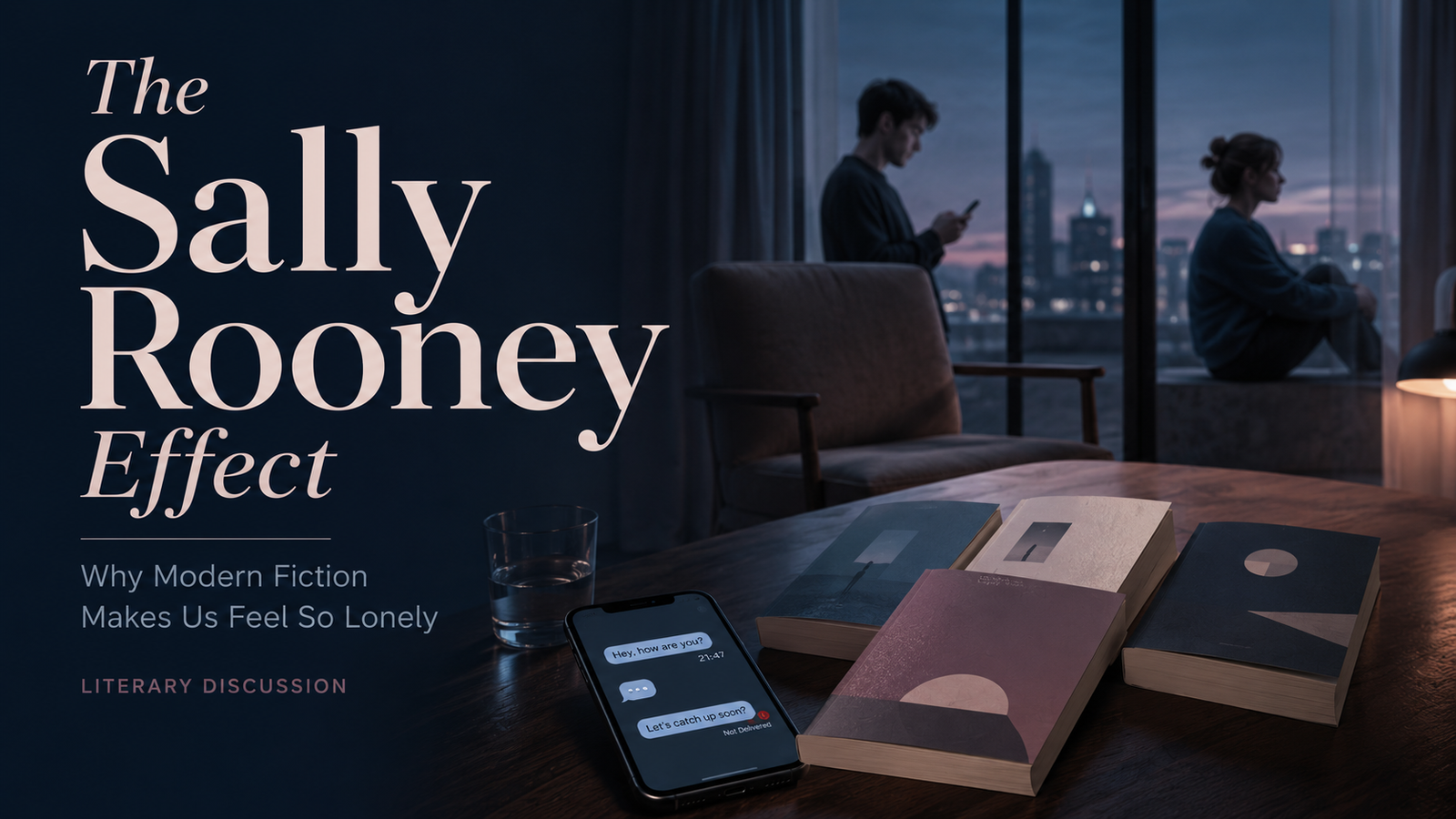
The simplest answer is that Sally Rooney makes loneliness feel familiar. Her characters are rarely alone in the ordinary sense. They have lovers, friends, families, group chats, parties and long email threads. They can reach one another in seconds. The pain comes from something harder to solve. They do not know how to turn access into closeness.
Because much of it follows people who are surrounded by communication but unsure how to speak plainly. Rooney helped make that tension central to popular literary fiction. Her characters understand power, class, sex and politics in sharp detail, yet a small honest sentence can still feel impossible.
That is what I mean by the Sally Rooney effect. It is partly a writing influence and partly a publishing label. After Conversations with Friends and Normal People, readers saw more novels marketed around clever young adults, difficult relationships, restrained prose and a cool surface covering real need. Some of those books were written before Rooney became famous. Many are distinct works that deserve to be read on their own. The comparison still became hard to escape.
Rooney’s own work is more complicated than the copy made from it. The books are not simply about sad people dating badly. They ask why love feels private when money, class, work, illness and social status keep entering the room. They also ask whether people can build mutual care without pretending that power has disappeared.
Rooney’s loneliest scenes often contain two people. The distance is not measured by an empty room. It is measured by the sentence neither person can say.
The emotional pattern running through her fictionWhat each Rooney novel adds to the feeling
Rooney’s four novels return to similar questions, yet each one changes the shape of isolation. Looking at them together makes the pattern clearer.
Conversations with Friends
Frances can analyse almost anything except her own need. She watches herself from a distance, even while an affair and a health crisis pull her into pain. Friendship, sex and intellectual confidence do not protect her from feeling unseen. The first-person voice makes that loneliness intimate because we know how much she notices and how little she admits.
Normal People
Connell and Marianne know each other with unusual depth, but class shame and fear repeatedly interrupt them. Their social positions change between school and university, while their private bond stays difficult to name. The novel hurts because a direct question could alter whole stretches of their lives, yet neither one feels safe enough to ask it.
Beautiful World, Where Are You
Alice and Eileen write long emails about politics, beauty and the future while their friendship carries its own unspoken strain. The emails are thoughtful and emotionally rich, but they also let both women shape themselves before being seen. The book catches a very current loneliness, the feeling of being articulate online and uncertain face to face.
Intermezzo
Peter and Ivan are brothers grieving the same father, yet grief does not bring them together. Their minds move differently and their anger protects older wounds. Romantic relationships give each man a route toward tenderness, while brotherly mutual care remains harder. The novel widens Rooney’s subject from couples to family and masculine isolation.
How Rooney turns closeness into distance
The lonely feeling does not come from plot alone. It is built into the way the books move. Rooney’s style keeps bringing us close to a character’s mind, then showing how little of that mind reaches another person.
Dialogue without quotation marks
Rooney’s dialogue often flows into narration without traditional quotation marks. Speech can feel less stable, almost as if the character is replaying it privately. The page removes a visual border between what was said and what was thought, while the emotional border stays firm.
Close minds and missing information
We often know why one character is frightened, ashamed or defensive, but the person beside them does not. That gap creates dramatic pain without a villain. A misunderstanding can survive because both people are acting from private knowledge they never share.
Messages that help and hide
Texts and emails give Rooney’s characters a space to be brave, funny and precise. They also give them time to edit. Digital communication is not treated as fake connection. It is real, useful connection that can still leave the hardest part untouched.
Money inside the love story
Rooney does not let romance float above ordinary life. Who has a home, who pays, who cleans, who has professional status and who can leave all change the emotional balance. A person may call a choice romantic while quietly depending on money they do not control.
The body says what speech cannot
Physical intimacy often gives the characters a temporary language. They can offer trust through touch before they can describe it. That can feel warm and painful at once because the clarity of the body may disappear when conversation returns.
Why this struck a nerve with modern readers
Loneliness is not the same as being physically alone. Researchers often define it as the gap between the relationships a person wants and the relationships they feel they have. That distinction fits Rooney’s fiction almost perfectly. Her characters may have active social lives and still feel that no one knows the part of them that matters most.
It is tempting to blame phones for this feeling, but the research is less simple. Studies of young adults have found that the quality and purpose of digital use can matter more than raw screen time. Online spaces can deepen comparison, harassment and withdrawal. They can also maintain friendship and make difficult conversations possible. Rooney’s novels understand that double quality. A message can be a bridge and a hiding place at the same time.
The books also arrived during a period shaped by insecure work, expensive housing and weak faith in old life plans. Her characters are educated enough to understand the systems around them, but knowledge does not give them control. They can explain capitalism at dinner and still struggle to pay rent, choose a career or decide what they owe a lover. That mix of intelligence and powerlessness feels very close to the experience of many younger readers.
What got me most while looking closely at these novels is how self-awareness becomes another defence. Rooney’s characters often know they are behaving badly. They can describe the pattern before repeating it. That knowledge does not free them because insight is not the same as courage. Modern fiction after Rooney has returned to this kind of person again and again, someone fluent in the language of attachment, politics and power who still cannot say, please stay.
The publishing version of the Sally Rooney effect
The effect was real, but the label became too broad
Rooney’s success made publishers eager to find readers who wanted literary fiction about sex, power and emotionally guarded young adults. Marketing copy began comparing many new writers to her, especially women writing in a dry or restrained voice.
Namwali Serpell later grouped a run of novels about young women and unequal relationships into what she called remaster novels. Titles by Naoise Dolan, Raven Leilani, Megan Nolan, Imogen Crimp and others were often placed in the same conversation. The grouping can be useful, but it can also flatten real differences in race, sexuality, form, humour and political focus.
The biggest Rooney influence may be commercial rather than technical. She proved that intimate literary fiction could become a mass cultural event. Publishers then tried to reproduce the audience by reproducing the surface. A distant narrator, an older lover and a few text messages are not enough. What makes Rooney work is the pressure underneath, the constant negotiation between private desire and social power.
This is why the phrase next Sally Rooney usually tells us more about publishing than about the writer being described. It creates an easy shelf. It also risks turning several gifted novelists into variations of one person. Rooney opened a door, but the writers who came through it did not all walk in the same direction.
Does Rooney romanticize bad communication?
Why the frustration works
The books make emotional avoidance feel costly. Silence is not presented as a cute obstacle placed between two perfect lovers. It damages trust, stretches pain across years and lets unequal situations continue. The reader’s frustration is part of the moral pressure.
Where the pattern can feel limited
Repeated hesitation can start to feel arranged. Some readers may wonder why intelligent people keep missing such clear openings for honesty. I understand that response. The style depends on believing that shame and fear can overpower language, even when the answer looks obvious from outside.
I do not think Rooney argues that pain makes love deeper. The books are more interested in whether love can survive once pain stops being treated as proof. Her strongest moments arrive when characters give up a little control and accept that another person cannot be managed like an argument.
Her novels are not as hopeless as they look
The grey covers, quiet prose and restrained characters can make Rooney seem like a writer of pure emotional coldness. That misses the care in the books. Again and again, the characters move toward mutuality, even when they reach it awkwardly and only for a moment.
In a 2024 conversation with Merve Emre, Rooney spoke about mutual ground in Intermezzo and the difficulty her brothers have finding it with each other. That idea reaches across all four novels. The characters begin from self-protection. A relationship changes when one person stops treating vulnerability as defeat.
The endings do not offer the solid comfort of a conventional romance. They leave room for movement, distance and uncertainty. Yet they usually contain some form of recognition. Someone has been seen more clearly. Someone has finally spoken with less disguise. For me, that is why the sadness does not feel empty.
The Sally Rooney effect is not that every modern novel became sad. It is that loneliness became visible inside ordinary intimacy, where love can be real and still fail to make people feel safe.
Why her influence still mattersModern fiction feels lonely because it has become honest about how connection works now. We can know a person’s location, typing status, politics and favourite song while remaining unsure whether they want us near them. Rooney found a clean literary form for that contradiction. Many writers have since explored the same mood in very different ways.
I think her lasting contribution is smaller and more human than the marketing label. She reminds us that being understood is not automatic, even between people who love each other. It takes language, risk and the willingness to hear an answer we cannot control.
Main research sources
Faber’s Sally Rooney author page for her official bibliography and publisher information.
The Paris Review conversation with Sally Rooney and Merve Emre for Rooney’s comments on mutuality, community, language and the novel.
Time’s essay on the Sally Rooney effect for the publishing response, cultural reach and marketing comparisons that followed her success.
Namwali Serpell’s essay on remaster novels for a critical account of the group of books repeatedly compared with Rooney’s early fiction.
The Environmental Risk Longitudinal Twin Study paper on lonely young adults in Britain for the distinction between social contact and felt loneliness.
Research on the causes of loneliness among young adults in London for the more careful view that the quality of digital use may matter more than time alone.
Stay With the Difficult Conversation
Explore more literary essays, book discussions and character studies on Epiloguely.
Explore More Blog Posts