
Why Piranesi May Be the Hardest Fantasy Novel to Adapt — and Why Everyone Wants to Try
Susanna Clarke built a novel out of endless halls, tides, statues, notebooks and a mind that does not fully understand its own story. Now both the Royal Shakespeare Company and LAIKA want to turn that private reading experience into something visible.
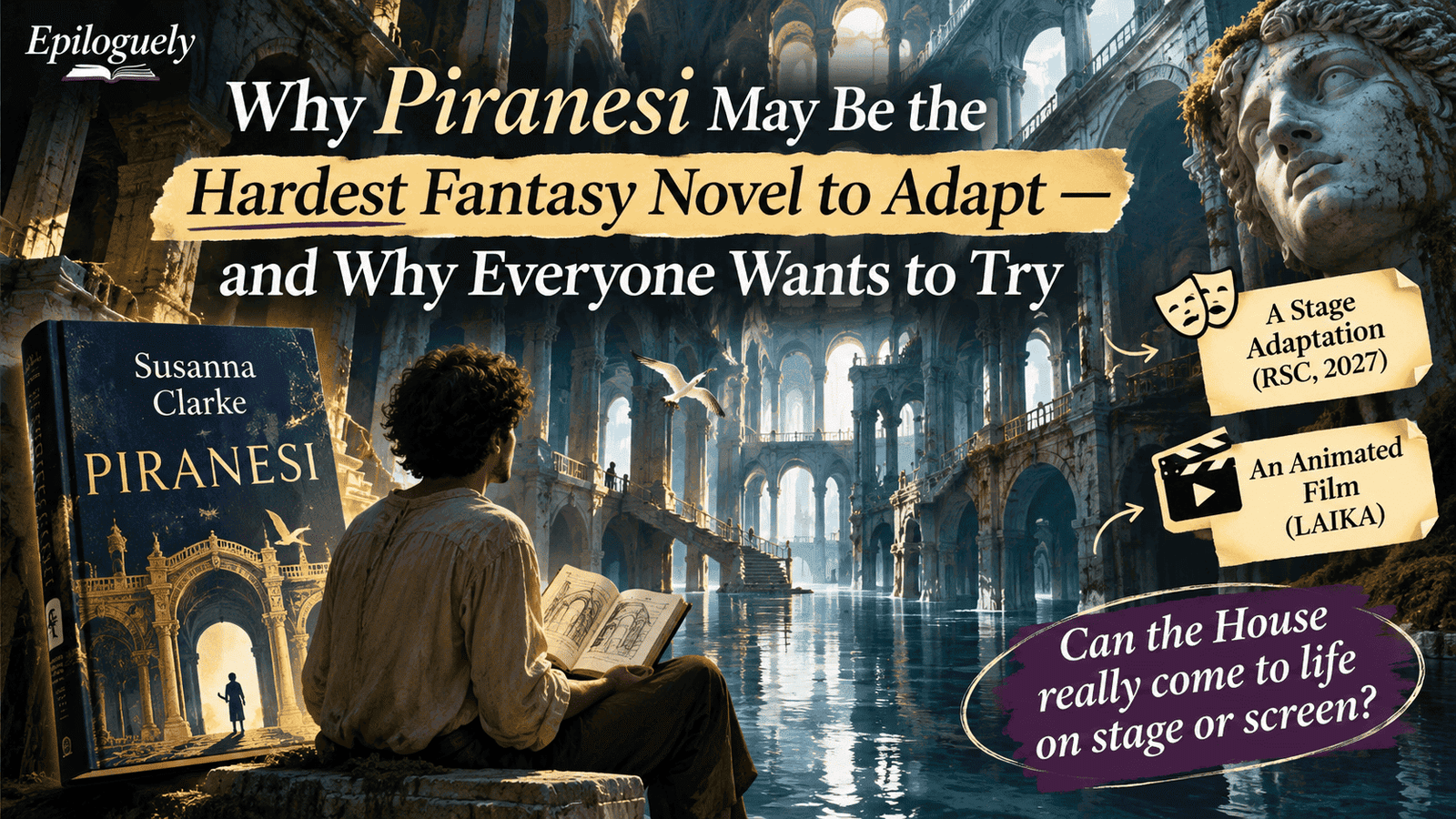
Imagine trying to adapt a novel whose most important character may not technically be a person.
In Susanna Clarke's Piranesi, the House is an impossible world of vast halls, thousands of statues, staircases flooded by tides and upper levels where clouds move through the architecture. Piranesi walks through it with patience and reverence. He records what he sees in journals. He cares for the dead. He meets a man he calls the Other. And because Piranesi accepts this world so completely, the reader initially has no choice but to accept it with him.
That is the magic trick. Clarke does not simply show us a strange place. She traps us gently inside one person's understanding of it.
Because its mystery depends on perspective rather than plot alone. The novel unfolds through Piranesi's notebooks, incomplete memory and deeply personal relationship with the House. A screen or stage adaptation must somehow show the world without revealing too much, preserve the loneliness without becoming visually static, and make an infinite architecture feel intimate rather than merely spectacular.
And yet two major adaptations are now moving forward. The Royal Shakespeare Company will premiere a stage version at the Swan Theatre in Stratford-upon-Avon from July 3 to August 21, 2027, adapted by Sami Ibrahim and directed by Ned Bennett. Meanwhile, stop-motion studio LAIKA is developing an animated film directed by Travis Knight, with screenwriter Dave Kajganich attached. Knight recently acknowledged the book's reputation for being “unfilmable” and said he was willing to take the challenge.
The House is huge, but the novel is strangely intimate
The easiest mistake would be to treat Piranesi as production-design heaven.
Of course the House is visually irresistible. Endless marble galleries. Classical statues. Ocean water surging through staircases. Birds crossing enormous chambers. Light entering spaces that seem far too large to belong to any human building.
A filmmaker could spend years designing those images. A stage company could build an extraordinary set around them. But if the adaptation becomes primarily about showing us how impressive the House looks, it may miss what makes the House matter.
Piranesi does not experience it as a fantasy attraction. It is home. He knows the tides. He notices birds. He catalogues statues. He treats the House as something benevolent and alive, not simply a puzzle that exists for him to escape.
The House only works if we feel two things at once: that it is impossibly vast, and that Piranesi knows it with the tenderness of someone walking through his own neighbourhood.
The central adaptation problemThat emotional contradiction is much harder to stage than an impressive flood.
The real special effect is Piranesi's mind
Clarke tells the story through journal entries. That gives the reader access not only to events, but to the system Piranesi uses to understand them. His dates, labels, observations and assumptions create the structure of the book.
On the page, we can notice a contradiction before he does. We can pause over a strange phrase. We can remember an earlier entry and realise that something no longer fits. The mystery is built collaboratively between narrator and reader.
Film usually wants to make information concrete. If a camera shows an object clearly, we know it exists. If it shows a room, we know what the room looks like. That certainty can be dangerous for a story where perception itself is part of the mystery.
Stage has the opposite limitation and perhaps the opposite advantage. Theatre cannot realistically build an infinite House, but it can make a small space behave psychologically. A door can become a threshold. A pool of light can imply another hall. Repetition can make architecture feel endless without literally constructing endless architecture.
Five reasons the novel resists adaptation
The story depends on restricted knowledge
The reader knows only what Piranesi knows, and even that information is filtered through his unusual memory and vocabulary. The tension comes from noticing gaps without immediately understanding them.
An adaptation that explains too much too early could turn a gradual revelation into a conventional mystery. One that hides too much risks leaving the audience emotionally detached.
Most of the emotional action happens inside one person
Piranesi contains mystery and danger, but it is not powered by constant external action. Much of the experience comes from how Piranesi thinks: his gentleness, curiosity, rituals and changing interpretation of evidence.
Voice-over could preserve the journals, but too much narration might make a film feel illustrated rather than dramatised. On stage, long monologues could preserve the language but flatten the mystery.
The House must feel infinite without becoming empty spectacle
An endless labyrinth is easy to describe and nearly impossible to fully show. Digital effects could build it. Stop-motion could sculpt it. Theatre could imply it. None of those choices automatically create the feeling Clarke creates on the page.
The audience needs to understand why Piranesi loves this place. If the House feels only threatening, one of the novel's most beautiful ideas disappears.
The novel changes genre while you are reading it
At first, Piranesi can feel like pure secondary-world fantasy. Then it begins to behave like a mystery. Then the emotional centre shifts again.
That instability is part of its pleasure. Screen marketing, however, likes clear promises. A trailer that sells only fantasy grandeur may prepare viewers for the wrong film. A trailer that explains the mystery may spoil the experience.
The book is short enough that every detail feels important
Unlike a sprawling fantasy series, Piranesi is compact. Clarke wastes very little. A detail that initially feels decorative can later become structurally important.
That makes cutting dangerous. But preserving everything would not necessarily create good theatre or good cinema either. Adaptation still requires compression and transformation.
The RSC may have one advantage film does not
Theatre is built on agreement.
A stage audience willingly accepts that one room can become ten rooms, that a lighting change can become evening, that a chair can become a carriage and that a few metres of floor can represent a journey across a country.
That willingness may be perfect for Piranesi.
Director Ned Bennett has a reputation for formally inventive work, while adapter Sami Ibrahim has previously worked across theatre that engages with history, politics and shifting perspectives. The RSC has also described Piranesi and its new Mrs Dalloway as part of a larger theatrical question about how to put inner life on stage.
The Swan Theatre itself may help. It is an intimate thrust-stage venue rather than a giant proscenium box. If the production allows the House to emerge around the audience rather than behind a frame, the limited physical space could become an advantage rather than a compromise.
Theatre cannot build an infinite House. It can do something stranger: convince us that the room we are sitting in has no edge.
Why stage might workAnd LAIKA may be the most logical film studio for it
If Piranesi must become a film, stop-motion is a fascinating choice.
LAIKA's best work has always depended on physical texture. Coraline turned buttons, fabric, miniature rooms and handcrafted faces into something simultaneously beautiful and unsettling. Kubo and the Two Strings, directed by Travis Knight, made myth feel tactile rather than weightless.
That matters because the House should not feel like an anonymous digital environment. Its statues, stone, water and architecture need weight. Piranesi touches things. He gathers things. He measures and catalogues. The physical world is central to his identity.
LAIKA acquired the rights in 2024, with Knight attached to direct. In 2025, Dave Kajganich — whose credits include Suspiria and Bones and All — was reported as the screenwriter. And in October 2026, Knight confirmed that the project remains in development, explicitly acknowledging that people have called the novel unfilmable.
That does not mean the film will arrive soon. Knight has also warned that LAIKA's stop-motion process takes time and that none of its next projects is right around the corner. For a book this delicate, that may be reassuring.
Why stop-motion could work
Miniature architecture can make the House feel physically real. Repetition of handmade statues and halls can create both beauty and unease without the polished sameness of a purely digital maze.
What could still go wrong
A visually astonishing House could overwhelm the quiet emotional story. The adaptation still needs to make Piranesi's innocence, trust and changing self-knowledge more important than the production design.
The biggest danger is explaining the mystery too well
Modern adaptations often fear audience confusion.
A strange detail becomes a line of explanatory dialogue. A symbolic image becomes a flashback. A character's uncertain memory becomes a clean timeline. The logic becomes easier to follow, but the atmosphere becomes thinner.
Piranesi cannot afford that trade.
The novel works because the reader slowly understands that the categories Piranesi uses are incomplete. Clarke gives us clues without announcing that they are clues. We are allowed to feel the world change shape underneath us.
A good adaptation therefore needs confidence. It must trust viewers and theatre audiences to sit inside uncertainty. It must allow silence, repetition and unanswered questions to exist long enough to become meaningful.
That is unusual in an entertainment culture that increasingly competes for divided attention. It is also exactly why the project is exciting.
Why readers will care even if the adaptations fail
Piranesi won the 2021 Women's Prize for Fiction and became a major bestseller, but its reputation has grown through something more intimate than awards. Readers hand this book to other readers with a peculiar warning: know as little as possible before you begin.
That kind of recommendation is powerful because it treats discovery as part of the artwork.
The RSC production and LAIKA film will inevitably change that relationship. Posters will show the House. Casting will give Piranesi a body and voice. Trailers will choose what imagery to reveal. People who have never opened the book may meet its world visually first.
That is not automatically a loss. A great adaptation can create a second doorway into a story. It can make readers return to the novel and notice things they missed. It can reveal a new interpretation of a familiar scene.
But Piranesi is the rare case where the adaptation will be judged not only by what it shows, but by what it has the courage not to show too quickly.
The perfect Piranesi adaptation should leave us with the same strange feeling as the novel: that we have understood the mystery and somehow made the House more mysterious.
My final viewThat is why the next year will be so interesting. The RSC will test whether the House can exist in a room full of live people. LAIKA will test whether a handmade film can make infinity feel physical. Both will have to solve the same impossible problem.
How do you adapt a story whose greatest power comes from the fact that the reader cannot see the whole thing?
Maybe you do not solve it completely.
Maybe you build another labyrinth.
For more on why publishers and studios keep returning to books for screen material, read our feature From BookTok to the Big Screen: How Viral Books Become Movies. You can also explore our guide to the most anticipated new books of October 2026.
Sources & References
Royal Shakespeare Company — Piranesi for the official 2027 production dates, creative team and RSC description of the stage adaptation.
Royal Shakespeare Company — Spring/Summer 2027 announcement for the world-premiere status and production details.
The Guardian — RSC embraces the challenge of staging Piranesi for comments from the RSC about adapting highly interior novels for the stage.
Bloomsbury — Piranesi for the novel's official synopsis, publication details and description of the House.
Women's Prize — Susanna Clarke wins the 2021 Women's Prize for Fiction for the novel's prize history and contemporary assessment of its originality.
Animation World Network — LAIKA to adapt Piranesi for the official 2024 film announcement and Travis Knight's involvement.
Animation World Network — Dave Kajganich joins Piranesi for the 2025 screenwriter announcement.
Collider interview with Travis Knight, October 2026 for Knight's current comments on Piranesi, its “unfilmable” reputation and LAIKA's development timeline.
Would you rather see the House on stage or in stop-motion?
Explore more literary adaptations, publishing trends, author features and book culture on Epiloguely.
Explore Epiloguely