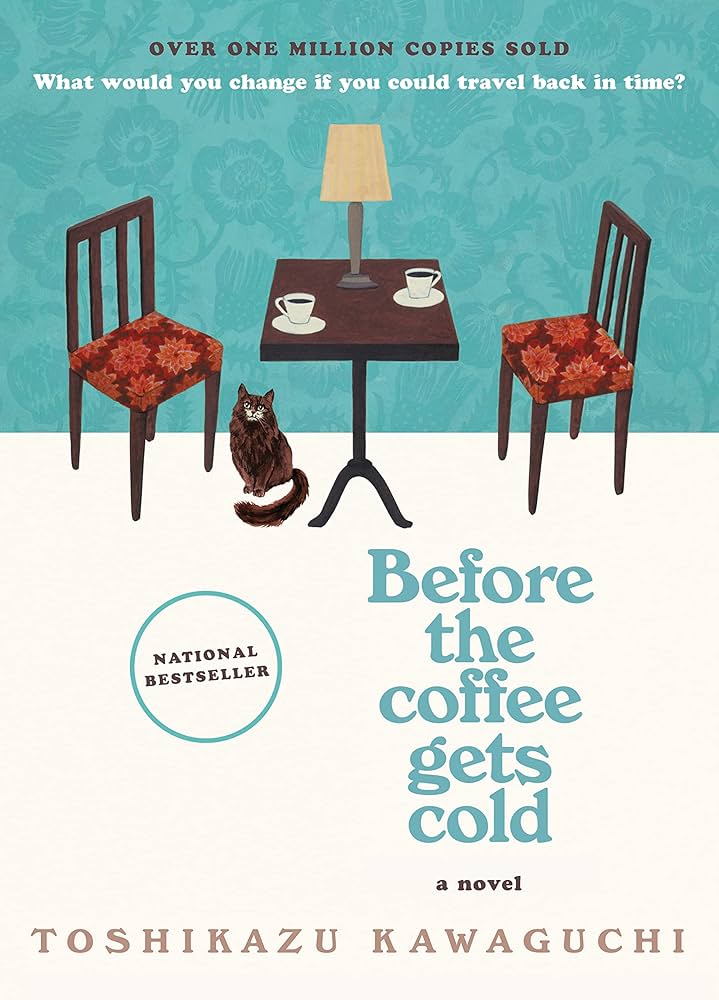
Before the Coffee Gets Cold Review
| Published | 2019-09-19 |
| Series | Before the Coffee Gets Cold |
| Genre | Magical Realism, Contemporary Fiction |
| Language | English |
| Publisher | Picador |
| ISBN-10 | 1529029589 |
| ISBN-13 | 9781529029581 |
📝Before the Coffee Gets Cold — My Honest Review
Written and reviewed by Shadab Alam. The opinions and rating in this review are my own.
Summary:
A small Tokyo café allows visitors to travel to the past under strict rules, including returning before their coffee gets cold. The story is shaped by the travelers matter more than mechanics, and every story asks what can change when events cannot. Its strongest elements include the café ritual, limited seat, repeated rules, and emotional focus on unfinished conversations, while its larger concerns are regret, grief, communication, family, love, time, acceptance, and the value of speaking honestly. The result is a magical realism novel that combines a clear narrative situation with questions that continue beyond the ending.
✅ What I Liked
I especially liked the café ritual, limited seat, repeated rules, and emotional focus on unfinished conversations. Those elements gave the book its most memorable emotional and visual identity. The story is strongest when it trusts scenes, objects, routines, and conversations to reveal its ideas without stopping to explain everything. The character work also stayed with me: the travelers matter more than mechanics, and every story asks what can change when events cannot.
❌ What Could Be Better
My main issue was the prose can feel repetitive, rules are restated heavily, and emotions are sometimes explained. These choices did not ruin the reading experience, but they made some sections feel less convincing than the strongest parts. Readers expecting a very different rhythm or tone should know that before starting.
The setup is clear: A small Tokyo café allows visitors to travel to the past under strict rules, including returning before their coffee gets cold. The book lets this situation become normal before showing what that normality costs.
I was especially drawn to the connection between personality and pressure. The travelers matter more than mechanics, and every story asks what can change when events cannot. The best scenes are often the ones where nobody announces a change, but a refusal, joke, silence, or practical action makes it visible.
I kept returning to the café ritual, limited seat, repeated rules, and emotional focus on unfinished conversations. Those elements carry more weight than the loudest dramatic scenes because they show how the world works when nobody is performing for an audience.
Its main concerns include regret, grief, communication, family, love, time, acceptance, and the value of speaking honestly. None is new by itself, yet the combination feels specific because the story keeps asking what an idea costs in daily life and who has to pay for another person's belief.
Another thing I appreciated is that Before the Coffee Gets Cold understands its own scale. A private decision rarely stays private; it changes a friendship, household, institution, or imagined future. That keeps the larger ideas attached to ordinary feeling.
The book also understands that change rarely happens in one clean moment. People repeat old habits, recognize a truth, avoid it, and then return to it under different pressure. That pattern made the character movement feel earned. It was particularly effective beside the café ritual, limited seat, repeated rules, and emotional focus on unfinished conversations, because the memorable details became markers of how the same person could see the world differently over time.
The emotional tone is controlled enough that the strongest moments do not need to announce themselves. A practical decision or brief exchange often tells us more than a dramatic declaration. That approach suited the material because the travelers matter more than mechanics, and every story asks what can change when events cannot. The novel becomes most persuasive when it allows that contradiction to sit on the page without immediately deciding how the reader should judge it.
What stayed with me most was the sense that nobody is acting with complete information. Each person sees one portion of the problem and builds a confident story around it. The reader is gradually given a wider view, but even that view has limits. This makes the conflict feel less like a contest between correct and incorrect people and more like a collision between fear, need, history, and incomplete understanding.
Structurally, the reading experience is strongest when form and subject work together. When they do not, the book can feel longer or more arranged than necessary.
The novel is not equally successful everywhere. The prose can feel repetitive, rules are restated heavily, and emotions are sometimes explained I can see why another reader might accept those choices as part of the genre, but they kept me from giving the book an uncomplicated five stars.
What I carried away from the conclusion is that time travel changes the person who returns rather than changing the fixed past. The last effect comes from reinterpreting what appeared important at the beginning.
Overall, this is a 4.1/5 read for me. It gave me enough pleasure, discomfort, or thought to justify the time it asks for, even where I resisted it.
📊Shadab's Rating
🎭Vibe Check
Read spoilers, debates, and detailed user reviews in our discussion room.
Discover Your Next Great Read
Handpicked recommendations from our collection of literary treasures