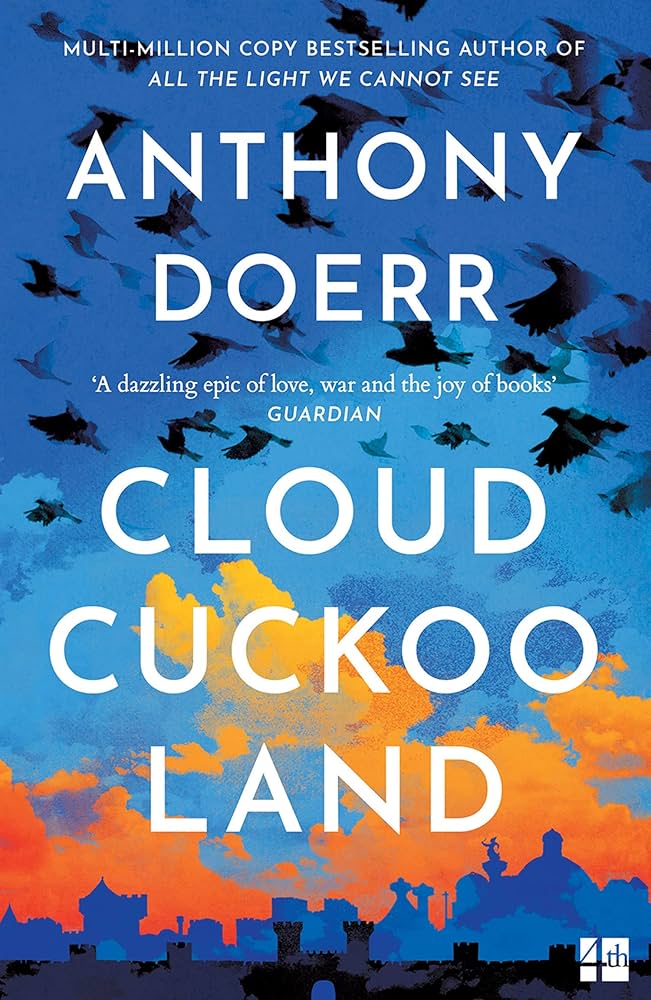
Cloud Cuckoo Land
| Published | 2021-09-28 |
| Series | Standalone |
| Genre | Literary Fiction |
| Language | English |
| Publisher | Scribner |
| ISBN-10 | 1982168439 |
| ISBN-13 | 978-1982168438 |
📝Honest Review
Summary:
Three different worlds, centuries apart, are held together by a single ancient story about a shepherd who turns into a bird and travels to a utopian city in the clouds. An orphan girl inside the walls of Constantinople in the 1400s, a lonely boy and an old man in present day Idaho, and a girl on a spaceship decades in the future are all touched by the same fragile text in different ways. It is about libraries and the survival of stories and what gets passed down across time even when everything else falls apart. It was a finalist for the National Book Award and spent over twenty weeks on the New York Times bestseller list.
✅ What I Liked
The structure is the boldest thing about this book and it is also the thing that makes it work so completely. Doerr is weaving together three timelines centuries apart, a besieged Constantinople in the 1400s, a small town in present day Idaho, and a generational spaceship sometime in the future, and somehow none of it feels like a gimmick.
Each thread earns its place because Doerr trusts the reader to hold the connections in mind rather than spelling them out constantly. Anna in Constantinople is one of the best child protagonists i have read in years, fierce and resourceful in a city that is about to fall, and her sections have a tension that genuinely had my heart racing even though i already knew, in the broad historical sense, how that siege ends. The way the ancient text about Aethon the shepherd threads through all three timelines, changing meaning slightly depending on who is reading it and why, is genuinely moving and it builds into one of the most satisfying meditations on why stories matter that i have read in fiction.
❌ What Could Be Better
The book is 626 pages and the spaceship sections set in the future, while necessary to the structure, were the ones i found myself least eager to return to compared to the historical and present day threads. Konstance's chapters have real emotional weight by the end but getting there required more patience from me than the Constantinople or Idaho sections did.
The sheer number of characters and timeframes also means that some side characters, especially in the Idaho thread, get less development than i wanted given how much time the book spends elsewhere. And the structure, while ultimately rewarding, asks a lot of you in the first hundred pages before the connections between the three timelines start to clarify, and i know readers who put it down before that payoff arrived, which is a real shame because the second half is so much stronger than the slightly disorienting opening suggests.
The book moves between three settings that have almost nothing obviously in common. Anna is an orphan inside the walls of Constantinople in 1453, working as a seamstress and slowly teaching herself to read, right as the Ottoman siege that will end the Byzantine Empire is closing in around the city. Seymour and Zeno are in present day Lakeport, Idaho, an awkward isolated teenager and an elderly Korean War veteran who is putting on a children's play in the local library, a play based on a strange ancient Greek text about a foolish shepherd named Aethon who wishes to become a bird and travels to a utopian floating city. And Konstance is a teenage girl aboard a generational spaceship called the Argos, traveling toward a new planet decades from now, raised entirely inside a vessel she has never left, also somehow connected to the same fragmentary old story.
What holds all of this together is the text itself, the story of Aethon, which exists in the novel as an actual ancient manuscript that survives in fragments across the centuries, passed down and nearly lost and rediscovered and copied and carried forward by people who have no idea of each other's existence but who are all, in their own way, saved a little by the same words. Doerr is writing about the fragility of how culture survives, how close we constantly are to losing things permanently, and how the people who copy and preserve and pass along stories, often unglamorous and unrecognized people, are doing something that matters more than they usually get credit for.
Anna's sections are the strongest in the book for me. Doerr writes the fall of Constantinople with real historical weight and real human stakes, and Anna herself, sharp and hungry and increasingly desperate as the siege tightens, is one of the most vivid characters in recent literary fiction. There is a sequence involving her and her sister and the city's final days that genuinely had me holding my breath even though the broad historical outcome was never in doubt.
Seymour and Zeno in Idaho are doing something quieter and in some ways sadder. Seymour is a lonely teenage boy radicalized slowly by online grievance into something dangerous, and Zeno is an old man finally finding purpose and connection late in his life through a children's play he is helping direct in the local library. Their two stories converge in the present day in a way i will not spoil, but it is the thread that most directly makes the case for why libraries, as physical communal spaces, matter in ways that go beyond simply housing books.
Konstance's sections on the spaceship took me longest to warm to. The setting is the most obviously speculative and the emotional stakes felt more distant from me for a while because everything about her world is unfamiliar by design. But Doerr earns her storyline by the end, and what she eventually does with the fragments of the Aethon story she carries connects everything that came before in a way that genuinely moved me once i understood what the whole architecture of the novel had been building toward.
This is a long book and it asks real patience in its opening stretch before the connections between the timelines begin to clarify. I think that patience is worth extending. By the final hundred pages i was reading as fast as i possibly could, and the way Doerr brings everything together is one of the most satisfying structural payoffs i have experienced in a novel this ambitious.
Five stars. It is a genuine argument, made through story rather than lecture, for why we keep telling each other stories and why the people who preserve them across centuries deserve more gratitude than they usually receive.
📊Community Rating
🎭Vibe Check
Read spoilers, debates, and detailed user reviews in our discussion room.
Discover Your Next Great Read
Handpicked recommendations from our collection of literary treasures