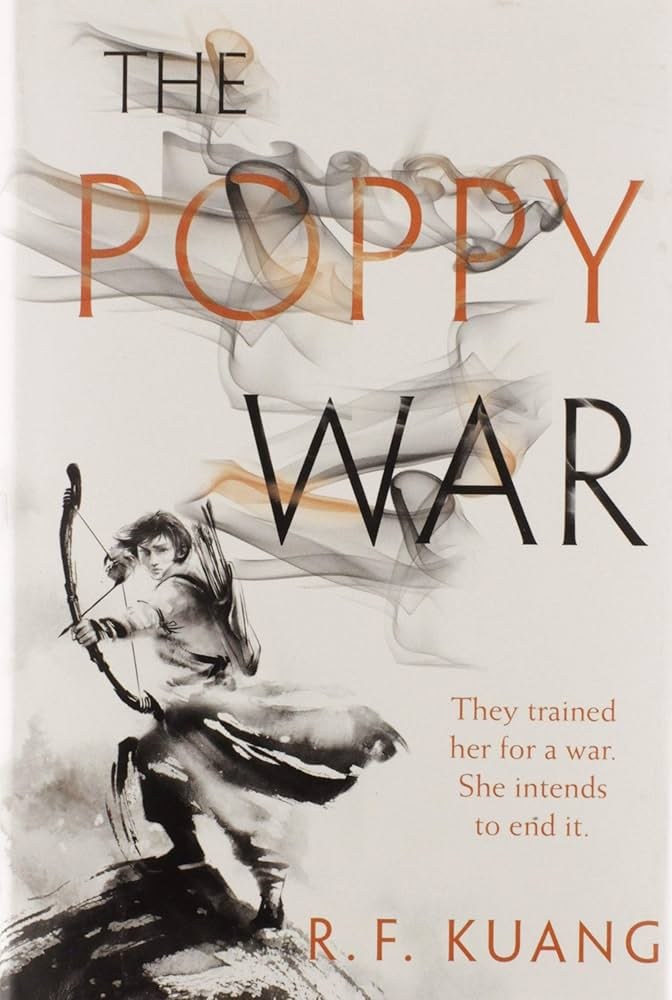
Rin's ambition is admirable and alarming, and the novel refuses to make talent the same thing as wisdom. I disagreed with several decisions, but the fear connected to class rarely felt invented when the brutal academy competition entered the scene.
The book circles around power, class, racism, war, vengeance, trauma, atrocity, and the temptation to answer violence with greater violence. I did not agree with every conclusion, but I liked being asked to judge actions connected to power, particularly around the brutal academy competition, rather than accept a ready-made moral.
The weaker stretch comes from the fact that the tonal shift is abrupt, and secondary characters sometimes disappear behind Rin's fury. The issue did not ruin the experience, though it made the handling of class, especially the brutal academy competition, feel arranged for effect.
The material I kept returning to was the brutal academy competition, shamanic training, and the shocking shift when war begins. The effect comes from accumulation around the brutal academy competition, not from one oversized speech.
Several scenes improve on reflection because the brutal academy competition acquires a different meaning later.
I would return to The Poppy War for the brutal academy competition, though I would still argue with its treatment of power.
Book Summary
War orphan Rin earns a place at an elite military academy and discovers dangerous divine power as her country moves toward invasion. Rin's ambition is admirable and alarming, and the novel refuses to make talent the same thing as wisdom. The plot uses that situation to examine power, class, racism, war, vengeance, trauma, atrocity, and the temptation to answer violence with greater violence, especially when a private choice begins affecting people who had no say in it.
What I Liked
What worked for me was the brutal academy competition, shamanic training, and the shocking shift when war begins. The book also benefits from this character choice: Rin's ambition is admirable and alarming, and the novel refuses to make talent the same thing as wisdom. I remembered the scenes around the brutal academy competition more clearly than the larger speeches.
What Could Be Better
The weaker part for me was that the tonal shift is abrupt, and secondary characters sometimes disappear behind Rin's fury. It did not erase what worked in The Poppy War, though it made the structure feel more visible than I wanted.
Context Behind the Book
Kuang's debut trilogy draws on Chinese history while building a fictional world of empire, war, and shamanic power.