🏆
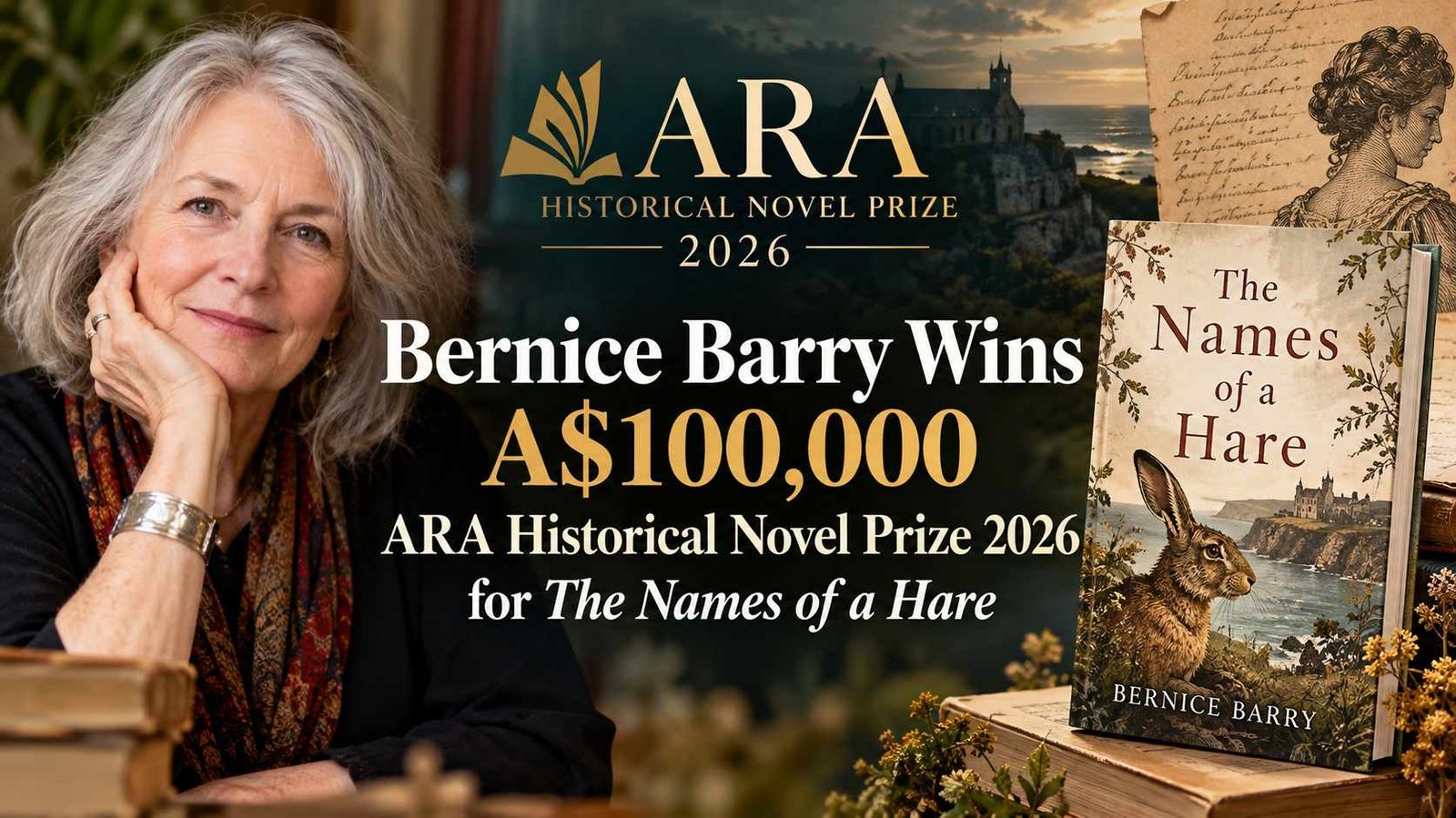
2026 WINNER CONFIRMED: Bernice Barry receives A$100,000 for The Names of a Hare; Meg Caddy and Wayne Marshall also receive awards.
Some literary victories feel like the arrival of a book at exactly the right moment. Others are a reminder of how long a story can live with its writer before the rest of the world catches up. For Bernice Barry, the winner of the 2026 ARA Historical Novel Prize, it is a little of both.
The Western Australia-based author has won the prize's A$100,000 Adult category for The Names of a Hare, published by Fremantle Press. The announcement was made on October 15, 2026, at the awards ceremony in Sydney. Set in seventeenth-century Cornwall, the novel follows an unnamed woman whose knowledge of healing, unusual experiences and determination to survive make her vulnerable in a society gripped by fear of witchcraft.
The award is a major recognition for a historical novel that asks readers to look beyond the familiar stories of powerful men and official history. At its centre is a woman whose very difference becomes dangerous, and whose life unfolds at the intersection of folklore, prejudice, solitude and the possibilities of storytelling.
Literary award result · October 15, 2026
Bernice Barry takes the A$100,000 top prize
Her novel The Names of a Hare wins the Adult category of the ARA Historical Novel Prize, presented by the Historical Novel Society Australasia with support from the ARA Group.
🏆
Adult winner
Bernice Barry
📖
Winning book
The Names of a Hare
📅
Announcement
October 15, 2026
📖 Inside The Names of a Hare: a woman the world cannot explain
Barry's novel begins in Cornwall in 1628. Its young protagonist has an extraordinary secret: she can leave her body and travel beyond the physical limits of her surroundings. She grows up learning about herbs, remedies and practices that offer comfort or healing, but which can also attract suspicion in an era when accusations of witchcraft carry terrible consequences.
As the girl becomes a woman, the fragile line between knowledge and danger becomes harder to navigate. Her life is shaped by the Cornish landscape, by the bonds she forms and by a society eager to interpret anything unfamiliar as a threat. The story also draws on the historical figure of witchfinder Matthew Hopkins, using the terror associated with witch-hunting to sharpen its central question: what happens when a community decides that difference is evidence of guilt?
The novel does not simply treat the seventeenth century as an atmospheric backdrop. It uses that history to explore how vulnerable people can be when superstition, authority and social pressure reinforce each other. The heroine's experiences give the familiar machinery of persecution an intimate human scale.
Fremantle Press describes the book as historical fiction, and its publisher's listing records a 236-page paperback released in 2026. For readers drawn to immersive historical settings, it offers folklore and mystery; for others, its deeper attraction may be its attention to women's lives left on the margins of the record.
✍️ A story rooted in Bernice Barry's own history
Barry is a writer and historian with a background in education. Originally from Cornwall and now based near Margaret River in Western Australia, she has spent much of her writing career exploring overlooked women's stories, often working across the boundary between documentary research and imaginative reconstruction.
Her earlier books include The Mind That Shines, A Lady's Pen and Sarah Evans. In writing about the past, she has repeatedly returned to lives that traditional accounts only partially preserve. The Names of a Hare extends that interest, but its origins are unusually personal.
On her author website, Barry explains that Lorna Doone, the novel she read as a child, stayed with her for decades. She became fascinated by a mysterious woman in its pages and by the possibility of an untold life behind that figure. The opening of the novel that would become The Names of a Hare, she says, was first written roughly thirty-five years before the book appeared.
That long gestation gives the prize a different emotional weight. The winning book is not an overnight publishing phenomenon but a story worked through over years, rooted in childhood reading, the landscape of Barry's birthplace and her longstanding interest in the traces history leaves behind.
🏅 What the judges saw in the winning novel
The Adult prize judges, chaired by editor and critic Linda Funnell, selected Barry's book from a shortlist that also included The Other Catherine by Lauren Keenan and The Trap by Fiona Kelly McGregor. The panel also included David Whish-Wilson, Renée Otmar, Robyn Cadwallader and Theresa Smith.
Their assessment emphasised the novel's beauty, depth and ability to immerse readers in the world of its seventeenth-century protagonist. That recognition matters because historical fiction faces two demands at once: it must evoke the past persuasively, while still creating characters whose emotional lives feel immediate to a modern reader.
Barry's approach appears to have struck that balance. Rather than using the witch trials merely for spectacle, the novel builds its tension around a character's vulnerability and resilience. The fantastical element of her experience sits alongside questions about belief, control and the stories societies choose to tell about women.
The wider significance The Adult category recognition offers a powerful reminder that historical fiction can recover neglected perspectives without turning them into textbook lessons. In Barry's novel, the past remains strange, but the pressures placed on its central character feel recognisably human.
📚 Meg Caddy and Wayne Marshall are also among the 2026 winners
Barry was not the only author honoured at the ceremony. The 2026 ARA Historical Novel Prize also recognised books written for younger readers and introduced a reader-selected result alongside the judged categories. Together, the announcements demonstrate the range of forms historical fiction can take.
Children and Young Adult winner — Meg Caddy, A Flash in the Dust (A$30,000)
The University of Queensland Press novel is set in 1899 Western Australia and follows young women escaping confinement and confronting danger. The story weaves questions of survival, justice and belonging into its historical adventure.
Readers' Choice winner — Wayne Marshall, Henry Goes Bush (A$5,000)
Published by Picador, the novel reimagines Australian writer Henry Lawson's time in the bush, combining literary history with an irreverent and inventive approach to national mythmaking.
The remaining shortlisted authors in the two judged categories receive A$5,000 each. Across the Adult, Children and Young Adult, shortlisted-author and Readers' Choice awards, the total announced prize pool is A$155,000. All these monetary figures are in Australian dollars.
🌏 Why the ARA Historical Novel Prize matters
The prize is presented by the Historical Novel Society Australasia, in partnership with the ARA Group, and recognises historical fiction by writers eligible through Australia or New Zealand. Its rules focus on novels in which most of the story takes place more than fifty years in the past.
The A$100,000 Adult award gives it unusual weight in the region's literary calendar. Money at that scale can have a material impact on an author's ability to continue writing, particularly in a field that often involves years of research before a manuscript is ready for publication. It can also direct booksellers, librarians and international readers toward titles that might otherwise pass quietly through a crowded market.
This year's shortlisted novels ranged across different countries and centuries, but they shared an interest in people frequently pushed out of conventional historical narratives. Barry's victory is therefore part of a broader trend within contemporary historical fiction: the effort to recover lives obscured by power, prejudice or the limits of surviving evidence.
There is an added resonance in the fact that a Cornwall-set novel has received major recognition from an Australasian prize. Barry's own movement between those places is mirrored in the reach of her writing, suggesting how historical fiction can make distant landscapes and histories meaningful to readers far from their origins.
🔎 What this win could mean for the book
The immediate result is clear: The Names of a Hare has received one of the most substantial honours available to historical novelists in Australasia. What follows is less certain, but prizes of this kind can change a book's trajectory. A winning title may attract new library orders, book-club attention, wider reviews and interest from readers encountering its author for the first time.
For Barry, the award also acknowledges an approach to history shaped by patience. The novel's fascination with old stories, forgotten women and the blurred edge of recorded fact reflects a body of work that has long explored those concerns. Her success is an occasion to celebrate the book itself, but also the slow, sometimes solitary process behind its creation.
And for readers looking for their next historical novel, the winning book promises something distinct: not a royal court or a famous battlefield, but one woman's attempt to preserve a life of her own in a world that fears what it does not understand.
🔗 Sources & References
📝
Editorial note This report concerns the winners announced on October 15, 2026. Prize amounts are expressed in Australian dollars. Descriptions of the novel are based on publisher and author information; interpretive observations are Epiloguely's editorial analysis.
Explore More Literary News
Follow the world's literary prizes, major authors, new releases and publishing stories with Epiloguely.
Read More Literary News