📦
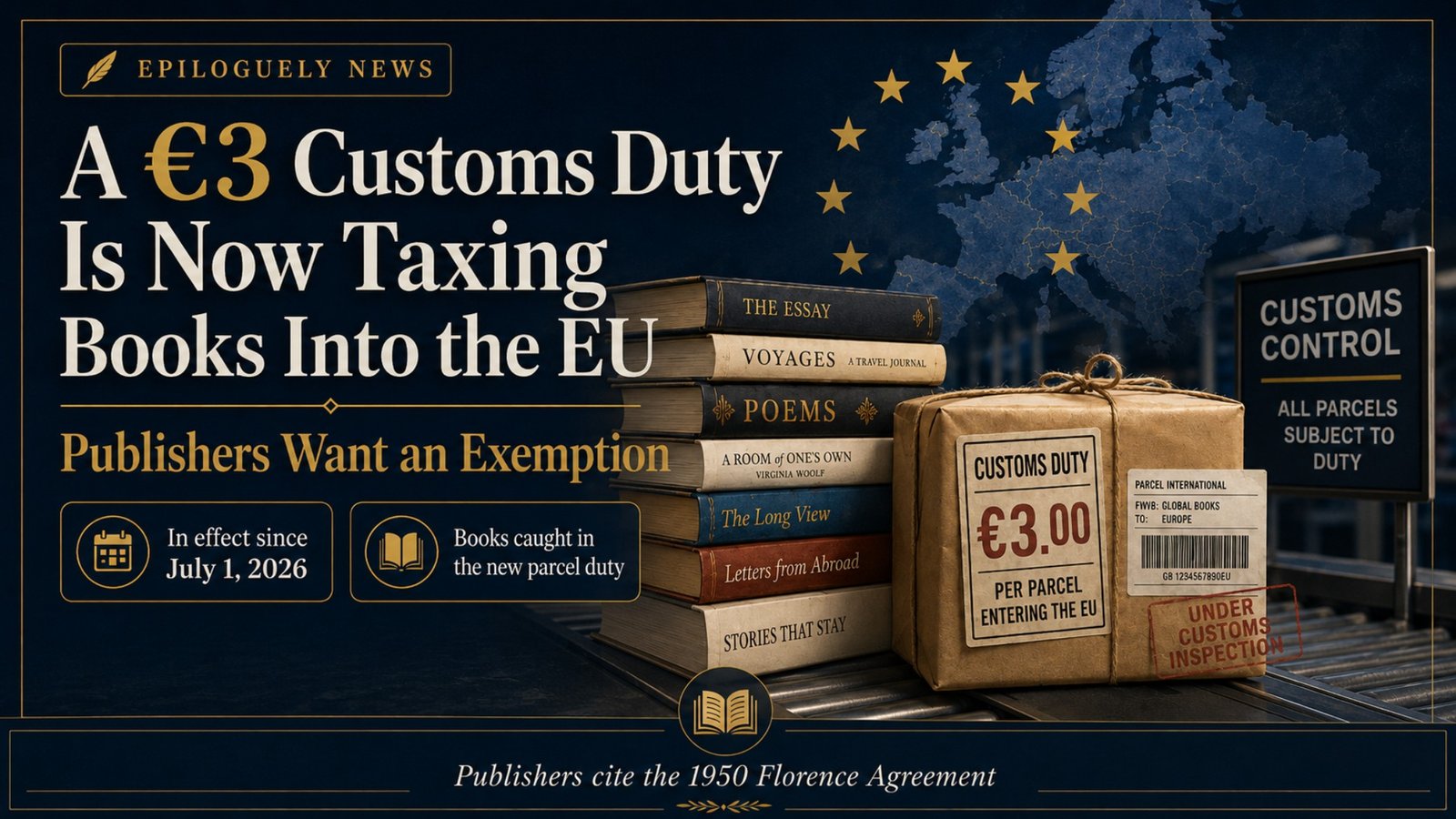
NEW RULES IN EFFECT Since July 1, 2026, every parcel entering the EU carries a €3 customs duty, with no exemption for books.
A quiet change in European customs law has put the book trade on alert. From July 1, 2026, every parcel imported into the European Union carries a €3 customs duty, replacing the previous exemption for goods valued below €150. There is no carve-out for books, journals or magazines.
In response, the UK's leading publishing organizations, including the Publishers Association, the Professional Publishers Association, the Booksellers Association and the European Publishers' Council, have urged the UK government to press for an exemption covering books and other print media, according to reporting from The Bookseller relayed by Publishing Perspectives.
Their central argument reaches back three quarters of a century: the 1950 UNESCO Florence Agreement, in which signatory nations pledged not to impose customs duties on books, publications and educational materials. Taxing a novel at the border, publishers argue, is exactly what the world agreed to stop doing in 1950.
Policy update
A tax aimed at cheap e-commerce is catching books in its net
The European Commission has framed the reforms as a response to floods of low-value e-commerce imports, not reading materials. But without an explicit exemption, books pay the same duty as trinkets.
📅
In effect since
July 1, 2026
📜
Replaced
Exemption for parcels under €150
🕊️
Key treaty cited
1950 Florence Agreement
📦 What actually changed on July 1
For years, small parcels entering the EU enjoyed a de minimis exemption: anything valued under €150 crossed the border duty-free. That threshold made cross-border bookselling frictionless. A reader in Berlin could order a paperback from a London bookshop, or a specialist title from a US press, without customs even entering the picture.
The new regime removes that exemption entirely and applies a flat €3 duty to all imported parcels regardless of value. The European Commission's stated target is the tidal wave of low-value e-commerce packages, particularly from Chinese platforms, that has strained customs systems and undercut European retailers.
The problem is proportionality. On a €200 gadget, €3 is a rounding error. On a €9 paperback, it is a meaningful price increase before postage, and for small presses shipping individual orders, it lands on every single book.
Who is asking for the exemption The Publishers Association, the Professional Publishers Association, the Booksellers Association and the European Publishers' Council have jointly urged the UK government to seek relief for books, journals and magazines.
The legal argument The 1950 UNESCO Florence Agreement commits signatories to the duty-free circulation of books and educational materials, a principle the groups say the new duty directly conflicts with.
📚 Why a small duty is a big deal for books
Books are a low-margin, high-volume trade. Independent booksellers and small publishers who built businesses on shipping individual titles across the Channel now face a tax that can approach a third of a cheap paperback's value. The likely outcomes are familiar: higher prices for readers, fewer cross-border orders, and consolidation toward large distributors who can bulk-ship around the problem.
There is also the principle. The Florence Agreement exists because the postwar world decided that ideas should cross borders more freely than goods. Even a small duty on books quietly reverses that decision, and precedents in trade policy have a way of growing.
Whatever the customs duty was designed to do, it also performs the oldest function of a tariff: protecting domestic sellers from foreign competition. For a continent that prides itself on the free movement of culture, that is an uncomfortable position to defend.
A €3 duty sounds trivial until you apply it to a €9 paperback. Then it becomes a tax on reading across borders.
Shadab Alam🔮 What happens next
The publishing organizations have addressed their request to the UK government, asking it to negotiate an exemption with Brussels. The European Commission, for its part, has signalled that the reforms target e-commerce abuse rather than print media, which gives campaigners an opening: if books were never the target, exempting them costs the policy nothing.
For readers and booksellers in the EU and UK, the practical advice for now is simply awareness. Cross-border book orders may arrive with new charges, and small sellers may adjust prices or shipping options while the exemption question is resolved.
For those of us watching from outside Europe, the episode is a reminder of how fragile the infrastructure of international bookselling really is. The free movement of books was never automatic. It was an agreement, and agreements need defending.
1950
Florence Agreement signed
UNESCO members pledged duty-free circulation of books and educational materials.
July 1, 2026
New EU duty takes effect
A €3 customs duty replaced the previous exemption for parcels under €150.
July 2026
Publishers push back
UK publishing bodies urged the government to seek an exemption for print media.
To be decided
Exemption question open
Whether books escape the duty now depends on negotiations with Brussels.
🔎 Sources used for this article
Publishing Perspectives reports the €3 duty, the removal of the €150 exemption, and the publishing organizations' request, citing The Bookseller.
The Bookseller first reported the joint call from the Publishers Association, PPA, Booksellers Association and European Publishers' Council.
UNESCO hosts the text of the 1950 Florence Agreement on the duty-free importation of educational and cultural materials.
📝
Editorial note The exemption request is ongoing and no decision has been announced. Duty amounts are stated as reported and may be adjusted by future EU regulation.
Read More Publishing Industry News
From copyright battles to border taxes, follow the policies shaping how books reach readers.
Explore More Literary News