⏱️
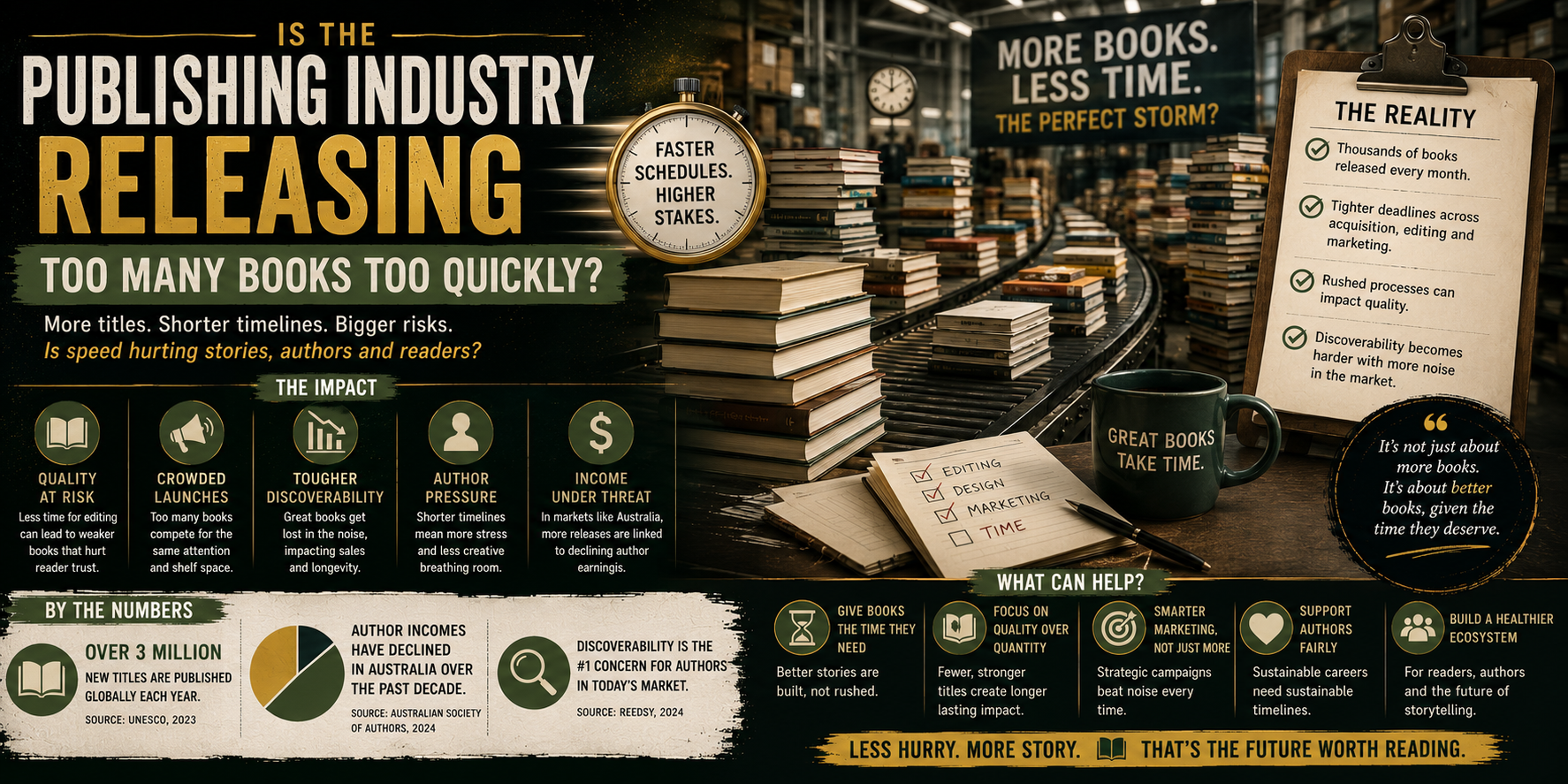
THE BIG QUESTION Are crowded lists giving readers more choice, or giving every book less time to become good and find its audience?
A book can take years to write and disappear from public attention within weeks. That mismatch sits at the centre of a growing argument inside publishing. Are publishers releasing too many books, and are they moving those books through editing, production and publicity too quickly?
The question has become especially sharp in Australia. A recent investigation described compressed schedules, stressed editors, rushed proofreading and authors watching their books lose attention almost as soon as they reached shops. NielsenIQ data cited in that report recorded more than 9,400 Australian print titles scheduled for publication in 2024.
The number alone does not prove there are too many books. It included textbooks, imports with Australian ISBNs, self-published titles and other formats. The stronger problem is capacity. Publishing houses, reviewers, booksellers and readers cannot give equal care to everything moving through the system.
The central argument
The problem may be speed and concentration, not simply the number of books
Too many titles are pushed toward the same sales periods while editorial teams and publicists work with limited time. Good books can arrive before they are fully ready and vanish before readers know they exist.
📚
Australian print titles
More than 9,400 in 2024
📉
Long-term comparison
7% below 10-year average
💵
Average author income
A$18,200 from writing
⏱️
Core pressure
More work in less time
📚 Why it feels like too many books
Readers see crowded release calendars. Booksellers receive boxes they cannot fully read. Review editors choose from more titles than they can cover. Publicists may be responsible for several launches in the same month.
From the outside, this can look like abundance. Inside the industry, it can feel like triage. Each book needs editing, design, production, sales work, metadata, review copies, events and a clear explanation of who might want it. When staff numbers do not grow with the list, time becomes the missing resource.
The result is not that every rushed book contains obvious mistakes. It is that the chance for thoughtful revision becomes smaller, and the marketing window closes faster.
For editors A collapsed schedule leaves less time for structural work and careful copy editing.
For authors Years of writing can be followed by a short publicity period and an expectation that the writer will keep promoting without extra pay.
For booksellers New titles arrive faster than staff can read, recommend and display them.
For readers Choice grows, but discovery becomes harder. A strong book may never reach the people who would love it.
⏱️ What rushing does to a book
A publishing schedule is not only a delivery date. It decides how much time exists between manuscript stages, how early booksellers hear about a title and whether reviews can appear near publication.
When the timetable is squeezed, every stage becomes reactive. An editor may have to choose between a deeper rewrite and keeping the printer slot. A proofreader may receive pages later than planned. A publicist may begin work before the final positioning of the book is clear.
The saddest part is that speed can hide inside a polished cover. Readers may never know that a missing chapter, a continuity error or a weak middle section came from a timetable rather than a lack of talent. They only know the finished book did not work.
Publishing more books is not automatically a cultural success when the people making them have less time to make each one good.
Shadab Alam💰 Why publishers keep accelerating
Publishing is a cultural industry with difficult commercial maths. Printing costs have risen, book prices face resistance and retailers expect discounts. A publisher may release a broad list because one breakout title can support many books that sell modestly.
Seasonal pressure adds another layer. Christmas, festival calendars, school terms and major news events create moments when a book is expected to arrive. Missing a slot can feel more dangerous than cutting the schedule.
Large lists also spread risk. Nobody can predict every bestseller. Publishing more titles creates more chances, but it also divides attention. The same strategy that protects a company can weaken the launch of an individual book.
✍️ Authors carry much of the hidden cost
Creative Australia research found that Australian authors earned an average of A$18,200 a year from their writing practice. The figure helps explain why a short publicity window hurts. Many writers cannot afford to spend months promoting a book for free while also beginning the next one.
Royalties may not arrive until an advance earns out. Events, social media and travel can demand time without direct payment. When the publisher moves on to the next release, the author may still be trying to create the attention the book never received at launch.
I do not think writers should be expected to become full-time content creators to prove they deserve a publishing contract. Some are good at constant promotion. Others wrote a book because writing is where their skill belongs.
📝
Writing time
Often measured in years
📣
Launch attention
Often measured in weeks
📱
Author burden
Ongoing self-promotion
📦
Industry rhythm
Next title arrives quickly
🏪 Why fewer books is not a simple answer
A call to publish fewer books can create its own danger. Which writers lose their contracts first? New voices, experimental work and books for smaller communities may be judged as the easiest risks to remove.
The number of titles also supports variety. A healthy literary culture should not contain only books with obvious mass-market potential. Smaller books can build slowly, reach classrooms later or become important years after release.
That is why the better answer is not an automatic cut. Publishers can spread major releases across the year, protect editorial time and plan smaller lists with clearer support. British publishers have already reduced and staggered parts of the crowded autumn hardback schedule, which suggests the calendar itself can change.
🌱 What slower publishing could look like
Smaller presses often show another model. They release fewer books, spend longer finding the right readers and allow each title to remain visible after launch week. The trade-off is scale. A careful list still needs enough sales to survive.
A slower system would not mean endless editing or avoiding deadlines. It would mean schedules built around the actual work. It would give editors space to question a manuscript, publicists time to understand it and booksellers a chance to read before recommending.
Readers also have a role. We can stop treating every book as old news after one month. Backlist reading, library borrowing and bookseller recommendations can give a title a life beyond its launch campaign.
Writing stage
The long beginning
Authors may spend years creating and revising a manuscript before acquisition.
Production stage
The compressed middle
Editing, design, proofing and printing compete for limited time.
Publication week
The crowded moment
Reviews, events and sales attention gather around a narrow window.
After launch
The fast disappearance
Many books lose display space and publicity as the next list arrives.
💭 So is the industry publishing too much
Sometimes, yes. A list can become too large for the team responsible for it. A season can become so crowded that books compete with their own publisher’s releases. A manuscript can be pushed out before it is ready.
The total number is not the best test. The better question is whether each acquired book receives enough editorial care and a realistic chance to find readers. When the answer is no, the list is too large for the system supporting it.
Books are not disposable content units. They can remain useful and alive for decades, but only when publishing gives them a fair beginning. Slowing down will not fix every financial problem. It may stop the industry from creating more books than it has time to care for.
🔎 Sources used for this article
📝
Editorial note This is an analysis article. Publication counts vary by definition and market, so the argument focuses on editorial capacity, timing and discoverability rather than treating one number as proof.
Keep Reading About How Books Are Made
Explore literary discussions, author stories and the changing business behind the books on our shelves.
Explore More Literary News