📣
CAMPAIGN LAUNCHED · 18 JUNE 2026 The We Are Better Than This campaign has begun with a public film, a sign-up drive and a crowdfunding target of £20,000.
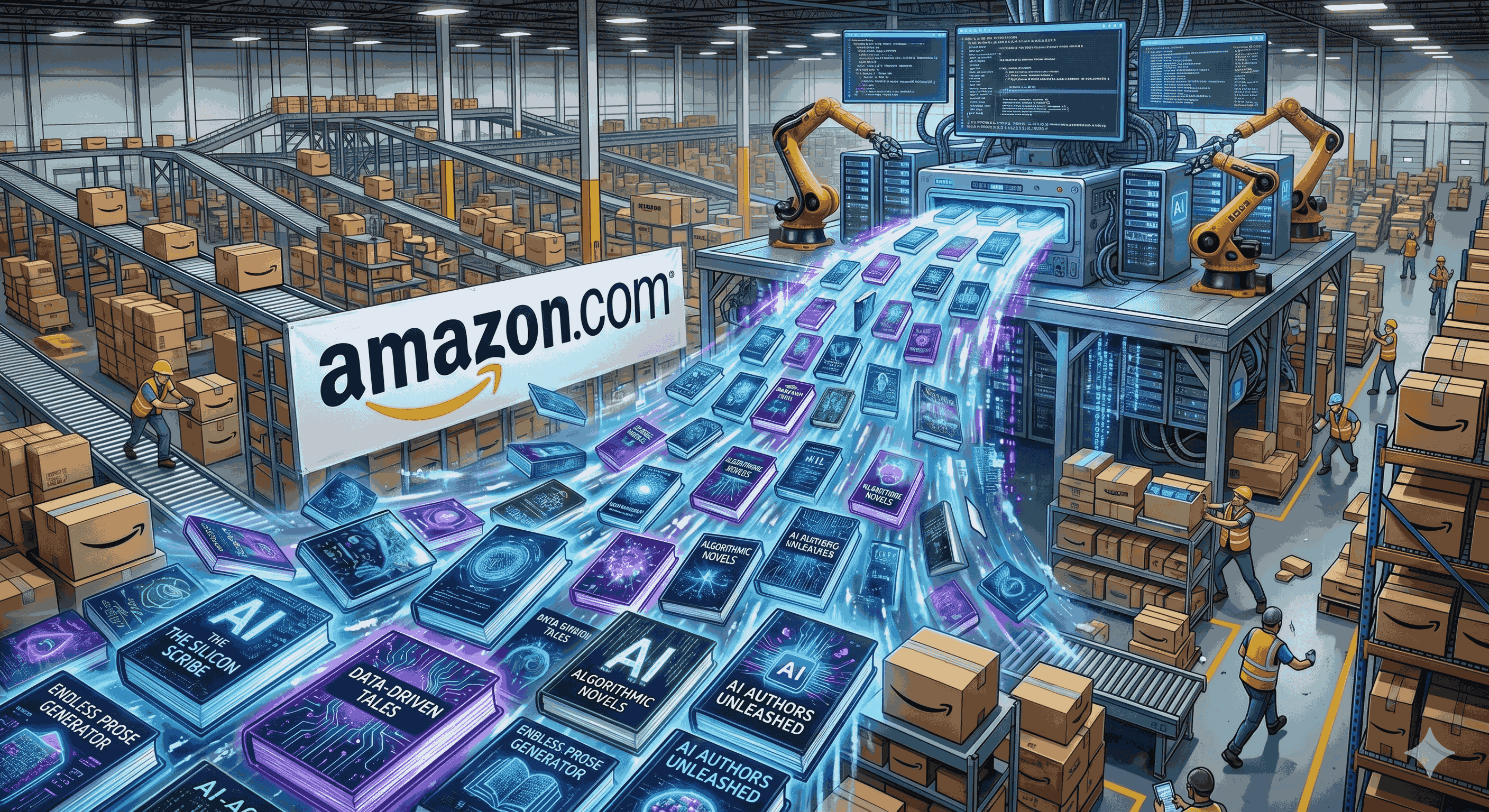
I keep hearing that creative workers should stop worrying and simply learn to live with AI. That sounds easy when the work being used does not belong to you. It sounds very different when years of drawing, writing and building a recognisable style may have been collected to train a commercial system without a clear request for permission.
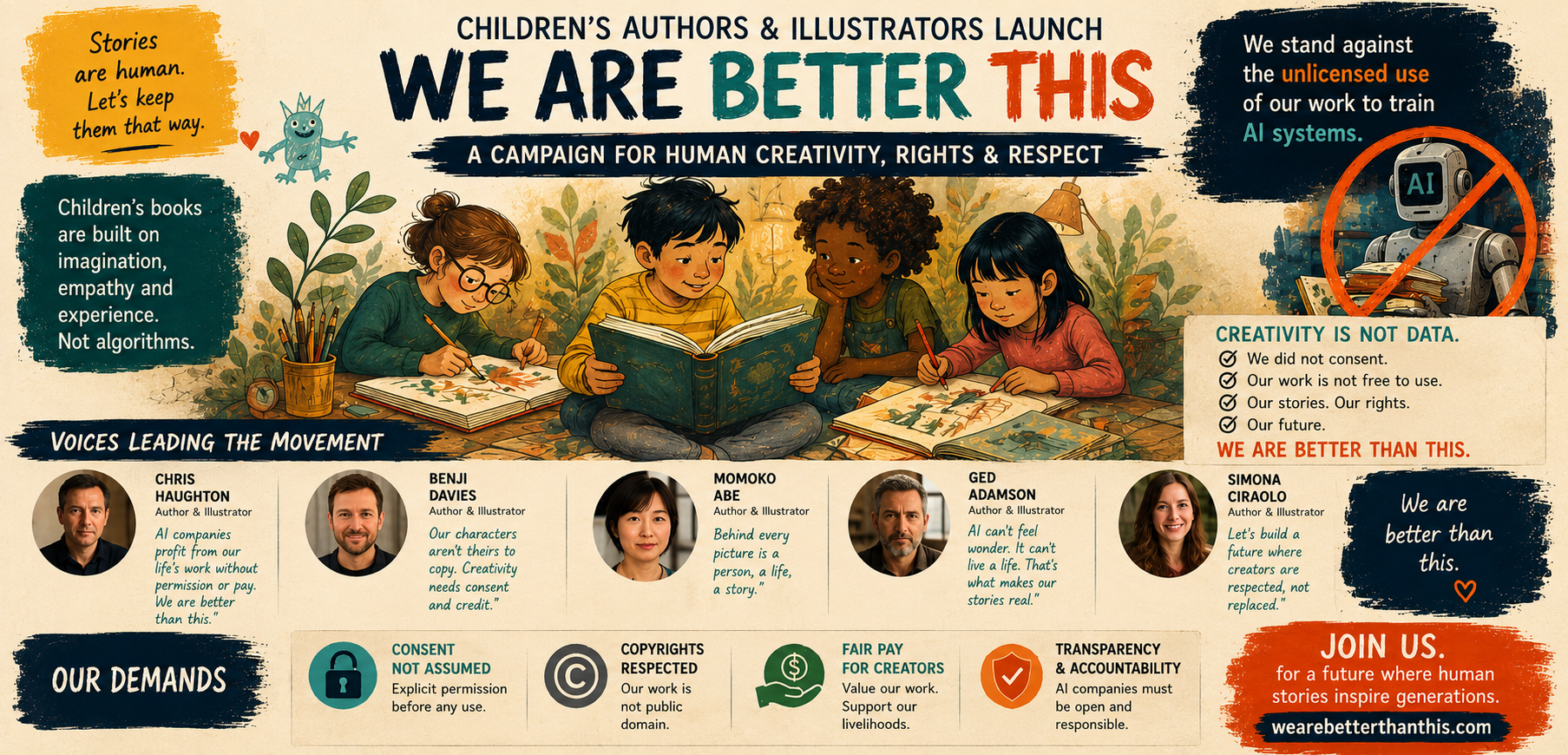
That anger now has a new public campaign behind it. Children's authors and illustrators Chris Haughton, Momoko Abe, Ged Adamson, Simona Ciraolo and Benji Davies have launched We Are Better Than This. They describe it as a creative uprising against the way generative AI is being built and pushed into creative work.
The campaign is not asking people to panic about every use of technology. Its central argument is much more direct. Artists should know when their work is used, they should have a real say, and commercial AI companies should not be allowed to treat creative careers as free training material.
What the campaign wants
Human creativity should not become unpaid fuel for generative AI
The founders are asking the public to watch and share their campaign film, join the movement and support a fund for future action. Their focus is copyright, creator control and a future where children still grow up seeing work made with human care.
✍️
Founders
Five children's book creators
🎙️
Film voice
Miriam Margolyes
💷
First target
£20,000 crowdfunding goal
🤝
Support
Creative industry groups
📚
Focus
Books, art and creator rights
📢 What We Are Better Than This is saying
The campaign begins from a feeling many illustrators have expressed for years. Their pictures are visible online because visibility is part of the job. Portfolios bring commissions. Book covers help readers discover a title. Social posts build an audience. The same openness can also make a huge amount of work easy to collect.
Generative image systems need large training datasets. Creators say the problem is not only that their work may have entered those datasets. The harder part is that systems trained on creative work can then compete for the same jobs. An illustrator may lose a commission to software that learned from thousands of artists who were never paid for that use.
🎨The theft claim The founders use forceful language and say creative work is being taken and used against the people who made it. That is the campaign's position. The legal arguments around training data still vary by country and by individual case, but the moral complaint is easy to understand. A creator does not stop caring about a picture just because it appears on a public webpage.
👧The concern for children Children's books are often a young person's first meeting with art. A picture book is not simply text beside an image. The rhythm, page turn, expression and tiny visual jokes are chosen for a reason. I think that is why this campaign coming from children's creators feels especially sharp. They are defending the idea that care matters even when the reader is very young.
💼The livelihood question Most authors and illustrators are not protected by enormous salaries. They depend on commissions, royalties, school visits and new contracts. A cheaper machine-made substitute does not need to replace every artist to cause damage. It only needs to remove enough paid work to make a creative career harder to sustain.
“This isn't about being anti-technology, it's about saying that people and creativity come first.”
Benji Davies, speaking about the campaign
That line gets to the part I find most useful. The choice is not between rejecting every new tool and allowing unlimited use of creative work. There is a large space in the middle where technology can exist alongside consent, licensing and honest labels. The campaign is trying to stop that middle ground from disappearing.
🖍️ The creators behind the campaign
This is not a campaign created by a distant policy office. The five founders work in the part of publishing that is most visibly tied to drawing by hand, building characters and thinking about how a child sees a page.
Chris Haughton
The author and illustrator helped write, design and direct the campaign film. His picture books are known for bold shapes, colour and visual comedy that works before a child can read every word.
Momoko Abe
A London-based author and illustrator whose work includes Avocado Asks What Am I. Her involvement connects the campaign to artists building careers across both writing and illustration.
Ged Adamson
A children's writer and illustrator with books published across the UK and the US. His work is rooted in character, humour and the sort of small visual decisions that make a picture book feel alive.
Simona Ciraolo
An author and illustrator whose picture books carry a distinct hand-drawn identity. That individual style is exactly what many artists fear can be copied or flattened by automated image systems.
Benji Davies
The author and illustrator of Grandad's Island has said the campaign is about putting people first. His words keep the message focused on fair treatment rather than fear of technology itself.
The short film is voiced by actor Miriam Margolyes, with music and sound by Matt Wand. The campaign has also received support from the Association of Illustrators, the Society of Authors and the Good Ship Illustration. That mix matters because the fight is not limited to five well-known names. It reaches freelancers, new graduates and artists who are still trying to win their first paid job.
⏰ Why the campaign is happening now
The timing is not random. The UK has spent more than a year arguing over how copyright should work when AI companies train models on books, images, music and journalism. A government consultation opened in December 2024 and proposed several possible routes. The most disputed idea would have allowed broad text and data mining with a system for rights holders to opt out.
Creative organisations objected because an opt-out model would put the burden on artists. A freelance illustrator would need to discover where the work had gone, understand technical reservation systems and keep checking whether those signals were respected. That is a lot to ask from someone who is already trying to make books and earn a living.
In March 2026, the government said a broad copyright exception with an opt-out was no longer its preferred path. Authors welcomed that move. The argument did not end. Work is still continuing on AI labelling, creator control, transparency and support for independent creatives. Campaigners worry that the final system may still leave too much uncertainty while technology moves quickly.
Why creators are still worried
Moving away from one disputed proposal does not reveal which books or pictures were already used to train a model. It also does not create an automatic payment system. Artists want rules they can use in real life, not promises that depend on tools they cannot inspect.
What the government says it is doing
The government has announced further work on labels, digital replicas, online control tools and transparency around training inputs. Those projects may lead to stronger protections, but the details and enforcement will decide whether they make a real difference.
⚖️
A useful distinction Saying that campaigners describe unlicensed training as theft is not the same as saying every AI training dispute has already been decided in court. Copyright cases are still developing. The campaign is making a public and political argument about consent, control and payment.
📚 This fight is bigger than one campaign
We Are Better Than This arrives after a series of public actions by writers and other creative workers. The Make It Fair campaign asked the UK government to protect copyrighted work from unpaid AI training. In March 2026, around 10,000 writers added their names to Don't Steal This Book, an intentionally empty publication distributed at the London Book Fair.
The Society of Authors also launched a Human Authored scheme so readers can identify books whose main creative expression came from a person. I can see why that appeals to readers. People are not only buying a plot. They often want to know that a person spent time choosing the words, carrying an idea through the difficult parts and taking responsibility for the finished book.
At the same time, the literary world is struggling with a different problem. Accusations of AI use can spread before anyone has reliable proof. That happened during the recent Commonwealth Short Story Prize dispute. I wrote about the Commonwealth Prize AI controversy and Granta's decision to leave the partnership. The two stories sit beside each other in an uncomfortable way. Creators need protection from unlicensed training, and writers also need protection from careless public accusations.
December 2024
UK copyright and AI consultation begins
The government asks how creators should control and receive payment for work used in AI development.
February 2025
Make It Fair brings creative industries together
Publishers, artists and news organisations campaign against weakening copyright protection for AI training.
March 2026
Writers publish an empty protest book
About 10,000 authors lend their names to Don't Steal This Book during the London Book Fair.
18 June 2026
We Are Better Than This launches
Children's authors and illustrators release a public film, open sign-ups and begin crowdfunding future action.
🔎 What happens next
The campaign's first goal is attention. It wants the film shared beyond publishing circles because copyright rules can sound distant until people connect them to a book they love. A parent may not follow every policy paper, but they understand why an illustrator should be asked before a company uses years of work to build a competing product.
The crowdfunding goal is £20,000. The organisers say the money will support a wider campaign that puts creativity before generative AI. At this stage, it is better to see the fund as a starting point rather than a complete plan. The real test will be what the movement does after the launch video has travelled through social media.
I will be watching for clear demands that ordinary readers can repeat. Consent before training is easy to understand. Transparent records of training material would help creators know what happened. Licensing gives companies a lawful route to use work and gives artists a route to payment. Labels can tell buyers when a book or image was made with generative AI.
None of those ideas solves every problem. They would still be a more honest starting point than asking individual artists to chase enormous technology companies after the work has already been collected.
💬 My view on the campaign
What got me was not the anger. I expected that. It was the fact that children's creators are talking about the future of imagination itself. Young readers learn that making something takes attention. They see pencil marks, odd characters and pages where the joke only works because a person knew exactly when to turn the page.
AI can be useful. It can help with admin, accessibility and tasks that do not replace the heart of the work. I do not think every use belongs in the same argument. The line should become much firmer when a company trains a commercial creative system on work it did not license, then sells the result back into the same market.
We Are Better Than This may not change the law by itself. Public campaigns rarely work that neatly. It can make the cost of doing nothing harder to ignore. For writers and illustrators, that is already something.
Sources used for this report
We Are Better Than This is the campaign website where readers can watch the film and join the public action.
The Bookseller reported the campaign launch on 18 June 2026.
DownTheTubes reported the founders, campaign film credits, supporters and £20,000 crowdfunding target.
Chuffed hosts the campaign's public crowdfunding page.
The Society of Authors explained the UK government's March 2026 copyright update and the remaining areas of uncertainty.
UK Parliament published the ministerial statement on the next steps for copyright and AI.
📖 Keep Reading Human Stories
Explore books written and illustrated by people, discover new authors and find your next read in the Epiloguely news coverage.
Explore More Literary News