⚖️
LATEST STATUS The Hot Girls Read registration was surrendered after a fierce BookTok backlash.
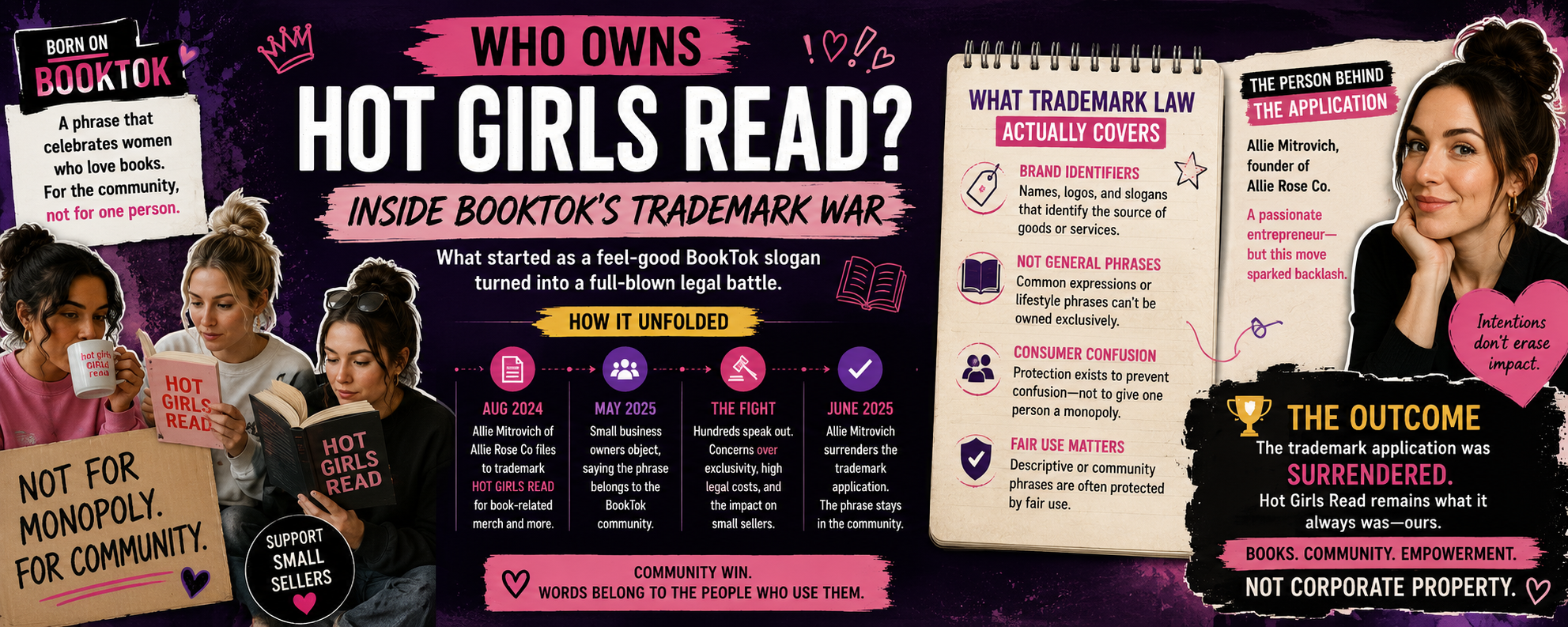
For a few days in June, BookTok stopped arguing about favourite tropes and started arguing about ownership. The phrase Hot Girls Read had become familiar across reading videos, tote bags, sweatshirts and small online shops. Then creator and business owner Allie Mitrovich announced that her company, Allie Rose Co., had secured a federal trademark registration connected to the phrase.
The response was immediate and angry. Small sellers worried that a line they had treated as community language could now become risky on merchandise. Readers asked a basic question that sounded almost absurd at first. Can one business really own three words that thousands of people already use?
My answer after looking at the filing and the rules is more complicated than either side of the online fight made it sound. A trademark does not hand someone ownership of a phrase in every setting. It can still create real commercial power inside particular product categories, and that was enough to make BookTok feel that something shared had been fenced off.
Latest position
The registration was surrendered after the backlash
Mitrovich said on June 8 that paperwork had been filed to surrender the registration. She apologised to small businesses and said the decision had placed business strategy ahead of the community that helped popularise the phrase.
📅
Announcement
June 3, 2026
↩️
Surrender announced
June 8, 2026
🛍️
Covered goods
Book items and apparel
⚖️
Key point
A trademark has a limited commercial scope
📚 What happened inside BookTok
Mitrovich announced the registration in a post that described Hot Girls Read as part of the growth of Allie Rose Co. Her business sells bookish stationery, clothing and accessories. The registration covered items including bookmarks, stickers, book covers, notebook products, sweatshirts, T-shirts and hooded sweatshirts.
That detail matters. The registration did not mean readers could no longer write the phrase in a caption, say it in a video or joke about it with friends. The dispute was about using the phrase as a brand marker on related goods. Small shops selling similar products saw a direct threat because their work lived in the same commercial space.
People reporting on the dispute found earlier social-media uses that predated the date claimed by the business. That made the announcement feel less like protection for an original brand and more like control over language that had grown through a much wider culture.
The legal version A trademark identifies the source of goods or services. The United States Patent and Trademark Office says registration does not give a person ownership of a word or phrase in every use.
The community version BookTok users did not hear a narrow legal explanation. They heard that one seller had placed a registration symbol beside a phrase many of them had used for years.
The business version Small shops often rely on familiar bookish sayings because those sayings instantly tell customers what the product is about. A new registration can change the risk around listings, ads and product names.
⚖️ What a trademark actually protects
Trademark law is often misunderstood because people speak about it as if it were copyright. Copyright protects original creative expression. A trademark points customers toward the source of a product or service. The protection is tied to commerce and to the goods or services named in the registration.
The USPTO makes this distinction plainly. A registered phrase cannot normally be used to stop every person from saying the same words. The owner may act when another commercial use is close enough to confuse customers about who made or approved the goods.
There is another part of the rules that explains why the fight became serious. The USPTO also warns that a phrase used widely in everyday speech may fail to work as a trademark because it expresses a common idea rather than identifying one source. That does not decide this dispute by itself, but it helps explain why earlier uses became central to the backlash.
A community slogan can become part of a brand. The trouble starts when the brand begins to look larger than the community that gave the slogan meaning.
Shadab Alam🔥 Why the reaction became so personal
BookTok is commercial, even when it pretends not to be. Creators earn through sponsorships and affiliate links. Publishers build campaigns around trending titles. Small businesses sell reading journals, stickers and shirts. Yet the culture still depends on the feeling that readers are sharing language with one another rather than renting it from a company.
Hot Girls Read worked because nobody needed an explanation. It was playful and open. It connected the wider hot girl language of social media with a reading culture that enjoys turning books into identity. Once the phrase appeared with a registration symbol, the mood changed.
I think the strongest criticism was not that a small business wanted protection. Small businesses need names and designs they can defend. The problem was the scale of the claim compared with the history of the phrase. People felt that community participation had been converted into private ownership after the value was already visible.
🗣️
Reader concern
Shared language
🏪
Seller concern
Product listings
📱
Platform effect
Fast public backlash
🤝
Trust issue
Community before control
↩️ The apology and surrender
By June 8, Mitrovich said the trademark had been surrendered and the paperwork was moving through the system. She apologised to small businesses that felt harmed and described the filing as a business decision that failed to account for the human side of the community.
She also denied that screenshots claiming she had sent cease-and-desist messages came from her. Merchandise already in stock was placed on sale with profits promised to Room to Read and Read and Feed.
The surrender does not erase the week of anger, but it changes the ending. This is no longer a simple story about a creator who won a registration and kept it. It is a case where online pressure altered a business decision within days.
June 3, 2026
Registration announced
Allie Rose Co. publicly celebrated securing the Hot Girls Read registration.
June 5, 2026
Challenge reported
A cancellation action had been filed against the mark.
June 8, 2026
Surrender announced
Mitrovich apologised and said she had filed paperwork to give up the registration.
💬 What this fight says about BookTok
The BookTok economy has reached a strange point. Phrases can begin as jokes, move into captions, become merchandise and then appear in legal filings. Nobody is fully outside the business side anymore.
That does not mean every popular phrase should be free for every commercial use. It means creators need to think about origin, public meaning and the damage a claim may cause before treating registration as a normal growth tactic.
For me, the lesson is not that trademarks are bad. The lesson is that a legal right and a good community decision are not always the same thing. A business can ask what it is allowed to protect. It should also ask what protection will cost in trust.
🔎 Sources used for this article
PEOPLE reported the announcement, the product categories, the cancellation challenge and the June 8 surrender.
U.S. Patent and Trademark Office explains that trademark rights apply to particular goods or services rather than every use of a word or phrase.
USPTO guidance on common phrases explains why widely used slogans may fail to identify a single commercial source.
📝
Editorial note This article explains a public trademark dispute and is not legal advice. The registration status can take time to update in federal records after surrender paperwork is filed.
More Stories From Book Culture
Explore literary debates, publishing news and the online communities changing how books are sold and discussed.
Explore More Literary News