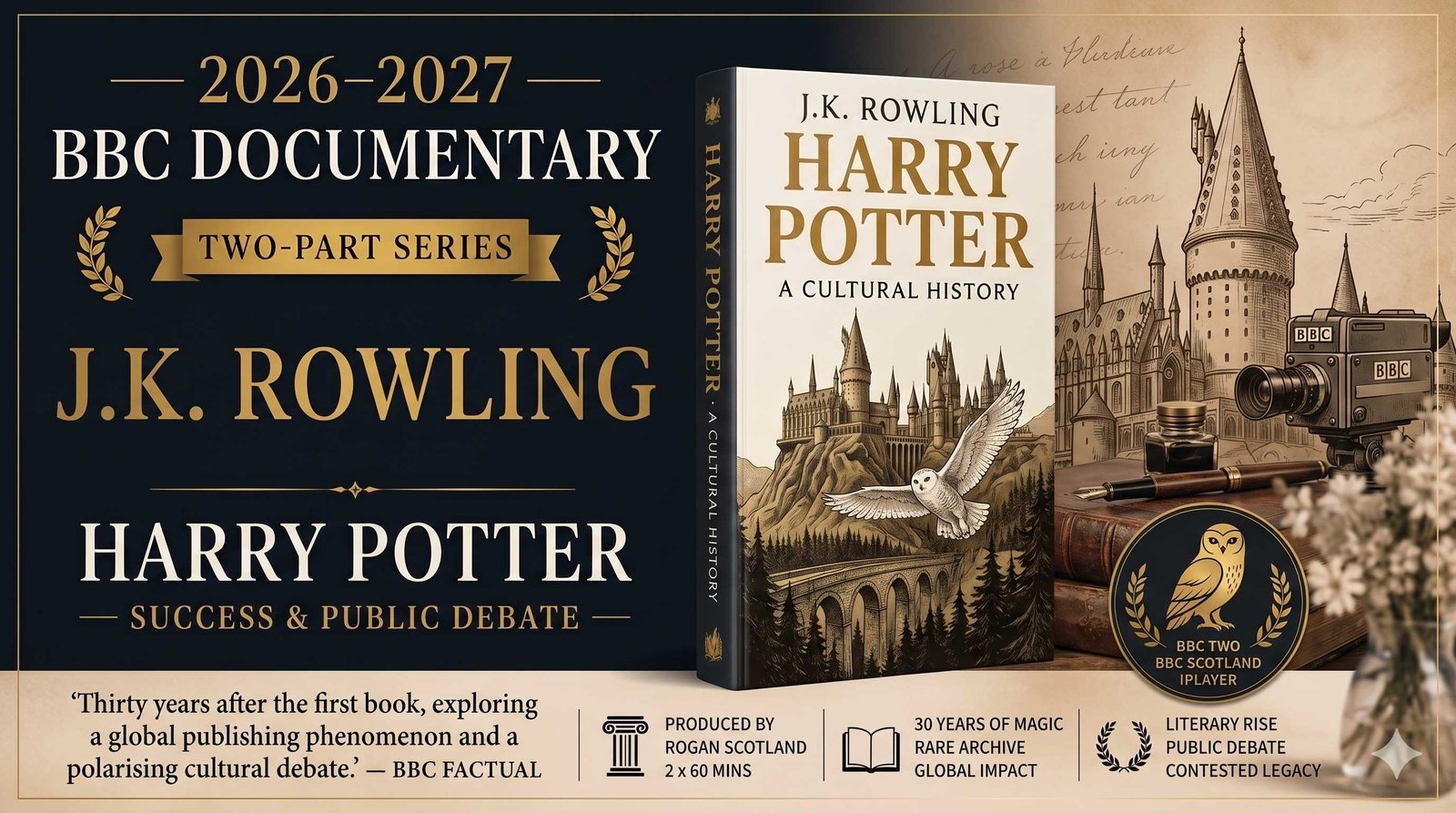
📺NEW BBC COMMISSION: Two hour-long episodes will examine Rowling's literary rise, the Harry Potter phenomenon and her later public controversies.
Few modern authors have had a career quite like J.K. Rowling's. She did not simply write a successful children's series. She created a publishing event that became a film franchise, a stage production, a theme-park universe and a permanent part of popular culture.
Now the BBC plans to look at the entire story — including the parts that have become much harder to separate from Rowling's name.
The broadcaster has commissioned a new two-part documentary about the Harry Potter author. Produced by Rogan Scotland for BBC Two, BBC Scotland and BBC iPlayer, the series will chart Rowling's rise from an aspiring writer in Edinburgh to one of the world's most commercially successful authors, before turning to the fierce political and cultural arguments that have surrounded her in recent years.
Each episode will run for an hour. Rowling herself will not be interviewed for the project, and the BBC has not yet announced an air date.
BBC commission
Two hours, two very different chapters of one extraordinary literary career
The first episode will focus on the creation and global success of Harry Potter. The second will examine Rowling's emergence as an increasingly influential and divisive public voice on feminism, free speech, Scottish politics and gender identity.
📺
Format
2 x 60-minute episodes
📡
Platforms
BBC Two, BBC Scotland & iPlayer
🗓️
Air date
Not yet announced
⚡ The first episode: how Harry Potter became much bigger than a book series
The BBC's timing is deliberate. The first Harry Potter novel approaches its 30th anniversary in 2027, making this a natural moment to revisit just how unusual Rowling's rise really was.
The familiar version of the story begins with Rowling writing while living as a single mother and working on the manuscript that would become Harry Potter and the Philosopher's Stone. What followed is less like a conventional publishing success story and more like one of the defining entertainment phenomena of the past three decades.
The novels turned midnight bookstore launches into global events. Children who might otherwise have been difficult to persuade into a bookshop queued for hundreds of pages of fantasy. Adults read the books openly too, helping erase some of the old distinctions between children's publishing and mass-market literary culture.
The films then expanded the audience again, turning Daniel Radcliffe, Emma Watson and Rupert Grint into international stars and creating an enormous screen franchise around the books.
According to the BBC's description reported by The Independent, the first episode will examine how Rowling created a fictional universe whose economic legacy is worth billions. That framing matters because Harry Potter is no longer simply a successful set of novels. It is a case study in what happens when literary intellectual property becomes an entire cultural ecosystem.
Books first. The documentary will return to the creation of the novels and the publishing story that transformed Rowling from an unknown writer into a global name.
Then a screen phenomenon. The film adaptations gave Hogwarts a visual identity shared by millions of people who had never imagined the castle in quite the same way.
Then something larger. Stage productions, merchandise, games, attractions and a new HBO television adaptation have kept the fictional world commercially active long after the original seven novels ended.
🪄 Why Harry Potter's publishing impact is still difficult to overstate
It is easy to talk about Harry Potter now as if its success were inevitable. It was not.
Part of what made the series remarkable was the way its audience grew with it. The books became longer, darker and structurally more ambitious while the readership became older. By the later installments, a children's fantasy series had become a genuine global release event.
Publishers learned from that appetite. Bookshops learned how powerful an anticipated release could be when treated like an event rather than simply another title arriving on a shelf. Hollywood learned how valuable long-form fantasy properties could become when audiences were emotionally attached to a literary world before a film even reached cinemas.
Harry Potter did not invent blockbuster publishing, but it helped teach a generation of publishers that a book release itself could become a piece of popular culture.
Shadab Alam⚖️ The second episode will enter much more difficult territory
If the first episode is about creation and success, the second is about what happened when Rowling's public identity stopped being defined primarily by her fiction.
The BBC says the documentary will examine her development into an increasingly powerful political voice, including her interventions on Scottish independence, feminism, freedom of expression and gender identity.
Rowling has repeatedly argued that sex-based rights and protections for women matter in law and public policy. She has said that she supports transgender people's right to live free from discrimination and abuse while rejecting some claims about sex and gender identity. Critics, including transgender-rights advocates, argue that her statements contribute to hostility toward trans people and undermine their rights and dignity.
The disagreement has become entangled with the Harry Potter franchise itself. Several actors associated with the original films, including Daniel Radcliffe, Emma Watson and Rupert Grint, have publicly expressed support for transgender people and disagreement with Rowling's positions. Other figures, including Ralph Fiennes and Helena Bonham Carter, have criticised aspects of the backlash against her.
That makes this documentary unusually complicated. The BBC is not merely making a profile of a famous novelist. It is attempting to document a cultural argument in which the subject remains one of the most active participants.
⚖️
Editorial context: Rowling disputes descriptions of herself as anti-trans and frames her position around women's sex-based rights and freedom of expression. Her critics argue that her statements and political influence have harmful consequences for transgender people. The documentary is expected to examine that conflict rather than treat either interpretation as uncontested fact.
🎥 Rowling will not sit for an interview
One of the most interesting production choices is also one of the simplest: Rowling will not be interviewed for the documentary.
Instead, the programme is expected to build its portrait through archive material, Rowling's own previously recorded and published words, and interviews with people who have worked with her across different stages of her career.
That decision may help the film avoid becoming a conventional celebrity interview, but it also raises the stakes for the editing. When a documentary's subject is absent from a new sit-down interview, context becomes particularly important. Old statements must be placed accurately, and opposing interpretations need enough space to be understood rather than reduced to a sequence of headlines.
🗣️ What the BBC says it wants to examine
Simon Young, the BBC's head of commissioning for history, described Rowling as one of the towering figures of British literature and argued that the approaching 30th anniversary of the first Harry Potter book makes this the right moment to reassess her story.
David Harron, commissioning editor for BBC Scotland, similarly framed the series as more than a biography. He said Rowling's life and work provide a way of examining wider cultural and technological changes in Britain.
That may ultimately be the more interesting version of this documentary. A straightforward biography of Rowling has already been told many times. What has not yet settled into history is the second half of the story: how one of the world's most beloved children's authors became one of Britain's most polarising public figures, and what that transformation says about celebrity, social media, politics and the way readers relate to authors they once encountered only through books.
📚 Can readers separate Harry Potter from J.K. Rowling?
This is the question the documentary may not be able to answer — because readers have already answered it in completely different ways.
For some, Harry Potter remains an important childhood text whose meaning belongs partly to the readers who grew up with it. They can disagree profoundly with Rowling while continuing to value the stories, characters and memories connected to the books.
For others, supporting the franchise now feels inseparable from supporting its creator, particularly because Rowling remains financially and creatively connected to the wider Wizarding World. And there are readers who strongly support Rowling's public positions and see the criticism directed at her as evidence of exactly the free-speech problem she says she is confronting.
There is no neat editorial sentence capable of resolving those positions. What makes the BBC project potentially worthwhile is the possibility of treating the disagreement as part of literary history rather than merely another internet argument.
🗓️ From Philosopher's Stone to a BBC documentary
1997
Harry Potter and the Philosopher's Stone is published
The first novel begins a seven-book series that becomes a global publishing phenomenon.
2001
Harry Potter reaches cinemas
The first film adaptation expands the audience and establishes the visual identity of the Wizarding World.
2020 onward
Rowling's public interventions become increasingly political
Her statements on sex and gender identity lead to sustained controversy, support, criticism and disagreement with several actors associated with Harry Potter.
October 13, 2026
BBC commissions two-part documentary
The broadcaster announces a series examining both Rowling's cultural achievement and her contested public legacy.
2027
Harry Potter approaches 30 years
The anniversary of the first novel provides the historical frame for reassessing Rowling's influence on publishing and culture.
🔮 Why this documentary could become one of the BBC's most scrutinised cultural programmes
There will be viewers who arrive wanting a celebration of Harry Potter. Others will watch primarily to see how the BBC handles Rowling's politics. Some will be suspicious of the programme before a single episode has aired.
That is exactly why the project is likely to attract attention.
Rowling's career contains an unusually sharp contrast. The same writer whose stories were repeatedly praised for themes of friendship, prejudice, courage and resistance to authoritarian power now sits at the centre of a political argument in which supporters and critics frequently interpret those themes in opposing ways.
A good documentary will not need to tell viewers which interpretation they must accept. It will need to explain clearly how we arrived here.
Thirty years after a boy wizard first entered a British bookshop, the Harry Potter story is no longer only about Harry Potter. It is also about the enormous cultural power a writer can accumulate — and what happens when that writer decides to use it.
🔎 Sources used for this article
📝
Editorial note: This article distinguishes between the BBC's confirmed documentary plans and the wider public debate surrounding Rowling. The documentary has been commissioned, but its broadcast date has not yet been announced. Rowling is not participating in a new interview for the programme.
Read More Literary & Author News
From major publishing developments and adaptations to the debates reshaping literary culture, Epiloguely follows the stories around the books.
Explore More Literary News