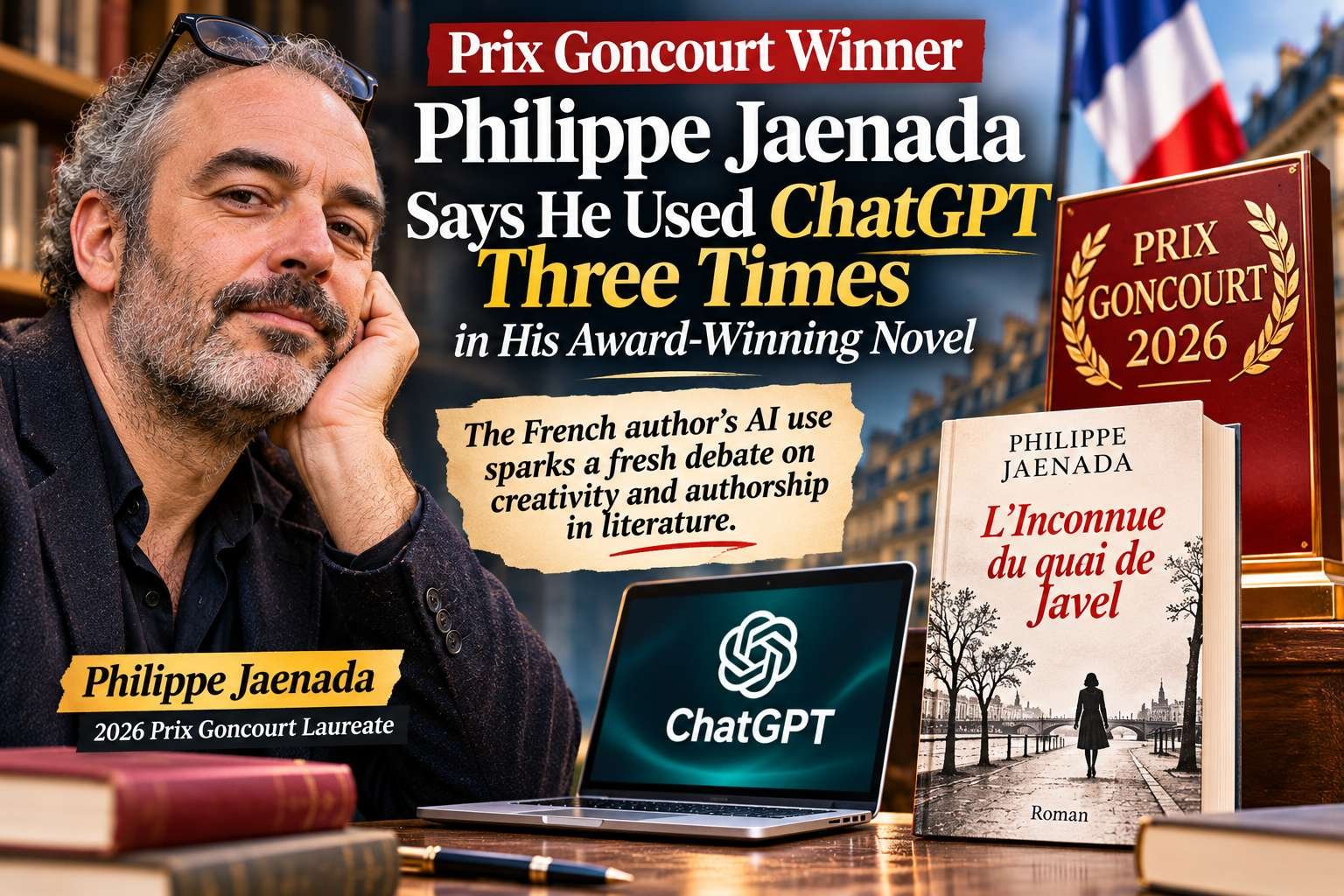
✒️NOVEMBER 4 UPDATE: Philippe Jaenada described three limited uses of AI after his November 3 Prix Goncourt victory. The book itself had already discussed his experiments with the technology.
Winning the Prix Goncourt usually puts a novel at the centre of France's literary conversation. This year, it also put a single sentence under a magnifying glass. On November 4, 2026, Philippe Jaenada spoke on France Inter about his limited use of artificial intelligence while preparing L'Inconnue du quai de Javel, the novel that had won the country's most prestigious fiction prize just one day earlier. He said he had turned to AI three times, including once to place a sentence generated by ChatGPT inside the finished book.
That detail was irresistible to headlines and social-media discussion. The literary world has been debating how writers should acknowledge generative AI, and the French autumn awards season has already been overshadowed by a separate controversy involving an author accused of undisclosed AI involvement. At first glance, Jaenada's comments appeared to offer another dramatic twist. But the more interesting story is not that the prizewinner had been caught hiding something: he had already described his AI experiments in the published novel itself.
Reporting by 20 Minutes points to pages 237–240, where Jaenada discusses consulting AI during his investigation and challenges readers to identify a machine-generated sentence. His November 4 radio appearance expanded on those details at a newly sensitive moment. That difference matters: publicly describing the use of a tool is not the same thing as being exposed for secretly outsourcing a novel.
The verified development
The 2026 Goncourt winner discussed three AI experiments—not an AI-written novel.
Jaenada said the technology helped with technical research, supplied one deliberately planted sentence and offered another opportunity for irony. There is no verified finding that AI authored the wider book or that the Goncourt jury revoked its decision.
🏆 What happened at the 2026 Prix Goncourt?
The Académie Goncourt announced the winner on November 3, 2026, following its customary deliberations at the Drouant restaurant in Paris. Jaenada received six votes, ahead of Sylvain Prudhomme's three, for L'Inconnue du quai de Javel, published by Flammarion. The result was a major personal milestone for the 62-year-old novelist, who had previously appeared on Goncourt selections without winning the final award. The prize is coveted less for its symbolic cash amount than for the extraordinary visibility and sales interest it can bring to a book.
Jaenada's winning work is a lengthy, unconventional investigation into the death of Louise Cansot, a young woman whose body was discovered in Paris in September 1949. Cansot had worked as a model for artists, but contemporary accounts of her death often reduced her to stereotypes and insinuations about her character. Jaenada's project is to reconstruct her life, reconsider the archival evidence and ask why her murder remained unresolved. In doing so, the novel deals with memory, prejudice and the way a society remembers—or forgets—the people it fails to protect.
The French National Library has highlighted the author's long-standing research practice, which involves digitized newspapers, historical files and extensive archival work. Its November 4 institutional note also specifically mentions his conversations with AI about technical questions, including drying hair and why skin wrinkles in water. The presence of AI in this book, then, is part of a larger story about how a contemporary investigator approaches a crime committed more than seven decades ago.
📅
Award announced
3 November 2026
🎙️
AI remarks
4 November 2026
📖
Winning novel
L'Inconnue du quai de Javel
🤖 How did Philippe Jaenada use ChatGPT?
In his November 4 appearance on France Inter, Jaenada gave three examples of using generative AI. First, he said he had inserted one sentence produced by ChatGPT as a playful challenge to readers. He declined to identify the sentence publicly, explaining that he had disclosed its location to the Goncourt jurors. The detail gives the book a small literary puzzle: readers who encounter its account of AI experimentation are invited to wonder which passage, if any, sounds different from the author's own voice.
His second use, he said, was more openly comic. He questioned ChatGPT about a technical point and found some of its answers absurd, treating those responses as material for his narrative rather than as unquestionable authority. The book itself discusses exchanges with both ChatGPT and Claude about physical details relevant to reconstructing events. The exchanges underline a familiar problem with chatbots: they can produce confident explanations that are not necessarily dependable.
Third, Jaenada said an AI system had been genuinely useful for certain technical research. That is a narrower claim than saying a machine devised the plot, conducted his archival investigation or wrote his prose. The interview and reporting do not establish that the full novel was produced by AI; they describe particular interventions within a much larger human-authored investigation. AFP's November 4 report via TV5MONDE confirmed the three uses and the writer's argument for learning to work with the technology without becoming dependent on it.
🔎
Important distinction: A writer acknowledging research assistance, a quoted chatbot response or a deliberately embedded sentence is not automatically equivalent to presenting a machine-written manuscript as wholly original human work. The scale of AI involvement and the author's transparency are both relevant when assessing an individual case.
📰 Was the AI use really a secret?
This is the question that turns a catchy headline into a more revealing publishing story. 20 Minutes reported on November 4 that the author had already described his AI interactions within the published novel, including an invitation for readers to locate the chatbot-generated sentence. The book had been available since August. A casual reader encountering only the latest reports could easily assume the information had just been uncovered, but that would misrepresent the circumstances.
There is also evidence that Jaenada discussed the broader issue before his Goncourt victory. In a pre-award interview with La Voix du Nord, he spoke about using AI partly to juxtapose different eras while researching the past. This does not mean readers must approve of the choice. Some will feel that a novel recognized for human literary achievement should contain no generated language, however short the passage; others may see the disclosed experiment as another tool in the author's long-established method of questioning sources and telling historical stories.
The distinction is not a technicality. Literary coverage has a responsibility to describe what was actually said, when it was said and what the published record already contains. A useful report can examine the discomfort surrounding an AI-generated sentence without implying that Jaenada was exposed in wrongdoing, that the jury had been deceived or that the prize was under formal challenge. The available sources do not support those stronger claims.
⚖️ Why the timing made the story spread
Jaenada's remarks arrived at an unusually charged moment in French literary culture. Earlier in the 2026 prize season, Haitian-Canadian author Thélyson Orélien faced allegations involving AI use in his novel C'était ça ou mourir. His book was removed from Goncourt consideration, and his Canadian publisher subsequently ended its relationship with him after reviewing manuscript materials. Orélien had disputed claims about the role of AI in his writing. That separate and much more contentious case made any mention of ChatGPT by another prize contender especially newsworthy.
Yet the two stories should not be collapsed into the same narrative. Orélien's case involved a disputed account of manuscript production and decisions by his publisher. Jaenada, by contrast, described limited uses within a novel that openly references those experiments. It is possible to have a serious argument about whether literary prizes should recognize books containing AI-generated sentences while still acknowledging that these circumstances are materially different.
The reaction itself was divided. Euronews reported supportive comments describing AI as an inevitable writing aid, alongside readers who wanted authors to write entirely without it. Such reactions reveal a genuine dispute over expectations, but social-media commentary is not proof of industry consensus. The literary profession, its publishers and its readers are still drawing boundaries, often case by case.
✍️ A hidden sentence raises a bigger question about authorship
At the heart of the argument is a surprisingly basic question: what are readers buying when they buy a novel? Most expect an author's distinctive imagination, judgment and language, not simply a sequence of competent sentences. But books have always been made with help—editors, translators, researchers, archives, databases and, increasingly, digital tools. The relevant distinctions are not always captured by a single label such as "AI-assisted." Readers may reasonably see the use of a chatbot for a factual query differently from asking it to draft entire chapters.
Jaenada's case makes that spectrum visible because it includes both research and a deliberate piece of generated text. The first raises questions of reliability: could a chatbot be trusted when the stakes include reconstructing a real person's death? The second raises questions of artistic intent: if the writer chooses to include a machine-written sentence as a puzzle, whose creative decision is that? For Jaenada, the gesture appears tied to the way his book moves between the world of 1949 and the investigative tools available in 2026.
Disclosure is therefore important, but it is not a complete substitute for judgment. A reader may appreciate that an author is transparent and still dislike the use of generative text. Another may see the experiment as no more troubling than quoting a flawed source and examining it. Rather than flatten those positions into a verdict about whether AI belongs in literature, the episode offers a rare example in which the precise practice can be discussed instead of guessed.
📚 What this means for literary prizes and readers
The 2026 Goncourt winner has become part of a conversation that cannot be settled by a provocative social-media post. Awards organizations will increasingly need to decide whether to ask entrants for AI disclosures, whether research assistance should be treated differently from generated prose and how to explain their standards to juries and readers. A workable policy will probably require more precision than a blanket declaration that a book either "used AI" or "didn't use AI." Those categories cover too many different activities to be informative on their own.
For now, the established facts are clear. Jaenada won the Prix Goncourt on November 3. He discussed three specific AI uses on November 4. His book already contained an account of his interactions with the technology, and the precise generated sentence remains a literary puzzle for readers who want to search for it. None of that proves the novel was written by a machine; nor does it require readers to celebrate his decision. It is enough to make this one of the more revealing discussions of AI in literature to emerge from an already turbulent prize season.
🔗 Sources & References
📝
Editorial note (November 5, 2026): This report concerns the author's own description of limited AI use and the reaction to it, not a finding of plagiarism or an investigation into his prize eligibility. The novel itself acknowledges AI interactions. The separate allegations involving Thélyson Orélien should not be treated as equivalent.
For related reporting, read Epiloguely's coverage of France's prize for AI-assisted literature and the authors' copyright lawsuits against Meta. Both stories examine different parts of the debate about how technology is changing writing and publishing.
More Literary News & Analysis
Follow award winners, literary controversies and the stories changing what we read.
Explore Epiloguely News