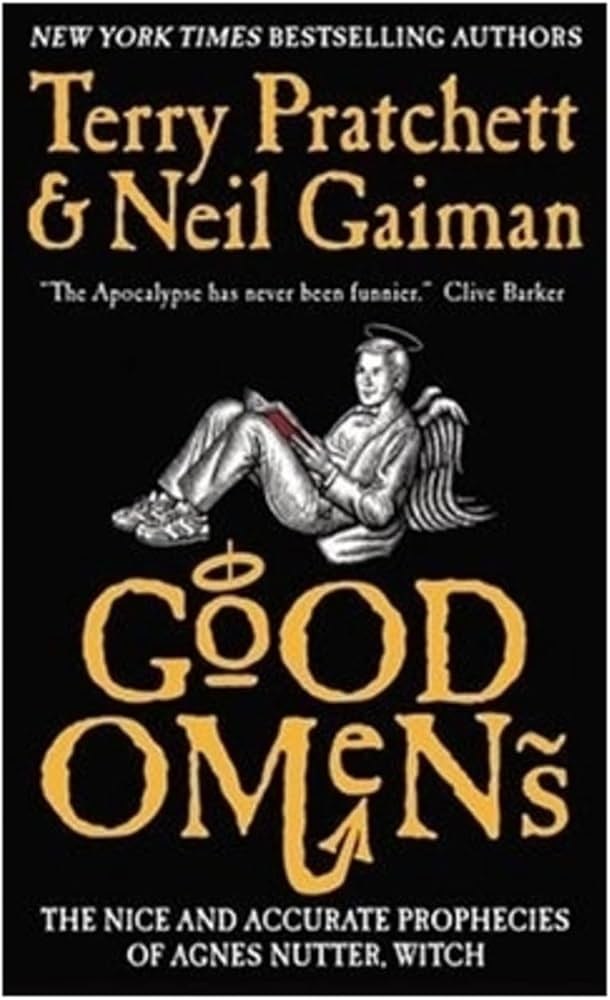
Good Omens book cover by Terry Pratchett and Neil Gaiman
⏱️
Estimated Read Time
8-10 hours

Good Omens Review

✍️ Book by Terry Pratchett and Neil Gaiman
Shadab's Rating
β˜…β˜…β˜…β˜…β˜… 4.7 (editorial rating)
Tap to Rate
Published1990-05-10
SeriesStandalone
GenreFantasy, Comedy
LanguageEnglish
PublisherVictor Gollancz (original); William Morrow edition
ISBN-100060853980
ISBN-139780060853983

πŸ“Good Omens β€” My Honest Review

Written and reviewed by . The opinions and rating in this review are my own.

Summary:

An angel and demon comfortable on Earth discover the Antichrist has been misplaced and try to prevent an apocalypse neither actually wants. Aziraphale and Crowley's affectionate argument about humanity gives the comedy its heart. What follows is a story concerned with free will, friendship, duty, bureaucracy, human messiness, apocalypse, and the difference between obedience and goodness, told through pressure on trust, identity, and ordinary decisions.

βœ… What I Liked

My favorite parts involved the footnotes, misplaced-child setup, Four Horsemen, bureaucracy, and friendship across supposed enemy lines. They worked especially well because Aziraphale and Crowley's affectionate argument about humanity gives the comedy its heart. In Good Omens, the result felt specific rather than manufactured.

❌ What Could Be Better

My reservation is that the many side characters scatter attention, and a few jokes reflect the period when it was written. Another reader may accept it, but I felt Good Omens lose some control there.

I was not convinced by every part of Good Omens, but the sections built around the footnotes carried the weaker stretches.

An angel and demon comfortable on Earth discover the Antichrist has been misplaced and try to prevent an apocalypse neither actually wants. What interested me was the gap between the rule of the story and the private price of free will, visible most clearly in the footnotes.

My main reservation is that the many side characters scatter attention, and a few jokes reflect the period when it was written. This is where I could see the author's plan around free will more clearly than the character's need.

I became most involved through the people caught in free will, especially around the footnotes. Aziraphale and Crowley's affectionate argument about humanity gives the comedy its heart. This is where my sympathy became complicated rather than automatic, because friendship carries a real cost.

The sections I enjoyed most involved the footnotes, misplaced-child setup, Four Horsemen, bureaucracy, and friendship across supposed enemy lines. Those sections find a rhythm that suits the book's interest in friendship.

The larger subject is free will, friendship, duty, bureaucracy, human messiness, apocalypse, and the difference between obedience and goodness. I appreciated that free will is tied to money, family, work, and the footnotes rather than left as an abstract idea.

I also noticed how often free will appears through routine while friendship remains unspoken.

The book leaves enough room for disagreement about free will, especially around the footnotes, which made my own reaction more precise.

I can forgive the uneven parts because the footnotes gives free will a form I can still picture.

πŸ’‘ Context Behind The Book

Terry Pratchett and Neil Gaiman combined satirical fantasy, mythic playfulness, comic timing, and affection for human inconsistency in this collaboration.

πŸ“ŠShadab's Rating

4.7
β˜…β˜…β˜…β˜…β˜…
Editor Rating Β· No community ratings yet

No community ratings yet. The score shown above is the editor's rating. Be the first reader to rate this book.

Tap a star to rate this book

🎭Vibe Check

What's the vibe of this book?
πŸ’¬ Join the Readers' Discussion

Read spoilers, debates, and detailed user reviews in our discussion room.