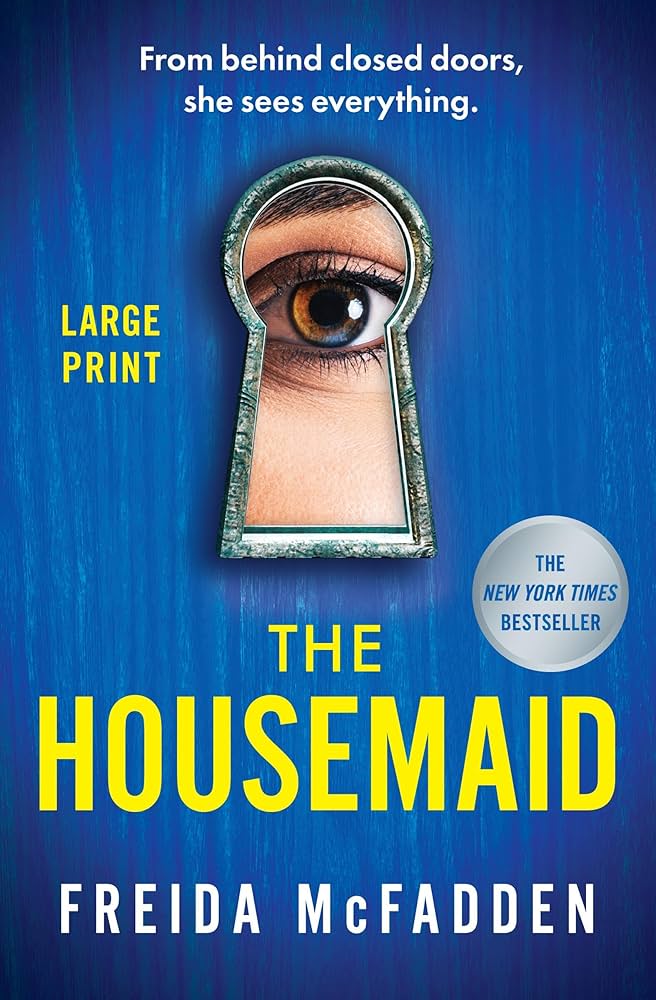
The Housemaid Review
| Published | 2022-04-26 |
| Series | The Housemaid — Book 1 |
| Genre | Psychological Thriller, Domestic Thriller, Mystery |
| Language | English |
| Publisher | Bookouture |
| ISBN-10 | 1803144378 |
| ISBN-13 | 978-1803144375 |
📝The Housemaid — My Honest Review
Written and reviewed by Shadab Alam. The opinions and rating in this review are my own.
Summary:
Millie is desperate for work and sleeping in her car when Nina Winchester offers her a live-in job as housemaid for a wealthy family. The position gives her food, money, and a room, but the room is in the attic and its door locks from the outside. Nina's behavior becomes increasingly cruel and unpredictable, while Nina's husband Andrew appears patient, kind, and trapped in an unhappy marriage. Millie begins crossing boundaries inside the house just as details from her own criminal past threaten to surface. The novel uses short chapters, shifting information, and a major change in perspective to turn a familiar rich-family setting into a fast domestic thriller about power, performance, and revenge.
✅ What I Liked
The pacing is extremely effective. McFadden knows how to end a chapter at the exact point where reading one more feels easier than stopping. The sentences are simple, but the structure keeps creating movement and i understood immediately why this book pulls people out of reading slumps.
Millie is also more interesting than a completely innocent narrator would have been. Her criminal past means she enters the Winchester house with secrets and with a believable willingness to protect herself. The attic room is a strong detail because it makes her lack of power physical. She works inside every private part of the house but has no secure space of her own.
The perspective shift in the second half gives several earlier scenes a new meaning. Not every part of the twist is realistic, but the reversal of sympathy is satisfying and the final movement delivers the kind of controlled revenge the book has been quietly preparing.
❌ What Could Be Better
Several characters behave in exaggerated ways so the first half can maintain its misdirection. Nina's cruelty becomes almost theatrical, and although the later explanation accounts for some of it, i still felt the author arranging her behavior for maximum effect. Andrew is similarly effective as a role in the thriller but thinner as a person.
The psychological depth is limited. Serious abuse, trauma, and criminal history are used mainly to power twists and reversals rather than explored with much complexity. The book moves too quickly to sit with consequences, which helps the pacing but makes parts of the ending feel cleaner than they should.
I also guessed the broad shape of the main reversal before it arrived. There were still details i did not predict, but readers who have read many domestic thrillers may recognize the pattern early. The final acts of revenge depend on timing and cooperation that become less believable the more closely they are examined.
Millie is living in her car when she interviews for a job with the wealthy Winchester family. She has a criminal record, almost no money, and very few choices, so the live-in position feels like a rescue even though the house begins sending warning signals immediately. Nina Winchester is unpredictable and humiliating. Her husband Andrew is calm, attractive, and apparently embarrassed by his wife's behavior. Their daughter Cecelia is openly hostile. Millie's bedroom is a tiny attic room with a door that can lock from the outside.
McFadden builds the first half around the pleasure of recognizing danger while the narrator keeps finding reasons to stay. Millie needs the job. The salary is good. Andrew is kind to her. Nina behaves badly enough that Millie's sympathy shifts toward everyone who has to live with her. None of these reasons are completely convincing, but they are convincing enough when combined with Millie's desperation.
The short chapters do a lot of work. Almost every one ends with a new insult, discovery, threat, or question. The prose is plain and the scenes move quickly because McFadden rarely spends time on anything that does not create suspicion. I finished the book faster than i expected, not because the writing was beautiful but because the structure is very efficient at making stopping feel inconvenient.
Millie is a useful narrator because she is hiding information from the reader as well as from the family. Her past is revealed gradually, and the fact that she has already done something serious makes her both vulnerable and potentially dangerous. I liked that she is not written as a completely innocent young woman wandering into a bad house. She has anger, survival instincts, and the capacity to make a terrible choice when she believes it is necessary.
The problem with discussing the second half is that almost every meaningful point risks revealing the mechanism. There is a major shift in perspective and the novel asks you to reinterpret what looked obvious in the first half. Some of the reversal is genuinely satisfying because small details return with a different meaning. Some of it depends on characters performing their roles with a precision that feels designed for the reader rather than natural inside the story.
Nina is the character who changes most as the novel reveals more information. Early on she can feel so exaggerated that i wondered whether the book was intentionally making her impossible to believe. The answer is connected to the larger twist, and while that explanation helped, it did not completely erase the artificiality. Andrew is effective as a thriller character but less convincing as a fully textured person. He is written to control the emotional temperature of a scene, and you can sometimes see the plot using him.
The domestic setting is handled well. The Winchester house is large, expensive, and constantly claustrophobic. Millie has access to every private room because she cleans them, yet she has no real privacy of her own. The attic bedroom turns the class arrangement into a physical fact: she is inside the family home but kept above it, useful and disposable.
The novel also understands the fantasy hidden inside many domestic thrillers. People who are underestimated because of class, gender, or their past are given a chance to see what respectable society hides. Millie notices the mess behind the polished rooms because cleaning is her job. McFadden uses that position directly rather than treating the housemaid title as decoration.
I did guess the general direction before the reveal, though not every detail. That did not ruin the book because the main pleasure is watching the power inside the house change hands. The final section becomes increasingly extreme and there are moments where realism gives way to revenge logic. I accepted most of it while reading, then questioned more of it after closing the book.
Four stars. It is fast, addictive, and carefully built to keep producing small shocks. The characters are broader than i prefer and the psychological explanations are not especially deep, but this is one of those thrillers where efficiency is a real skill. It knows exactly what kind of reading experience it wants to create and it creates it with very little wasted motion.
📊Shadab's Rating
🎭Vibe Check
Read spoilers, debates, and detailed user reviews in our discussion room.
Discover Your Next Great Read
Handpicked recommendations from our collection of literary treasures