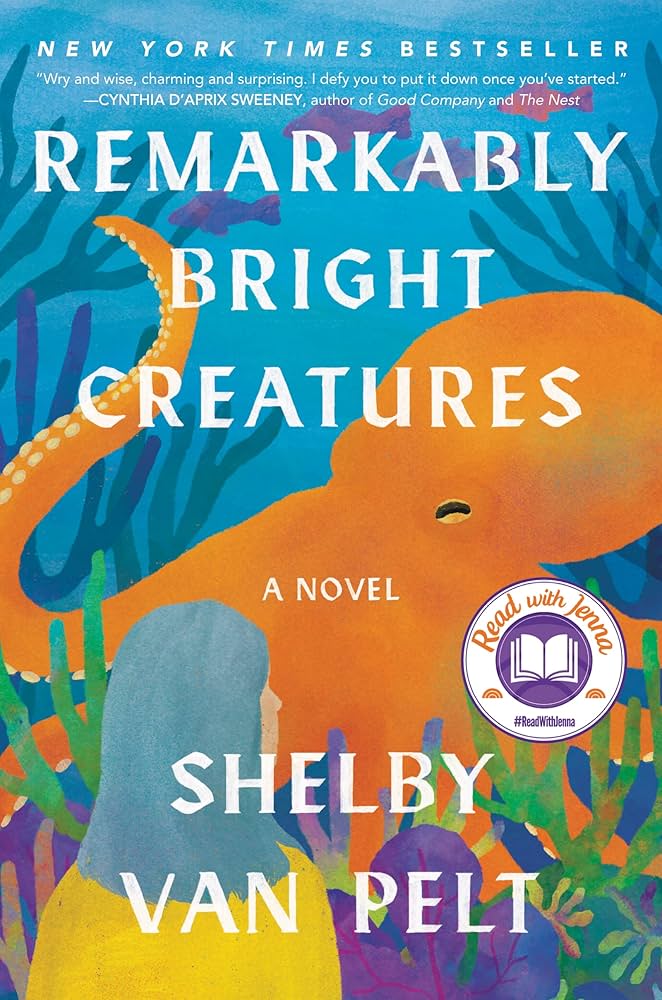
Remarkably Bright Creatures had me almost immediately, although not for the reason I expected.
The premise sounds like it could become overly sentimental: a grieving older woman forms an unusual friendship with an intelligent octopus who knows something important about her past. Somehow, the book mostly avoids that trap.
Tova Sullivan works nights cleaning the Sowell Bay Aquarium. Her husband has died, her son disappeared decades earlier, and she has responded to both losses by becoming extremely good at keeping herself busy. She cleans because things need cleaning. She shows up because there is work to do. When people try to help her, she often finds a polite way to manage without them.
Then there is Marcellus.
Marcellus is a giant Pacific octopus living at the aquarium, and he knows perfectly well that he is smarter than the humans responsible for keeping him there. His chapters immediately change the mood of the book. He is observant, impatient, funny, and occasionally rather judgmental.
I liked him almost at once.
What surprised me was that his presence never completely erases the sadness underneath the story. Tova and Marcellus develop an unusual kind of companionship, but he is not there simply to cheer her up. If anything, he notices the things Tova has spent years avoiding.
That makes their relationship much more interesting.
Tova's grief is rarely dramatic. She does not spend every chapter thinking about loss or explaining how lonely she feels. Instead, it shows up in habits. In the way she keeps working. In what she does not talk about. In how reluctant she is to become dependent on anyone.
That restraint worked for me because grief often does become ordinary after enough time. It can sit beside grocery shopping, work schedules, small conversations, and all the other things a person still has to do.
The novel becomes broader when Cameron enters the story. He is younger, directionless, and carrying his own questions about family. It does not take very long to suspect that his story and Tova's will eventually connect.
That is probably the book's biggest weakness.
The mystery is gentle rather than difficult, and some of the coincidences required to bring everyone together are huge. There were moments when I could see the machinery underneath the story a little too clearly. A character arrives at exactly the right place. Someone knows exactly the piece of information another person needs. Another connection clicks into place.
After a while, you stop wondering whether the characters are connected and start waiting for them to realize it themselves.
Strangely, I did not mind as much as I normally would.
The mystery was never really what kept me reading. I wanted to see what the truth would do to these people once they finally understood it.
The book is especially good with lonely characters who are not necessarily good at admitting they are lonely. Tova has spent years protecting herself through independence. Cameron often covers uncertainty with frustration. Even some of the smaller characters have their own routines and private disappointments.
Marcellus, meanwhile, watches all of them with the patience of someone who cannot understand why humans make simple things so complicated.
His sections could easily have become gimmicky. They never quite did for me.
Part of that is the voice. He is funny, but there is sadness underneath his humor too. He understands that his own life is limited, and that gives his interest in Tova a different weight. He cannot fix everything for her. He can only notice what others have missed and push things slightly in the right direction.
I liked that limitation.
Not every part of the book receives the same care, though. Some side stories feel more functional than lived-in, and a few emotional developments happen quickly once the plot needs them to. The later sections also rely heavily on coincidence, which makes the resolution feel neater than the earlier grief sometimes deserves.
But the ending did not leave me with the feeling that Tova's losses had somehow been erased.
That matters.
The book understands that finding family does not cancel the family you lost. Making a new connection does not rewrite old grief. It simply gives someone another reason to keep moving.
That is where Remarkably Bright Creatures worked best for me. Beneath the octopus, the mystery, and the warmer moments, it is really about people who have become accustomed to being alone and slowly discover that independence and isolation are not quite the same thing.