He sits with her after nightmares, plays the accordion, paints houses, and understands that patience can be a form of courage. Rosa is louder and harsher, constantly insulting the people she loves, but the novel gradually shows the loyalty underneath her language without pretending the language does not hurt.
Rudy Steiner, Liesel's neighbor and closest friend, gives the book much of its warmth. He is impulsive, devoted, hungry, and famous in his own street for covering himself in mud to imitate Jesse Owens. His request for a kiss becomes a running joke and then something much sadder because Death has already warned the reader about his future. Zusak's habit of announcing tragedy should reduce its force, but in Rudy's case it increases it. Every ordinary scene becomes something you know Liesel will one day remember.
Words are the novel's main subject. Hitler's power is built through speeches, slogans, books burned, and identities repeated until they become official truth. Liesel's response is not a grand political program. She steals books, reads aloud during air raids, and eventually writes her own story. Zusak can be very direct about this theme and sometimes Death explains the symbolic meaning more than once. Still, the idea is built into the characters rather than added afterward.
The book is long and sometimes emotionally insistent. Metaphors arrive constantly. Colors, skies, words, and physical objects are asked to carry heavy meaning, and there were pages where i wanted the prose to become quieter. A few antagonistic characters are broad, particularly when compared with the complexity given to the Hubermanns. The novel knows exactly when it wants the reader to cry, and occasionally i could feel that intention too clearly.
But the final section earned the emotion for me. Because Death has already revealed so much, the ending is not a twist. It is the arrival of something the reader has been carrying for hundreds of pages. Liesel's survival does not feel like a clean victory. It feels like the burden of remembering people whose ordinary habits have become precious because they are gone.
The Hubermanns hide Max Vandenburg, a Jewish man connected to a promise Hans made years earlier. Max lives in the basement where Liesel learned to read, and their friendship develops through nightmares, stories, weather reports, and the shared experience of being separated from family. Some of the most affecting parts are the handmade books Max creates for her, where words and drawings become a private resistance to the language surrounding them.
The narration is divisive. Death interrupts with bold headings, lists, definitions, colors, and comments about what will happen later. At first i found these interruptions mannered. They seemed determined to remind me that the book had a distinctive narrator.
Book Summary
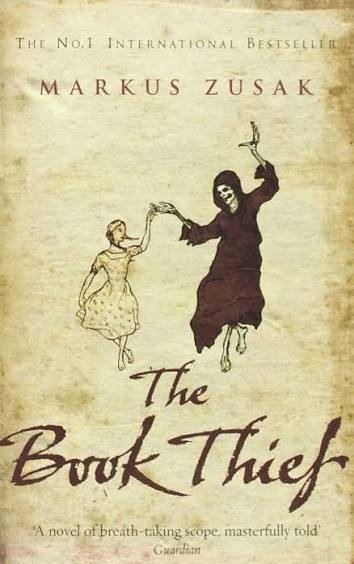
In Nazi Germany, nine-year-old Liesel Meminger is sent to live with build parents Hans and Rosa Hubermann after the death of her brother and the loss of her mother. She arrives unable to read but carrying a stolen copy of The Gravedigger's Handbook. Hans teaches her words in the basement, where the family later hides Max Vandenburg, a Jewish man fleeing persecution. Liesel's friendships with Max and her neighbor Rudy develop as war, hunger, book burnings, and air raids close around Himmel Street. Narrated by Death, the novel often reveals tragedy before it happens and focuses instead on memory, language, and the small acts of tenderness or resistance that survive inside a violent political world.
What I Liked
Hans Hubermann is the emotional center for me. His kindness is specific and practical rather than presented as saintliness. He teaches Liesel to read because he sees what her nightmares are doing to her, and his accordion, paintbrush, and quiet presence become part of the safety she associates with home.
The relationship between Liesel and Max is equally strong. They meet in a basement under terrible circumstances, but their friendship is built through imagination rather than only shared suffering. The handmade books, weather descriptions, and stories show how language can create a space that political power cannot completely enter.
What Could Be Better
The narration initially felt overdesigned. Death uses headings, lists, definitions, interruptions, and constant foreshadowing, and the book sometimes seems too eager to display the originality of its voice. I adjusted, but the style will remain a barrier for some readers.
Zusak also uses a great deal of metaphor. Many images are beautiful, but nearly every emotion receives a color, object, or unusual comparison, and the accumulation occasionally made scenes less clear rather than more powerful. The novel can underline its central point about words after the point is already understood.
Context Behind the Book
Markus Zusak is an Australian novelist born in Sydney to parents whose European childhood stories influenced his interest in war, memory, and ordinary family life. Before The Book Thief he wrote several novels for younger readers, including The Messenger. The Book Thief was first published in Australia and later reached a very large international audience, becoming the work most closely associated with his name. Zusak's style often uses unusual narrators, direct addresses to the reader, and recurring physical images. In this novel he combines those techniques with stories he heard about Germany during the Second World War, focusing on how children and working families experienced a society organized by propaganda and fear.