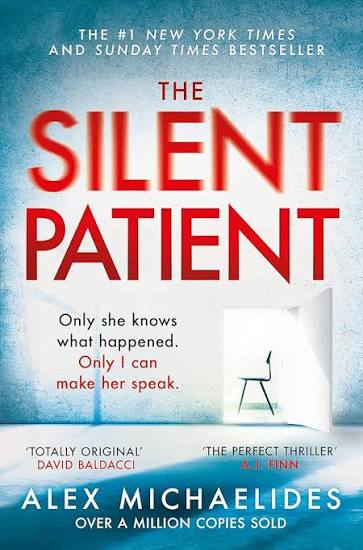
The Silent Patient Review
| Published | 2019-02-05 |
| Series | Standalone |
| Genre | Psychological Thriller, Mystery, Suspense |
| Language | English |
| Publisher | Celadon Books |
| ISBN-10 | 1250301696 |
| ISBN-13 | 978-1250301697 |
📝The Silent Patient — My Honest Review
Written and reviewed by Shadab Alam. The opinions and rating in this review are my own.
Summary:
Painter Alicia Berenson is found beside her murdered husband after shooting him five times, then refuses to speak another word. Her silence turns the case into a public mystery and leads to her confinement at the Grove, a secure psychiatric facility. Psychotherapist Theo Faber becomes convinced that he can reach her and takes a job there, gradually investigating Alicia's marriage, childhood, art, and the people around her. Alicia's diary offers glimpses of the weeks before the murder while Theo's own marriage begins to fracture. The novel combines therapy, obsession, Greek tragedy, and an unreliable timeline, building toward a reveal that forces the reader to reconsider how the two central stories have been arranged.
✅ What I Liked
The central idea is immediately gripping. A woman commits an apparently inexplicable murder and then removes the one thing everyone wants from her: an explanation. Alicia's silence creates tension without requiring constant action, and it gives every other character room to reveal what they want her story to mean.
The diary sections are useful because they allow Alicia to exist as more than a silent object while still protecting the mystery. I also liked the Alcestis connection. It gives the paintings and the marriage a second language built around sacrifice, abandonment, and the dangerous idea that love can be proved through suffering.
The final reveal is genuinely well constructed. It does not depend only on a hidden stranger or a piece of evidence introduced at the last minute. It depends on chronology, narration, and the assumptions i made while reading. Afterward several scenes changed meaning, which is what i want from this kind of twist.
❌ What Could Be Better
The book uses therapy more convincingly as a mystery device than as a realistic professional practice. Theo crosses boundaries, investigates people outside treatment, and gains access in ways that the Grove seems unusually willing to allow. The institution often behaves according to the needs of the plot.
Some psychological explanations are also too neat. Childhood trauma and adult obsession are connected in direct lines, as though identifying the original wound fully explains everything that follows. Alicia remains partially hidden even after the mystery is solved, and i wanted more sense of her artistic life beyond the symbolic function of her paintings.
Several supporting characters are made suspicious in fairly obvious ways, then become less important once their red-herring purpose is complete. The twist is stronger than the middle investigation, and readers who guess the timeline early may find the remaining character work too thin to carry the same impact.
Theo Faber is a psychotherapist who becomes convinced he can make her speak. He takes a position at the Grove, the secure psychiatric facility where Alicia is being treated, and begins working through her history, her relationships, and the people who may have reasons to fear what she remembers. Theo narrates most of the novel, with sections from Alicia's diary providing a second voice from before the murder.
The setup is immediately effective because therapy creates a formal reason for investigation. Theo can ask about childhood, marriage, fear, and trauma without behaving exactly like a detective, though in practice he crosses enough boundaries that the distinction becomes thin. His interest in Alicia is presented as professional at first, but obsession enters early. He does not simply want to help her. He wants to be the person who solves her.
Michaelides uses the myth of Alcestis, the woman who dies in place of her husband, as a frame for Alicia's painting and for the novel's idea of love as sacrifice. I liked the mythological layer because it gives Alicia's silence a symbolic language before she is willing to use an ordinary one. At times the references are explained more directly than necessary, but they are connected to the plot rather than added only for atmosphere.
The Grove is an appropriately closed setting. The staff members have competing ideas about treatment and their own private weaknesses. Other patients create moments of danger and distraction. The institution is less convincing as a detailed portrait of psychiatric care than as a locked-room environment where information can be controlled. Theo's access is sometimes easier than i believed, and professional rules become flexible whenever the mystery needs him to continue.
Theo's personal life runs beside the Alicia investigation. He is married to Kathy and becomes increasingly suspicious that she is having an affair. These chapters initially felt separate from the stronger central plot, but their purpose becomes clearer later. The novel is very carefully constructed around what Theo tells the reader, what he delays, and what assumptions the order of scenes encourages us to make.
That construction leads to the famous twist. I will not explain it, because the experience depends on the reader reorganizing the timeline in a few pages. It worked on me. I had suspected several people and noticed that Theo was not completely reliable, but i did not put the structure together in the correct way. The reveal is clever because it changes earlier scenes without requiring the novel to invent an entirely new fact at the end.
At the same time, the twist is stronger than some of the psychology around it. Characters often have one defining wound or obsession that explains a large amount of behavior. Alicia's trauma is serious, but the book sometimes treats psychological theory as a key that opens a person rather than one possible way of understanding them. Theo's confidence in interpretation is part of his character, yet the novel occasionally shares too much of that confidence.
Alicia is both the center and the absence of the book. Her silence makes her compelling, but it also means most of what we know about her comes through men who desire, treat, observe, or judge her. The diary helps, though even there her voice is shaped to preserve the mystery. I wanted slightly more of Alicia as an artist and as a person beyond the role the final reveal requires her to play.
The prose is clean and moves quickly. Chapters are short, clues are planted visibly enough to feel fair afterward, and the final hundred pages accelerate well. A few red herrings are obvious and some supporting characters seem suspicious mainly because every thriller needs a field of suspects. None of that stopped me from reading, but it did make parts of the middle feel more mechanical than the opening.
Four stars. The twist deserves its reputation and the central silence is a powerful idea. I am less convinced by the novel's view of therapy and by some of the character depth, but as a tightly organized psychological mystery it does exactly what it needs to do. The best part is not simply learning what happened. It is realizing how confidently the narration taught you to place events in the wrong relationship to one another.
📊Shadab's Rating
🎭Vibe Check
Read spoilers, debates, and detailed user reviews in our discussion room.
Discover Your Next Great Read
Handpicked recommendations from our collection of literary treasures