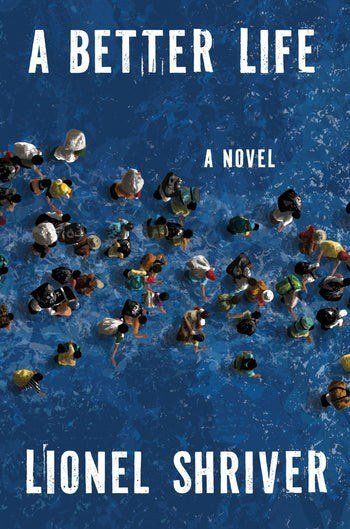
A Better Life book cover by Lionel Shriver
⏱️
Estimated Read Time
5–7 hours

A Better Life Review

✍️ Book by Lionel Shriver
Editorial Rating
★★★☆☆ 3.2
Epiloguely review by Shadab Alam
Reader Rating
☆☆☆☆☆ 0.0
No reader ratings yet
Rate This Book
A written review is optional
Published2026-02-10
SeriesStandalone
GenreLiterary Fiction / Political Satire
LanguageEnglish
PublisherHarper
ISBN-100063482142
ISBN-139780063482142

📝Epiloguely Editorial Review

Written and reviewed by .

A Better Life becomes interesting almost immediately because Lionel Shriver does not choose a quiet subject. She builds the novel around immigration, asylum, political identity, and the kind of argument that can turn an ordinary dinner table into something much larger. Gloria Bonaventura believes in helping migrants and is happy to make that belief concrete. Her son Nico is skeptical before Martine has even properly settled into the house. That conflict gives the novel a strong opening because ideology is no longer something these characters discuss from a distance. Someone is actually living upstairs.

Gloria’s decision to host Martine is based loosely on a migrant-hosting idea associated with New York City politics, though the specific scheme in the novel is fictional. Shriver turns that possibility into a domestic experiment: what happens when a political position becomes a bedroom, a grocery bill, a family argument, and a stranger who begins occupying emotional space as well as physical space? Google Books

That is the part of the book I found most promising. Gloria’s generosity is not abstract once another person is inside her home, and Nico’s suspicion is not abstract once he has to live beside the person he is judging. Both characters are forced to move beyond the slogans they might otherwise use.

Gloria is especially interesting because the novel puts pressure on the difference between believing in compassion and living with the consequences of it. She genuinely wants to help. That does not necessarily mean every decision she makes is wise, but reducing her to a hypocrite would make the story too easy. The better scenes allow the possibility that someone can be sincere, generous, naïve, stubborn, and politically motivated at the same time.

Nico creates a different problem. He is twenty-six, educated, unemployed, and comfortable enough in his mother’s home that he has very little reason to change his life before Martine arrives. The disruption makes him more alert, but it also gives his resentment somewhere to go. The publisher itself signals that his narration should not be treated as completely reliable, which matters because so much of the novel’s political tension is filtered through the way he interprets what is happening around him. OverDrive

I liked that choice in principle. An unreliable narrator should make a political satire more difficult, not less. If Nico is wrong about some things and right about others, the reader has to keep reconsidering where observation ends and prejudice begins.

Martine is therefore crucial.

She cannot simply exist as a symbol of immigration, because the whole novel depends on whether she becomes specific enough to resist the political categories other people place around her. Some reviews found that she has more complexity than the surrounding migrant characters, particularly in her changing relationship with Nico. Even strongly negative criticism acknowledged that there is an interesting push and pull between them. Kirkus Reviews

The problem is that the novel appears to become increasingly determined to prove something.

This is where much of the critical disagreement around A Better Life comes from. The Financial Times argued that the book begins with comic potential and interesting family dynamics but gradually gives more space to polemical speeches and increasingly exaggerated developments. Kirkus went much further, condemning the novel’s depiction of migrants and arguing that its satire gives way to xenophobic paranoia. The Atlantic similarly criticized the book for allowing its political argument to overwhelm character and fiction. Financial Times

Other readers have responded very differently. A review in The Australian praised Shriver’s willingness to challenge progressive assumptions about migration and argued that the novel gives migrants agency rather than treating them only as passive victims. The Spectator review also recognized Shriver as a strong storyteller, though even that piece questioned whether the characters sometimes become vehicles for polemical views. The Australian

That division is worth taking seriously because this is exactly the kind of novel where a reader’s political expectations can easily swallow the fiction.

For me, the more useful question is not whether Shriver is “allowed” to criticize immigration policy. Of course a novelist can. The better question is whether the criticism produces convincing characters.

That is where I have more reservations.

Political fiction becomes thinner when everyone begins behaving exactly as their ideological position requires. A liberal character must be foolish in the correct way. A skeptic must receive evidence confirming every suspicion. A migrant character must either vindicate compassion or expose it as naïve. Once that pattern becomes visible, the story starts feeling arranged.

And A Better Life appears to flirt with that problem repeatedly.

The house itself is a strong setting because it gives the political argument physical limits. There are only so many rooms. Only so much privacy. Only so much money. Gloria’s generosity therefore has practical consequences for Nico and the rest of her family. That creates a reasonable question about whether altruism is still entirely personal when other people are required to share its costs.

I think the novel is much stronger when it stays there.

A mother decides to help someone.

Her son resents losing space.

A guest begins becoming part of the family.

Other relationships change.

Trust becomes harder.

Those are recognizable human tensions before anyone turns them into an argument about national borders.

The more the plot expands into an exaggerated portrait of migration crisis, the more difficult it becomes to keep that human scale. Several critics objected specifically to the increasingly extreme depiction of the people connected to Martine and to the novel’s movement toward melodrama. Kirkus Reviews

I also think Nico’s generational position is potentially more interesting than the political material surrounding him. He is a young man who has not really begun adult life, yet he becomes intensely concerned with the idea that others are taking something from him. There is an uncomfortable irony there. Before Martine arrives, he is already dependent on his mother’s resources. His anger about entitlement therefore exists beside his own comfortable dependence.

That contradiction could carry a novel by itself.

Shriver’s better satirical instinct is visible when characters are allowed to expose themselves without the narration immediately deciding what lesson we should take from it. Gloria can be self-congratulatory. Nico can be observant and selfish at the same time. Martine can appreciate help without becoming permanently grateful or morally perfect.

Those complications are far more interesting than asking the reader to select a political team.

I also understand why the novel has attracted readers who are tired of fiction approaching immigration only through one moral framework. Shriver clearly wants to challenge assumptions about who receives sympathy, who pays for policy choices, and whether private generosity is easy when someone else carries the consequences. Those are legitimate subjects for satire.

But provocation by itself is not complexity.

A novel earns its argument when the characters remain capable of surprising the argument.

That is what I wanted more often from A Better Life.

The satire appears sharpest when it targets self-image. Gloria wants to see herself as generous. Nico increasingly wants to see himself as the person willing to acknowledge realities everyone else refuses to discuss. Both identities can become flattering stories people tell themselves.

Martine disturbs those stories simply by being a person whose motives cannot always be neatly categorized.

That is where the novel could have remained most uncomfortable.

My main issue, then, is not that A Better Life has a political viewpoint. Lionel Shriver has never been especially interested in writing books without arguments. The problem is that an argument this contentious needs characters with enough independence to resist being drafted into it.

Published criticism suggests that many readers found that balance missing. Others clearly enjoyed precisely the bluntness that critics disliked. That makes A Better Life difficult to recommend as a neutral social novel, but easier to recommend as deliberately provocative satire. Book Marks

I finished more interested in the Bonaventura household than in the novel’s larger political claims. The best parts ask what happens when a belief enters someone’s home and starts using the bathroom, eating at the table, borrowing space, needing money, and becoming emotionally difficult to remove.

That is a genuinely good fictional question.

I only wish the novel trusted it more often.

Book Summary

A Better Life begins with Gloria Bonaventura, a sixty-two-year-old divorced mother living in a large Brooklyn house with her unemployed adult son, Nico. When Gloria joins a city scheme that pays residents to host migrants, she welcomes Martine, a Honduran asylum seeker, into the family home. Gloria sees the arrangement as a practical expression of the political values she already believes in, while Nico is suspicious almost immediately. As Martine becomes closer to Gloria and her daughters and more people connected to her begin entering the family’s life, the house turns into a pressure point for arguments about immigration, generosity, entitlement, fear, and who gets to decide when helping someone has gone too far. The novel also complicates Nico’s perspective by making him an unreliable narrator rather than a neutral observer of what unfolds. Google Books

What I Liked

The strongest material for me is the conflict inside Gloria’s house. Turning a political belief into a shared domestic reality gives the story immediate friction, and Gloria, Nico, and Martine have enough competing interests to create genuinely uncomfortable scenes. Nico being an unreliable narrator is also a useful choice because it prevents his interpretation from automatically becoming the novel’s objective truth. I especially liked the questions surrounding altruism: who gets to make a generous decision, who pays for it, and whether someone receiving help is required to remain grateful in exactly the way the helper expects. Those ideas are sharper when they emerge through family arguments and everyday inconvenience rather than political speeches.

What Could Be Better

My biggest problem is that the political argument can become more visible than the characters. Several confrontations appear designed to confirm positions that have already been established, and later developments have been criticized for moving from satire into increasingly exaggerated melodrama. I also wanted the migrant characters surrounding Martine to have more individual complexity rather than primarily functioning as evidence within a debate about immigration. The novel is strongest when I am uncertain about everyone’s motives; it is weaker when I can see exactly which argument a character has been placed there to represent.

Context Behind the Book

Lionel Shriver is an American novelist and essayist whose fiction frequently takes on politically or socially contentious subjects. She is best known for We Need to Talk About Kevin, which won the Orange Prize, and her other novels include So Much for That, The Mandibles, Big Brother, Should We Stay or Should We Go?, and Mania. Shriver also writes journalism and commentary and has contributed regularly to The Spectator. Her fiction often places large public arguments—healthcare, economics, family responsibility, aging, political conformity—inside relationships where the consequences become personal.

Sources & References

Reader Reviews

0 published written reviews · Reader star ratings remain separate from the editorial rating.

No reader reviews yet Be the first reader to share a thoughtful review of at least 100 words. A quick star rating can still be submitted separately above.

📊Reader Rating Breakdown

0.0
★★★★★
No reader ratings yet

No reader ratings yet. Be the first reader to rate this book using the separate quick-rating stars above.

🎭Vibe Check

What's the vibe of this book?
💬 Open Reader Comments & Discussion

Use the separate comment-style discussion room for spoilers, endings, characters, theories, questions, and replies. Formal reader reviews stay on this page.