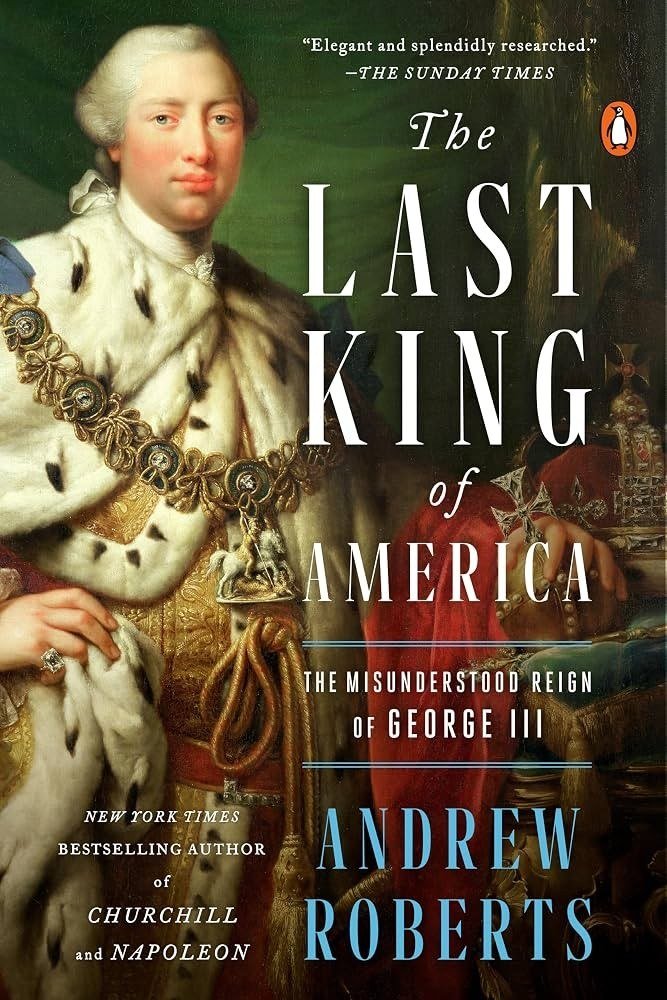
The Last King of America: The Misunderstood Reign of George III Review
| Published | 2026-11-09 |
| Series | Standalone |
| Genre | History / Biography |
| Language | English |
| Publisher | Viking |
| ISBN-10 | 198487926X |
| ISBN-13 | 9781984879264 |
📝Epiloguely Editorial Review
Written and reviewed by Shadab Alam.
The Last King of America begins with a difficult task because most readers already know who George III is supposed to be. For Americans especially, he occupies a convenient role in the national story: the distant king who taxed the colonies, ignored their complaints, provoked a revolution, and lost an empire. Popular culture has only strengthened that image. Andrew Roberts does not merely ask whether the picture is incomplete. He spends hundreds of pages arguing that it is badly distorted.
That makes the book more interesting than a straightforward royal biography. Roberts is not simply telling us when George was born, whom he married, which ministers served him, and when wars began. He is arguing with a reputation that has been built over more than two centuries.
His George III is hardworking, serious, deeply religious, devoted to Queen Charlotte and their large family, interested in agriculture and science, and committed to what he understood as constitutional duty. Roberts draws heavily on George's correspondence and other material made available through the Georgian Papers Programme, allowing the king's private thoughts to occupy far more space than they often do in popular accounts of his reign. That archival foundation is one of the book's strongest qualities. Whatever a reader eventually thinks of Roberts's conclusions, it is difficult to dismiss the amount of material behind them. Star Tribune
I found the book most convincing when Roberts separates George III from the cartoon version of monarchy that American revolutionary rhetoric required. The Declaration of Independence places enormous responsibility on the king personally, but eighteenth-century Britain was not an absolute monarchy in which George could simply dictate policy according to mood. Parliament, ministers, factions, patronage, constitutional custom, imperial finances, and competing political interests all mattered.
That does not mean George becomes innocent of every disastrous decision. Roberts's better passages are the ones where the distinction is allowed to remain uncomfortable: George could be conscientious without being wise in every crisis, constitutionally limited without being politically powerless, and personally decent while still supporting policies that helped drive the colonies toward rebellion.
The American Revolution naturally occupies a major place in the biography. Roberts's central argument is provocative because he rejects the idea that the Revolution is best understood as a response to George III's personal tyranny. He sees the break instead as the result of deeper arguments over sovereignty, taxation, imperial authority, and the political maturity of the colonies.
Sources & References
Penguin Random House — The Last King of America
Publishers Weekly — The Last King of America Review
The Washington Post — Review of The Last King of America
Museum of the American Revolution — Andrew Roberts on The Last King of America
Reader Reviews
0 published written reviews · Reader star ratings remain separate from the editorial rating.
📊Reader Rating Breakdown
🎭Vibe Check
Use the separate comment-style discussion room for spoilers, endings, characters, theories, questions, and replies. Formal reader reviews stay on this page.
Discover Your Next Great Read
Handpicked recommendations from our collection of literary treasures