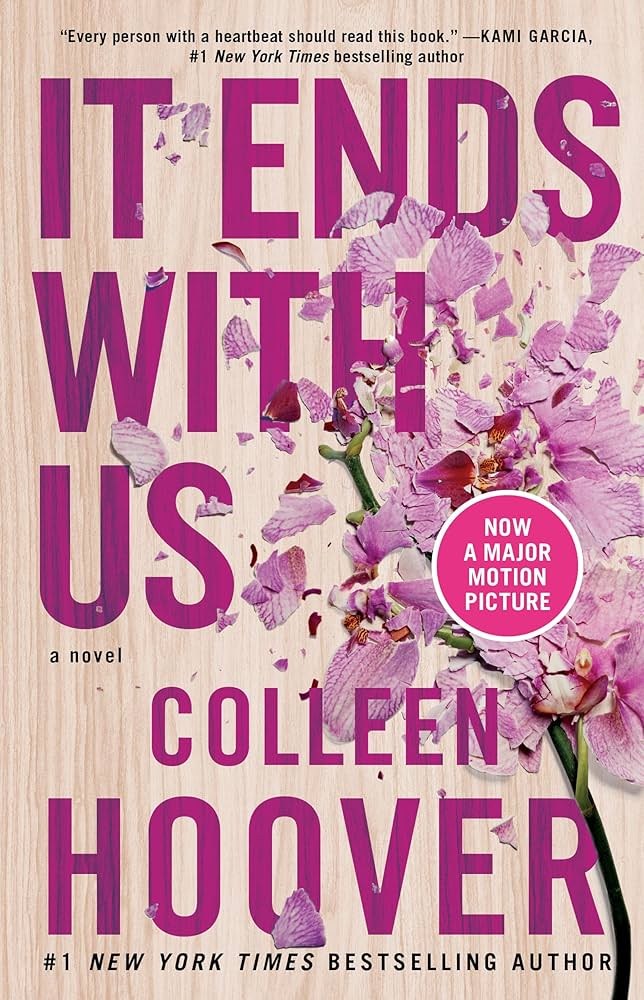
It Ends with Us book cover by Colleen Hoover
⏱️
Estimated Read Time
7-9 hours

It Ends with Us Review

✍️ Book by Colleen Hoover
Editorial Rating
★★★★☆ 3.9
Epiloguely review by Shadab Alam
Reader Rating
☆☆☆☆☆ 0.0
No reader ratings yet
Rate This Book
A written review is optional
Published2016-08-02
SeriesIt Ends with Us
GenreContemporary Fiction, Romance, Domestic Drama
LanguageEnglish
PublisherAtria Books
ISBN-101501110365
ISBN-139781501110368

📝Epiloguely Editorial Review

Written and reviewed by .

It Ends with Us initially looked like a story I could understand in fairly simple terms: a relationship becomes abusive, the main character has to decide what to do, and the novel explores how difficult leaving can be. What made it more interesting to me was the way love complicated that picture. Lily does not stop caring about Ryle the moment he hurts her, and the book is strongest when it refuses to pretend that recognizing abuse automatically makes every emotional decision easy.

Lily meets Ryle, a successful neurosurgeon who is confident, charming, and intense in a way that initially feels romantic. At the same time, memories of her first love, Atlas, and of the abusive marriage she witnessed between her parents continue to shape how she understands relationships. Those two parts of her life begin to overlap in uncomfortable ways. She has already seen what abuse can do to a family, yet knowing that history does not protect her from finding herself inside a similar pattern.

That is where Lily’s perspective became important for me. The novel does not present her as someone who fails to understand what is happening simply because she stays. She notices changes, questions her own reactions, remembers what she once thought about her mother, and gradually discovers how different abuse looks when you are the person inside the relationship. It is much easier to say someone should leave when love, memory, fear, hope, and practical consequences are not involved.

I thought the book handled that contradiction better than its simpler moral moments. Lily can love Ryle and still be harmed by him. She can remember his kindness and still understand that kindness does not cancel violence.

That distinction matters because abusive relationships are often reduced to a much easier story in which one person is entirely cruel from the beginning and the other simply needs to recognize it.

Ryle is more complicated than that, although the way the romance is framed around him sometimes made me uncomfortable. The early attraction is written with the intensity of a conventional romantic story, which means the later abuse changes how those earlier scenes feel. I understand why that contrast is part of the novel’s design, but it can also make the tonal shift difficult. There were moments when I was not sure whether the book wanted me to remain invested in the romance or step outside it and judge what was happening more critically.

The memories of Lily’s parents give those scenes more weight. As a child, Lily watched her mother remain with a man who hurt her, and she judged that choice without fully understanding it. Once Lily finds herself confronting similar decisions, those old judgments become harder to maintain. I liked that the novel allows her to reconsider her mother without pretending the abuse itself was ever acceptable.

That idea of repeating a family pattern is probably the part I found most convincing. Lily does not simply fear Ryle; she fears becoming trapped inside a cycle she has already seen. The novel keeps returning to the difference between understanding a pattern intellectually and finding the courage to break it when doing so costs something personally.

Motherhood sharpens that conflict. Once Lily’s decisions begin affecting more than her own future, the question changes. She is no longer deciding only how much she can forgive or whether love is enough. She has to think about what kind of environment another person may grow up believing is normal.

That is one of the places where the title earns its meaning.

The book also does something useful by refusing to reduce victims to weakness. Lily’s difficulty is not that she lacks intelligence or independence. She has a career, opinions, friendships, and a clear sense of what she once believed she would do in this situation. None of that makes her immune to emotional attachment, fear, or hope. The gap between what she thought she would do and what she actually feels gives the story much of its emotional pressure.

I had more mixed feelings about Atlas. He provides an important contrast to Ryle and represents a relationship associated with safety and understanding, but at times he felt almost too idealized. The difference between the two men can become so clear that Atlas occasionally seems less like a complicated person and more like the emotional answer the story wants Lily to have available.

That did not ruin his role for me, but it made the structure more visible. I wanted a little more uncertainty around him, not because Lily needed another difficult relationship, but because the rest of the novel is strongest when people are not easily sorted into emotional categories.

The marketing and romantic framing around the book also complicate the reading experience. Someone expecting a conventional romance may be surprised by how central domestic abuse becomes, while someone approaching it primarily as a novel about abuse may find some of the romantic presentation uncomfortable. That tension is part of why reactions to the book can vary so much.

For me, the strongest scenes were the ones where the book stopped explaining its message and simply stayed with Lily’s decisions. A moment of hesitation, a memory of her mother, the fear of repeating the same pattern, or the realization that loving someone does not make them safe carried more weight than the larger statements about breaking cycles.

Those scenes made the subject feel lived rather than arranged.

I did not agree with every narrative choice, and there are places where the emotional structure feels designed to push the reader toward a very specific conclusion. Still, I appreciated that the novel does not treat leaving an abusive relationship as an obvious act that only requires courage. It shows how love can remain present even after trust has been damaged, which is exactly what makes the decision so painful.

That is what I kept thinking about after finishing It Ends with Us. The book is not most effective when it asks whether abuse is wrong; that answer is obvious. It becomes more difficult when it asks what someone does when the person causing harm is also someone they love, remember differently, and once imagined a future with.

The novel’s answer is not that love disappears.

It is that love is not always a reason to stay.

Book Summary

Lily begins a relationship with charming neurosurgeon Ryle while memories of her first love and her parents' abusive marriage complicate what she recognizes as love. Lily's gradual understanding of abuse is strongest when it rejects the idea that leaving is simple or that love prevents harm. The plot uses that situation to examine domestic abuse, love, shame, family patterns, choice, motherhood, and the courage to end a cycle, especially when a private choice begins affecting people who had no say in it.

What I Liked

I liked the attention to cycles of abuse, Lily's perspective, and the refusal to reduce victims to weakness. Lily's gradual understanding of abuse is strongest when it rejects the idea that leaving is simple or that love prevents harm. Those details gave It Ends with Us a distinct emotional shape, and the writing trusted the scenes instead of explaining every idea twice.

What Could Be Better

My main problem was that the romantic framing creates discomfort, Atlas feels idealized, and marketing led some readers to expect conventional romance. It Ends with Us remained readable, but those choices reduced the force of scenes that should have landed harder.

Context Behind the Book

Colleen Hoover is a bestselling American novelist whose books blend romance with trauma; this one was partly inspired by experiences in her family.

Reader Reviews

0 published written reviews · Reader star ratings remain separate from the editorial rating.

No reader reviews yet Be the first reader to share a thoughtful review of at least 100 words. A quick star rating can still be submitted separately above.

📊Reader Rating Breakdown

0.0
★★★★★
No reader ratings yet

No reader ratings yet. Be the first reader to rate this book using the separate quick-rating stars above.

🎭Vibe Check

What's the vibe of this book?
💬 Open Reader Comments & Discussion

Use the separate comment-style discussion room for spoilers, endings, characters, theories, questions, and replies. Formal reader reviews stay on this page.